Table of Contents
Scaling Up Learning by Communicating with AutoTutor, Trialogs, and Pedagogical Agents
Professor Art Graesser

Background in discourse processes - building computer agents to conversations with learners.
Agents
Need to be sensitive to
- Social
- Cognitive
- Affective
- Motivational mechanisms?
Roles
- user-initiated help seeking
- navigational guide (students don't know what to do next)
- pairs of agents modeling action, thought, and social interaction
- roles: peers, tutor, mentor, demagogue, adversarial
Poor at answering arbitrary questions, but only 5% of students ask questions actively.
Systems
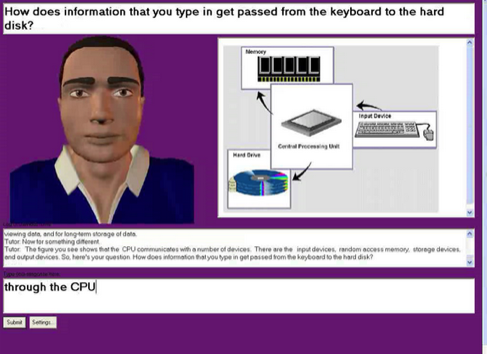
AutoTutor
Managing turns
- short feedback on previous turn
- advance dialogue by one or more dialogue moves connected by discourse markers
- end turn with a signal that transfers floor to student
- question
- prompting hand question etc
- otherwise they just stare at each other “stand-off”
Research
What do actual human tutors do. ”Metaknowledge in tutoring”, Graesser & Person (2009).
Strategies rarely used:
- socratic tutoring (Collins, Stevens)
- modeling-scaffolding-fading (Rogoff, Gardner)
- reciprocal teaching (Brown, Palincsar)
- building on pre-requisites (Gagne)
- sophisticated motivational techniques (Lepper)
- scaffolding SRL strategies (Azevedo, Winne)
Tutor communication illusions (things they don't do well)
- grounding
- feedback accuracy (don't “round-reference”), usually positive feedback after major errors, because it's polite
- discourse alignment, tutor throws out information, think that it's understood - it often isn't
- student mastery
- knowledge transfer
Impact on learning
- unskilled human tutors: .42
- AutoTutor .80
- intelligent tutoring systems 1.0
- skilled human tutors ??
Track emotions during learning
- boredom 23%
- confusion 25% - best predictor of learning
- delight 4%
- flow 28%
- frustration 16%
- surprise 4%
Face at moment of confusion, and dialogue history, can help track emotions. Very difficult to differentiate between flow and boredom.
Best emotional attitude of agent differs with time.
Trialogs
- low ability → vicarious learning
- medium ability → tutorial dialogue
- high ability → teachable agent
Learning Conceptual Physics (VanLehn, Graesser 2007)
Conditions - test required conceptual understanding
- read nothing (slightly higher than reading the textbook)
- read textbook
- AutoTutor (higher, about the same as human tutor)
- human tutor
Other presentations about conversational agents (AERA 11):
how are agents different from implicit affordances, embedded prompts, teacher-led scripts, etc?

