Openness, dynamic specialization, and the disaggregated future of higher education

| Wiley, D., & Hilton III, J. (2009). Openness, dynamic specialization, and the disaggregated future of higher education. The International Review of Research in Open and Distance Learning, 10(5), Article–10. Retrieved from http://www.irrodl.org/index.php/irrodl/article/download/768/1415. |
BibTex
BibTex
@article{wiley2009openness,
author = {Wiley, D. and Hilton III, J.},
date-added = {2012-04-07 02:37:37 +0000},
date-modified = {2012-11-28 00:43:35 +0000},
date-read = {2012-04-07 22:53:33 -0400},
journal = {The International Review of Research in Open and Distance Learning},
keywords = {1p2pu},
number = {5},
oa-url = {http://www.irrodl.org/index.php/irrodl/article/download/768/1415},
pages = {Article–10},
read = {1},
title = {Openness, dynamic specialization, and the disaggregated future of higher education},
url = {http://www.irrodl.org/index.php/irrodl/article/download/768/1415},
volume = {10},
year = {2009},
bdsk-file-1 = {YnBsaXN0MDDUAQIDBAUIJidUJHRvcFgkb2JqZWN0c1gkdmVyc2lvblkkYXJjaGl2ZXLRBgdUcm9vdIABqAkKFRYXGyIjVSRudWxs0wsMDQ4RElpOUy5vYmplY3RzViRjbGFzc1dOUy5rZXlzog8QgASABoAHohMUgAKAA1lhbGlhc0RhdGFccmVsYXRpdmVQYXRo0hgMGRpXTlMuZGF0YU8RAYQAAAAAAYQAAgAAB1NTREhvbWUAAAAAAAAAAAAAAAAAAAAAAAAAAMl5T9hIKwAAANrWUhV3aWxleTIwMDlvcGVubmVzcy5wZGYAAAAAAAAAAAAAAAAAAAAAAAAAAAAAAAAAAAAAAAAAAAAAAAAAAAAAAAAGeaUFy9dNmVBERiBDQVJPAAIAAgAACSAAAAAAAAAAAAAAAAAAAAAHQmliZGVzawAAEAAIAADJeZYoAAAAEQAIAADL14XZAAAAAQAMANrWUgAXPTEAAZ9eAAIANFNTREhvbWU6VXNlcnM6AFN0aWFuOgBCaWJkZXNrOgB3aWxleTIwMDlvcGVubmVzcy5wZGYADgAsABUAdwBpAGwAZQB5ADIAMAAwADkAbwBwAGUAbgBuAGUAcwBzAC4AcABkAGYADwAQAAcAUwBTAEQASABvAG0AZQASAClVc2Vycy9TdGlhbi9iaWJkZXNrL3dpbGV5MjAwOW9wZW5uZXNzLnBkZgAAEwABLwAAFQACAAz//wAAgAXSHB0eH1gkY2xhc3Nlc1okY2xhc3NuYW1lox8gIV1OU011dGFibGVEYXRhVk5TRGF0YVhOU09iamVjdF8QIy4uLy4uL2JpYmRlc2svd2lsZXkyMDA5b3Blbm5lc3MucGRm0hwdJCWiJSFcTlNEaWN0aW9uYXJ5EgABhqBfEA9OU0tleWVkQXJjaGl2ZXIACAARABYAHwAoADIANQA6ADwARQBLAFIAXQBkAGwAbwBxAHMAdQB4AHoAfACGAJMAmACgAigCKgIvAjgCQwJHAlUCXAJlAosCkAKTAqACpQAAAAAAAAIBAAAAAAAAACgAAAAAAAAAAAAAAAAAAAK3}
}
Links here
Highlights (28%)
Openness is a fundamental value underlying significant changes in society and is a prerequisite to changes institutions of higher education need to make in order to remain relevant to the society in which they exist. There are a number of ways institutions can be more open, including programs of open sharing of educational materials. Individual faculty can also choose to be more open without waiting for institutional programs. Increasing degrees of openness in society coupled with innovations in business strategy like dynamic specialization are enabling radical experiments in higher education and exerting increasing competitive pressure on conventional higher education institutions. No single response to the changes in the supersystem of higher education can successfully address every institution’s situation. However, every institution must begin addressing openness as a core organizational value if it desires to both remain relevant to its learners and to contribute to the positive advancement of the field of higher education. p. 1
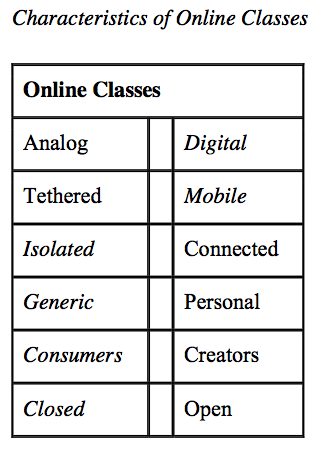
Consider the in-class experience of a typical undergraduate: After applying for admission to the university, registering for classes, and paying tuition (universities are closed unless you’re approved to enter and you can afford to pay), Jay makes his way into a large, stadium seating-style room (he is tethered to that place and time if he wants to hear the lecture). Talking during the lecture is taboo and the professor has a strict “lids down” policy to help students focus on the course material (Jay is effectively isolated because even though he is surrounded by friends and peers, and wireless Internet is available across campus, he is forbidden from drawing on these resources during class). Having read his textbook and reviewed the assigned handouts (analog materials), Jay joins 150 other students in listening to a 50-minute lecture (every student is a consumer of the same generic information regardless of their academic preparation). p. 4
Now consider Jay’s experience throughout the rest of his day: From his dorm room, the student center, a cafe, and a bus, Jay connects to the Internet via his laptop and mobile phone (he is mobile) in order to search Google for information (digital resources are open for him to freely access) relevant to tomorrow’s test. Temporarily stymied, he chats with friends on the phone and by Instant Messaging (IM) to see if they can assist in his search (he is connected to other people). Finally finding a good source, he follows some links to explore related information (the content is connected to other content), ignoring material he has already mastered (reading only what is important to him personally). Later that evening at study group Jay shares his find with friends (participating in the teaching process). p. 4
The traditional distance education student suffers many of the same challenges. Consider the experience of Jane, a student at a large distance education institution. After applying for admission to the university, registering for classes, and paying tuition (the university is closed to her unless she’s approved to enter and can afford to pay), Jane waits until she receives a password and permission to enroll in the university learning management system. She is not tethered in place (as she can access the course from wherever network connection is available), but she is tethered to a strict schedule to meet the pacing constraints of the institution. Jane remains isolated even from students in the same class who may live in her neighborhood (because privacy legislation doesn’t allow the university to release location information to fellow students). Although some course content is available online, copyright restrictions insure that students must purchase materials encapsulated in analog textbooks. The course content has been prepared months or even years earlier, and even the tutor assigned to evaluate her work is not allowed to change or update the course content (every student is a consumer of the same generic information regardless of their academic preparation). p. 4
We refer to the painful disconnection between Jay’s lived experience in the real world and the artificial environment inside the classroom as the daily divide. Unlike the digital divide, the daily divide also discriminates against people of higher socioeconomic status. Individuals with abundant access to information and communication technologies who have habits of effective use of these technologies in information-seeking and problem-solving activities are unable to make effective use of these technologies in higher education settings like the class described above. They may, of course, choose to “go rogue” outside of class and draw upon modern technologies and their skills with the same in completing assignments outside of class, but this only serves to reinforce the feeling of disconnection and disorientation on in-class exams. p. 5
One may be tempted to respond, “Who cares about a daily divide? We’re higher education! Without a college degree, they aren’t going to get jobs. Whether we’re responsive to changes in our environment or not, it’s not like students are going to stop coming to our institutions.” But higher education’s historic monopoly is being challenged in each of its major functional areas: structuring and providing access to content, tutoring and learning support services, curating and providing access to research materials, acting as a hub for social activities, and awarding degrees and other credentials. p. 5
An appropriate response to changes in higher education’s supersystem should include increases in connectedness, personalization, participation, and openness. Of these four, a significant increase in openness is the most pressing priority for higher education because a culture of openness is a prerequisite to affordable, large-scale progress in the other three areas, as explained below.  p. 8
Connecting and openness. p. 9
When a resource or service is closed it cannot be connected to. For example, if the student from our previous examples, Jay, wants to review material from an online course he took last semester, which is located in the university’s course management system, he will be sorely disappointed. He cannot reconnect with that material because he is not registered this semester, so the course is closed to him. If Jay’s professor depends on her students having learned something in the previous course and would like to link them back to that material for review before launching into a new topic in her course, she will also be sorely disappointed. The potential for connectedness within higher education is related to the degree of openness within higher education. p. 9
Personalizing and openness. p. 9
While the inability to connect without openness is a technical issue, the impediments to personalizing without openness are legal in nature. Editing, adapting, or otherwise changing educational materials to be more appropriate for a specific use is technically straightforward thanks to the variety of technologies currently available. p. 9
m. On the other hand, if the instructor starts with an openly licensed educational resource, his revisions are both legal and sharable to the wider world. The potential for personalization of educational materials, an entire course or a single resource, is directly proportional to the openness of the material’s license. p. 9
Creating and openness. p. 9
After the search engines, most of the top 50 sites in Alexa’s ranking of the most trafficked websites in the world are sites based on the act of sharing: sharing things like videos, status updates, photographs, personal information, files, blog posts, and other media. As recently as five years ago, very few people were producing video. And without an outlet for sharing their creative works, where was the motivation for making video? p. 9
If, as we have argued, openness is the fundamental value underlying the other changes needed in institutions of higher education, the critical question becomes, “how can an institution be more open?” p. 10
Models of Openness in Higher Education1 p. 10
Individual faculty members who are interested in being more open do not have to wait for their institutions to launch formal initiatives. A practice known as “open teaching” is gaining ground among some faculty: see, for example, courses by Wiley (http://opencontent.org/wiki/index.php?title=Intro_Open_Ed_Syllabus), Siemens and Downes (http://ltc.umanitoba.ca/connectivism/), and Couros (http://eci831.wikispaces.com/). In open teaching, faculty publish their course materials online under an open license before the beginning of the course and invite others from outside their university to participate in the course together with the “official students” of the course. In many cases, all students (both tuition-paying and informal students) post their work to publicly accessible blogs for critique and discussion by the larger group. Fini and colleagues (2008), who were students in Wiley’s 2007 course, provide a more detailed description of the course model and outcomes. Sometimes, course content and interaction is provided and mediated by wikis, sometimes blogs are used, and sometimes social networking sites like Ning or Facebook are used to host content and conversation. p. 11
Because openness – properly construed – is a practice and not a project (Robertson, 2009), openness will manifest itself differently in different institutions as it becomes part of the core organizational culture. p. 11
Openness and the Disaggregated Future of Higher Education p. 11
When world-class capabilities are not only provided but are provided freely and openly, the potential for innovation increases significantly. The increase in innovation is due to the decrease in transaction costs (specifically, bargaining costs) for those attempting to access these worldclass capabilities because open licenses (like the Creative Commons licenses, see http://creativecommons.org/) specify the terms on which the services can be accessed and used (e.g., without cost). Lower transaction costs decrease the overall cost and risk of experimenting with various innovations, thereby increasing the number of actors capable and willing to innovate. p. 12
Organizations such as Peer-to-Peer University (see http://p2pu.org/), the University of the People (see http://www.uopeople.org/), and Tech University of America (see http://www.techuofa.com/) each bring a different set of internal capabilities to their relationships with “open service providers.” Open service providers are those individuals or organizations that provide access to world-class capabilities under open licenses and at lower transaction costs. p. 13
Because open service providers lower the cost and risk of educational experiments, they are a critical piece of the infrastructure necessary for enabling rapid educational innovation. It is in this sense that Wiley (2005, 2008) argued that “content is infrastructure,” referring to the important role of open educational resources in enabling educational innovations. Educational experiments like the Open High School of Utah and the University of the People could not exist without a sufficiently broad, high-quality infrastructure of open educational resources to build upon. Put another way, they could not exist without open service providers like MIT OCW and CMU OLI. p. 13
References p. 15
Fini, A., Formiconi, A., Giorni, A., Pirruccello, N., Spadavecchia, E., & Zibordi, E. (2008). IntroOpenEd 2007: An experience on Open Education by a virtual community of teachers. Journal of e-Learning and Knowledge Society, 4(1), 231-239. Retrieved from http://www.je-lks.it/en/08_01/11Apfini_en.pdf. p. 15
Robertson, J. (2009, September 9). Open education: Project or process and practice? [Web log post] Retrieved from http://blogs.cetis.ac.uk/johnr/2009/09/09/open-education-project-or-process-andpractice/. p. 15
Images
p. 8

