Peoples-uni: Developing public health competences–Lessons from a pilot course module

| Reynolds, F., & Heller, R. (2008). Peoples-uni: Developing public health competences–Lessons from a pilot course module. OPEN WORKSHOP OF. Retrieved from http://dspace.learningnetworks.org/bitstream/1820/1634/1/Proceedings_Madrid_upload.pdf#page=28. |
BibTex
BibTex
@inproceedings{reynolds2008peoples-uni,
author = {Reynolds, F. and Heller, R.},
booktitle = {OPEN WORKSHOP OF},
date-added = {2012-04-07 03:11:00 +0000},
date-modified = {2012-11-27 22:32:57 +0000},
date-read = {2012-04-07 23:34:33 -0400},
keywords = {1p2pu},
oa-url = {http://dspace.learningnetworks.org/bitstream/1820/1634/1/Proceedings_Madrid_upload.pdf#page=28},
pages = {28},
read = {1},
title = {Peoples-uni: Developing public health competences–Lessons from a pilot course module},
url = {http://dspace.learningnetworks.org/bitstream/1820/1634/1/Proceedings_Madrid_upload.pdf#page=28},
year = {2008},
bdsk-file-1 = {YnBsaXN0MDDUAQIDBAUIJidUJHRvcFgkb2JqZWN0c1gkdmVyc2lvblkkYXJjaGl2ZXLRBgdUcm9vdIABqAkKFRYXGyIjVSRudWxs0wsMDQ4RElpOUy5vYmplY3RzViRjbGFzc1dOUy5rZXlzog8QgASABoAHohMUgAKAA1lhbGlhc0RhdGFccmVsYXRpdmVQYXRo0hgMGRpXTlMuZGF0YU8RAZwAAAAAAZwAAgAAB1NTREhvbWUAAAAAAAAAAAAAAAAAAAAAAAAAAMl5T9hIKwAAANrWUhtyZXlub2xkczIwMDhwZW9wbGVzLXVuaS5wZGYAAAAAAAAAAAAAAAAAAAAAAAAAAAAAAAAAAAAAAAAAAAAAAAAGdcMZy9dH4lBERiBDQVJPAAIAAgAACSAAAAAAAAAAAAAAAAAAAAAHQmliZGVzawAAEAAIAADJeZYoAAAAEQAIAADL14AiAAAAAQAMANrWUgAXPTEAAZ9eAAIAOlNTREhvbWU6VXNlcnM6AFN0aWFuOgBCaWJkZXNrOgByZXlub2xkczIwMDhwZW9wbGVzLXVuaS5wZGYADgA4ABsAcgBlAHkAbgBvAGwAZABzADIAMAAwADgAcABlAG8AcABsAGUAcwAtAHUAbgBpAC4AcABkAGYADwAQAAcAUwBTAEQASABvAG0AZQASAC9Vc2Vycy9TdGlhbi9iaWJkZXNrL3JleW5vbGRzMjAwOHBlb3BsZXMtdW5pLnBkZgAAEwABLwAAFQACAAz//wAAgAXSHB0eH1gkY2xhc3Nlc1okY2xhc3NuYW1lox8gIV1OU011dGFibGVEYXRhVk5TRGF0YVhOU09iamVjdF8QKS4uLy4uL2JpYmRlc2svcmV5bm9sZHMyMDA4cGVvcGxlcy11bmkucGRm0hwdJCWiJSFcTlNEaWN0aW9uYXJ5EgABhqBfEA9OU0tleWVkQXJjaGl2ZXIACAARABYAHwAoADIANQA6ADwARQBLAFIAXQBkAGwAbwBxAHMAdQB4AHoAfACGAJMAmACgAkACQgJHAlACWwJfAm0CdAJ9AqkCrgKxAr4CwwAAAAAAAAIBAAAAAAAAACgAAAAAAAAAAAAAAAAAAALV}
}
Links here
Highlights (32%)
The Peoples Open Access Educational Initiative’s (http://peoples-uni.org) aim is to deliver public health education that is of high quality as well as low cost. A key requirement is to develop appropriate public-health competences. Methods: The subject selected for the pilot module was maternal mortality. Competences, were dictated by and through the requirements and needs for learning and building public-health capacity. Results: Assessment of identified competences was based on published competences, but these required modification for problem-based learning and the settings that they are being used in. p. 1
Peoples-uni.org has achieved several successes, which suggest that building an on-line, accredited Diploma in Public Health is not an impossible aim and this is because of its aim of building education and skills development around Open Education Resources, to help with capacity building in developing countries and because the educational model includes competence and problem based approaches. p. 1
Obviously, in setting up this course, a key requirement was to develop appropriate public health competences and explore the assessment possibilities. As straight-forward as this sentence sounds, it doesn’t take into account the consideration that went into deciding which competences we should include. Once these had been established, could we assess achieved competences mapping them against internationally recognised standards to ensure that we were building meaningful and useful public health training? The next question was: could we do this outside the traditional university system, making learning flexible and more responsive to the needs of participants? The early stages of developing the Peoples-uni and a first course in public health began in September, 2007 with the piloting of a module on the subject of maternal mortality. p. 2
The process of establishing and delivering the courses and was used to set up the pilot module. This was as follows: 1. Identify a health problem. 2. Identify the educational need (such as Masters level for health professionals or ‘train the trainers’). 3. Identify the competences required. 4. Identify the on-line resources relevant to the competences. 5. Develop a set of focussed discussion topics for tutor/facilitators to lead on-line groups, using a learning management system (currently Moodle). 6. Assess and accredit learned competences. 7. Do this across a range of relevant problems to cover a whole set of competences to build a public health course. 8. In addition, the course developers are committed to revising the resources as they are used, in order to ensure local relevance. p. 2
So, with this in mind, we decided to develop the Peoples Open Access Educational Initiative (http://peoplesuni.org) – established in 2006 as a loose association of interested parties. Its aim is to deliver public health education that is of high quality as well as low cost, using the openaccess resources that are available. p. 2
Competences, at this stage, were dictated by and through: p. 2
- The requirements and needs for learning and building public health capacity in developing countries;
- The Maternal Mortality module’s focus and topics;
- The experience and views of the module’s developers and facilitators. p. 3
The module had five topics. p. 3
Assessment of identified competences was based on published competences, but these required modification for problem-based learning and the settings that they are being used in. Furthermore, to add weight to value of the training, external accreditation was sought from the Royal Society of Health. p. 3
Each of the topics ran for two weeks of discussion. The delivery of the module was through problem-based learning. Participants were required to read the peer-reviewed materials and discuss questions raised to meet the competences. p. 3
Results p. 3
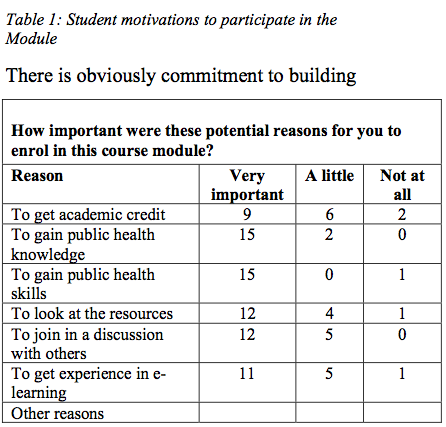
The module was delivered over ten weeks to fit between the end of Ramadan and the onset of the Christmas and Eid festivals. There were five topics based on competences and three assessments (one formative). There were several general and content-expert facilitators. 38 students from Pakistan; Turkey; Democratic Republic of Congo; India; Nigeria; Sudan; Ghana; and the USA signed up to the course, after limited publicity, and their backgrounds ranged from clinicians wanting public health perspective to policy-makers and programme leads. p. 3
The key issues for running the pilot were:
- Educational materials
- Delivery mechanism (ICT and tutors)
- Accreditation of learned competencies p. 3
The pilot Maternal Mortality module has been a successful exercise – in exploring competence development and most importantly, as far as the participants are concerned, delivering useful public health education. Further modules are to be developed to form a Diploma of Public Health. Demand was highest for the following subjects – suggesting that a generic, skillsdevelopment approach would be most useful: p. 5
Competences and their assessment criteria will be listed on permanent pages of the website – available to all of those considering enrolling on the modules. p. 5
Images
p. 3

