Teaching as a Design Science: Building Pedagogical Patterns for Learning and Technology.
| Laurillard, D. (2012). Teaching as a Design Science: Building Pedagogical Patterns for Learning and Technology.. ERIC. |
BibTex
BibTex
@book{laurillard2012teaching,
author = {Laurillard, Diana},
date-added = {2013-04-09 11:05:02 +0000},
date-modified = {2013-04-19 11:19:58 +0000},
keywords = {0sotl},
publisher = {ERIC},
title = {Teaching as a Design Science: Building Pedagogical Patterns for Learning and Technology.},
year = {2012}
}
Links here
p. 1 teaching - art, science, design science (like engineering). Herbert Simon The Sciences of the Artificial. design principles rather than theories, heuristics of practice rather than explanations uses what is known about teaching to attain the goal of student learning, uses the implementation of its designs to keep improving them
tools always important for teaching - from writing. not developed for education.
p3 knowledge technologies. change our relationship to what is known and how it can be known. example: reading/writing about business case, role-play with simulation, experiment with spreadsheet… learning outcomes similar wrt factual, but different experiences, different ways of knowing. forms of knowledge: analytical, experiential, experimental.
Roger Saljo
p. 5, how do we learn about teaching. lack of feedback loops in the system - define outputs (intended learning outcomes), design means of achievement (teaching methods, lesson plans), specify and judge criteria for success of outputs (exams and grades), use information to judge student, but not the teaching design…
knowledge generated by teachers is not shared
idea that education can be treated as a design science originated in the 1990s, taking research out of the laboratory. develop design research methodology. not classically experimental but iterative, progressively refining the initial theory-based design as it is actually implemented. then it can refine both theory and practice. Allan Colins. principled reflective practice. Cobb et al 2003, Collins, Joseph and Bielaczyc 2004, diSessa and Cobb 2004.
p6 not meant as methodology for teaching practitioners, too much work
design science research grounded on existing ideas drawn from the domain knowledge base (theories of teaching and learning). Additions to the knowledge base as a result of design research will include any additions or extensions to the original theories and methods, the new artefacts, and all experience gained during the iterative design cycles and field-testing of artefact.
p7 design patterns for learning - being able to externalise the knowledge is what makes it a shared object in a community that can therefore critique and build its knowledge
format of a design pattern? machine-readable/textual…
p11 what is formal learning? imparting knowledge? Now: 'The aim of teaching is simple: To make student learning possible' (Ramsden 2003:5).
p16 discussion of aims of education, work-place learning vs academic disciplinary learning (hard to reconcile). most jobs mainly require skills, not knowledge. UK QAA asked academics to come up with skills taught by every discipline. criticised for “reducing” academic lofty aims to “mere goals” - curriculum should embrace both knowing and acting, but also “being”, develop a sense of self. future-proofing curriculum.
p 19 tuning in Europe, common skills and knowledge for graduates in different disciplines, to encourage mobility
p20 can learning goals be defined across disciplines. “Enhancing teaching-learning environment” worked with 28 university courses to analyse their aims and learning outcomes, how to align these with the teaching methods
p23 40% of learning outcomes seen as relevant to 75% of the disciplines - expressed at a high level
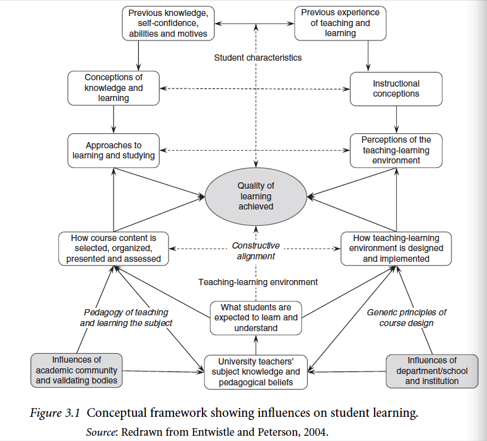
p27 input/presage variables - impact how students approach learning - process/environment variables, what happens during study, product/output variables they lead to (Biggs 1993, Gibbs 2010).
most salient variables: 1) previous knowledge, self confidence, abilities, motives 2) conceptions of knowledge and learning, 3) approaches to learning and studying, 4) expectations. Influenced by students' previous experience with learning (Entwistle and Peterson 2004, Biggs 1993).
p28 emotional engagement, most elusive, least stable. self-efficacy related to self-directed learning (Bandura 2006)
p29 support students to be efficient self-regulators. promote students' domain-specific self-efficacy beliefs rather than general self-esteem intrinsic and extrinsic motivation, academic/personal/vocational/social - stable categories
p31 Haggis and Pouget - learners without academic background often at loss - don't know enough to intrinsically motivated by discipline, don't have good enough study skills to realise extrinsic motivation for success - explicit modelling of cognitive approaches necessary, bridging courses
Umbach and Wawrzynsk: educational context created by faculty behaviours and attitudes has dramatic effect on student learning and engagement - environment that emphasises effective educational practices → students are active participants in learning, perceive greater gain from undergrad experience.
p32 effective techniques: active and collaborative learning techniques, high level of academic challenge, writing and revising, emphasise higher order cognitive activities, enriching co-curricular work, high-level of course-related interaction with students
p33 From the teachers' point of view, the most important intellectual characteristic is what a student knows about their subject. This is seen as an emergent property of how they come to know it. Research studies have coalesced around two aspects: the student's conception of the nature of formal knowledge (dualistic or relativistic), and their approach to study (what contribution they expect to make to the process of learning)
William Perry, what students know about the nature of knowledge. Longitudinal account over four years, maturing intellectually. Nine distinct stages of development. Broadly: from dualistic position, right or wrong is the responsibility of an authority, to an open view of knowledge as a multiplicity of positions of equal value to relativistic view, knowledge as contextualised, requiring personal commitment to aligning it with one's own values
p34 Marra and Palmer 2004: how students' conceptions of knowledge relate to teaching context: if student perceives a vast body of knowledge to master, mastery is seen as a struggle, they need help from teacher to minimise what needs to be done. If they see knowledge as a means for acting in the world, alternative ways of conceptualising a particular context and their role is to take responsibility for how they use knowledge in that context, they are in a good position to know what they need form the teacher.
p35 Perry-levels might be contextual to discipline - harder to achieve in sciences
p37 Vermetten, Vermunt and Lodewijks 2002 - students only take from learning what suits their existing habits, ideas and preferences for learning and study - might be skeptical to discussion etc, - but habits come from interaction, is fluid.
Students' perceptions of their learning context are not stable, but develop continuously in response to that context (Lowyck, Elen and Clarebout 2004). “Students can adapt their ways of tackling academic work to circumstances” (Entwistle and McCune 2004) - refers to reflection, metacognition, self-regulation - how students adjust their study strategies to their perceptions of the teaching and assessment context.
Comparison of six study inventory surveys, 3 principle dimensions needed to describe intellectual characteristics that students bring to learning, each of which encapsulates intentions, motives and processes of learning and studying:
- deep approach - understanding, meaningful learning, critical thinking, relating and structuring ideas, constructing knowledge, use of evidence
- surface approach - reproducing, learning is intake of knowledge, memorising, unthinking acceptance of ideas, extrinsically motivated by external regulation
- strategic approach focused on achieving, aware of study requirements, self-regulating through careful time management, concentrating, working hard and systematically
p 38 Most effective teaching methods
- guide students towards independent learning
- situate the application of knowledge in different contexts
- stretch students beyond their preferred styles
- encourage reflection and self-regulation
p 39 Formal and informal learning (Eraut 2004, Marsick 2006).
Piaget separated spontaneous and non-spontaneous concepts, Vygotsky saw scientific concepts, with systematic knowledge in disciplines - need special investigation, cannot assume that they are learned in the same way as spontaneous concepts. Different but not separate from spontaneous informal learning - interdependence and mutual value.
p40 Differentiate informal learning about the world, and studying fomal learning about others' descriptions of the world, which is the educationist's domain. Formal learning made possible through language.
Frith 2007, language as a technology to transfer other people's models of the world, putting together the models of many people - construct a new model that is better than any model produced by a single individual.
p41 Knowledge derived from experiencing the world at one remove must be accessed differently from that known through a first-order experience. Difference between developmental psychology (first-order knowledge of the world) and educationist (second-order, described by others). Every human learns to move their hands, very few really understand Newton's second law.
“Institutional learning is, to a large extent, to be understood as a systematic shortcut to insights that many never occur in individuals unless there is a rather systematic assistance in the processes of foregrounding perspectives, introducing concepts and discussing models.
Rather systematic assistance = pedagogy/learning design.
Theory of the relationship between formal and informal learning is still undeveloped (Sharples, Taylor and Vavoula 2007). We need one, because virtual environments in which students operate in education work and leisure are more easily integrated than equivalent physical environments - boundaries will begin to break down, need to use this opportunity, not be marginalised by it.
p 44. 4: What it takes to learn
Theories of learning in psychology are not easy to adapt to the classroom, because they did not originate there. But these alternative ways of conceptualising learning as a fundamental aspect of human cognition contribute to our understanding of formal learning in education.
p 45 Trying to synthesise all the learning theories. Behaviourism. Product, not process of learning. Learning to exhibit certain behaviours, can be manipulated through 'operant conditioning' without needing to understand how mechanism of learning takes place. Use marks etc as rewards, if they are the principal goal, does not matter how students got them (parroting etc). But formal learning has higher goal.
p 46 Associative learning - Pavlov and Thorndike - process of learning as physiological mechanism. Thorndike's cat, pull a string to access food. Connectionism - offers an account of the process of learning. Trial-and-error learning process now basis of neural network models that successfully model phenomena like recognising images. Relevance to early years education.
p47 Cognitive learning (Gestalt psychology) - learner uses success to think differently about the situation, to make a holistic structural reorganisation if that allows a link to be made between the action and its consequences (Wertheimer 1959). Modern: connections in neural pathway strengthen in response to the success of a random trial action.
Meaningfulness to learner - conscious process enabling learner to make sense of relationship between goal, action and result. Wertheimer - structural approach to teaching. Let students discover rules by doing tasks, rather than being taught explicitly.
p 48 Experiential learning - Dewey: It's the learner's own organisation of the problem situation that enables them to develop new knowledge within a curriculum. Task of teacher is to plot the appropriate sequence of realistic experiential problems for their learners. Brain has developed to learn through imitation, perception of activity triggers a pattern of brain activity in the same motor area that will control the action itself. Task of the teacher is to work out how to deconstruct the activity so that learners become aware of what is salient to achieving the goal.
Social constructivism - Skills and knowledge that has been developed by other individuals must be learned through imitation, discovery or communication. Dewey - social process - individual acculturated through social interaction. Vygotsky: Learning through discussion is important, distinct form learning through practice, because the act of articulating an idea is itself a contribution to what it means to know that idea.
p 49 Cognitive neuroscientist's account of how the brain deals with learning through communication - person A's brain constructs a model of person B's idea, compares it with what B should do as a result, uses any error in the prediction to see where the difference lies between the two models, and adapt their communication accordingly.
p 50 Conceptual learning
Deep and surface level processing, derived from studying how students read a text (Marton and Saljo 1976a,b). Internal relationship between the approach to study and the learning outcome achieved - the how and what of learning. Long-term research program in many countries on qualitative differences in how students approach the task of learning others' ideas from reading texts and listening to lectures and in how they conceptualise what they have learned as a result (Marton, Hounsell, Entwistle 1997).
p51 Common finding: Some learners attend to the discourse in a way that distorts its intended meaning, so communication fails. Only when learners are aware of different structural levels within a text can they interpret and discern its intended meaning (Marton and Booth 1997).
Research program able to relate the way students worked on a text, through interview data, to the way they were able to summarize it, or use it to solve a problem. If student fails to perceive the principle-example structure in a text, their summary is about the illustrative samples and misses the principle completely. (Marton and Wenestam 1979)
Ausubel (2000) contrasted 'meaningful learning' that learners do for themselves informally, outside their school experience, with 'rote learning' common in schools.
Marton's phenomenographic method of describing how students understand formal concepts in science, social science and engineering, established “outcome space” of family of misconceptions that students were capable of developing around the target conception (Marton 1981, Marton and Pong 2007).
Developing conceptions and misconceptions
Correct interpretation has a more complex logical structure, to discern it requires the cognitive activities involved in the deep approach to study:
- seeking meaning
- looking at broad picture
- relating ideas to previous knowledge and experience
- looking for patterns and underlying principles
- checking evidence and relating it to conclusions
- examining logic and argument cautiously and critically
- monitoring understanding as learning progress
- engaging with ideas and enjoying intellectual challenge
p 53 challenges in interpreting structure of text, an also of using forms of representation (symbols, graphs etc).
Ainsworth comprehensive review of research on learning from formal representations: cognitive tasks to understand
- form of representation
- relation between representation and domain
- how to select an appropriate representation
- how to construct an appropriate representation
p54 Constructionism
Emphasizing learning through experience, through practice, learning by doing, learning by constructing, situated learning. Papert's term linked to his idea of a micro world, environment designed to afford learning of some system or set of concepts and powerful ideas (Papert 1980). All forms of learning through practice require a practice environment that has this property of affordance.
Form of constructivism that construct something, an overt production or public entity of some kind. Social constructivism: overt production is the articulation of an idea. Students learn more deeply because the actions they take to produce something elicit results that feed back information about how to improve their next action. Related to situated learning.
p 55 Central idea: teachers recruit for academic learning the 'unsupervised' learning process that their learners have already developed for learning about the world without a teacher. Supervised learning uses guidance and feedback from the teacher to keep the learner on track. However, if the learning is situated in a meaningful context with a meaningful goal in view, the learner should be able to cope with less teacher direction and rely solely on the direct feedback from the environment on their actions.
Two kinds of feedback, from the environment, and from the teacher. Consequences of action vs coach (Schank, Berman and Macpherson 1999), knowledge of results vs knowledge of performance (Romiszowski 1999).
p56 Extrinsic feedback is potentially more efficient than intrinsic feedback, because it guides the student towards the optimal answer - but if the guidance is too helpful, it stops the learner doing their own active reflection.
p 57 Collaborative learning
The nature of “learning through production” has not been thoroughly researched, despite the importance in formal education of insisting that learners produce something to show that they have learned. Stahl, Koschmann and Suthers 2006. A group collaboration works toward a clear end-point, or output in the form of a shared understanding that requires participants to confront any discrepancies or contradictions in their discussions - in discussion disagreements can be left open, but in production needs to be specified (like co-authoring a Wikipedia page) (Dillenbourg and Traum 2006).
This can happen in discussion, each learner may be pushed by peer to elaborate and defend their idea until they reach a better understanding - but takes skill, which we don't often teach, although can be taught (Wegerif 2007).
p 58 3 main principles from Bransford NAS report:
- students come with preconceptions, if their initial understanding is not engaged, they may fail to grasp new concepts and information
- to develop competence in their area of inquiry, students must a) have deep foundation of factual knowledge, b) understand facts and ideas in the context of a conceptual framework, c) organise knowledge in ways that facilitate retrieval and application
- metacognitive approach to instruction can help students learn to take control of their own learning by defining learning goals and actively monitoring their progress in achieving them
Analysis comparing contributions from studies of 'implicit learning' in psychology and neuroscience, 'informal learning' outside the classroom, and 'formal learning' in education. Bransford et al 2006.
The concepts and relations involved in learning
- Learning as an active process is triggered by a personal goal that requires action
- the goal is partly individual and partly socially determined
- the learner has access to a model of the relevant actions and their outcome
- the action required for the goal is within their current practice capability
- and is informed by their current conceptual organisation
- the articulation required represents their current conceptual organisation
- which results from access to another's articulated conceptual organisation
- or from the use of feedback on previous actions and articulations
- or from another's comment on their own articulated organisation
- and the feedback is used to modulate future actions
- and to modulate the conceptual organisation that generated the action
- and to modulate the goal
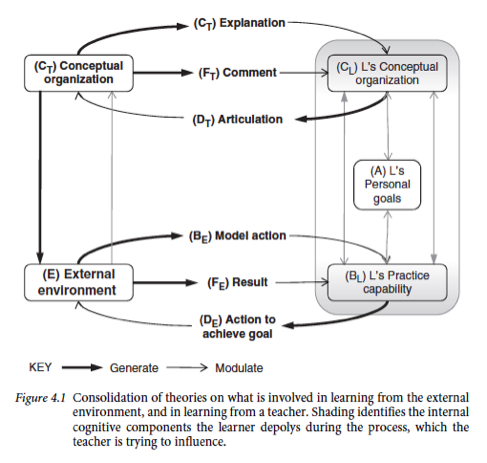
p 61 Learning happens when each connection drives the next - each one generates an output from its origin to modulate its destination component - which in turn provides impetus or capability for that component to produce the next connection, et.c
p 62 Consequences for teacher
| What is involved in active learning | How the teacher promotes successful active learning |
|---|---|
| Learning oriented towards personal goals of learner (1, 2) | Personal goal has to be aligned with what the teacher needs their goal to be. According to Dewey, align by grounding task to be learned in learner's own experience, securing learner's socialised interest (A) |
| Learner uses the model action and their practice capability to generate their action to achieve the goal (2, 3, 4) | Learner's current practice capability must include those needed to achieve the goal. Teacher must model and deconstruct complex actions (Be), task goal requiring actions that are within ZPD |
| Learner uses another's concepts and their current concepts to generate their articulation (2, 3, 5, 6, 7) | Learner needs access to the teacher's conceptual organisation (Ct), teacher has to clarify internal structure of the concept, and text (Ct) |
| Learner uses feedback to modulate their concepts and practice capability in relation to the goal (2, 8, 9) | Building a repertoire of appropriate actions requires teacher to provide an external environment (E) giving learner sufficient feedback for testing actions (De) in relation to their goal (A) to build improved practice capability (Bl) and concepts (Cl). Teacher has to monitor learner actions in the environment (De) and articulations of their concept (Dt) as representation of their current practice capability (Bl) and conceptual organisation (Cl) |
| Learner uses feedback from an action or articulation to modulate their current conceptual organisation, practice capability and personal goal (10, 11, 12) | Teacher has to ensure that learner receives meaningful intrinsic feedback from their actions in the external environment (Fe), meaningful extrinsic feedback comments or guidance from the teacher (Ft). |
Not clear how learning through discussion, practice and experience operates differently when mediated by digital technologies (absence of social and emotional factors).
p 63 Chapter summary: “Learning is a process of using concepts and practice to generate articulations and actions that elicit communication from the teacher and information from the environment to modulate those concepts and practice.”
p 64: What it takes to teach
Principal content factors influencing the design of teaching and learning
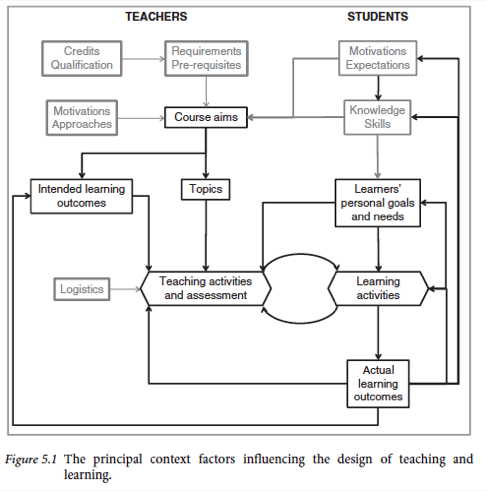
p66 “Designing for learning” is preferable to “instructional design” or “teaching design” or “pedagogy design” because the focus is on the learner. We cannot design learning, but we can create the environment and conditions within which the students find themselves motivated and enabled to learn.
Reigeluth's extensive volume on instructional design theories and models, 20 diagrammatic models of the process (1999a). Most cited by ID: J. R. Anderson, Bereiter, Bloom, Bruner, Dewey, Gagne, Vygotsky. Other: Biggs, Boud, Gibbs, Ramsden. Dalziel, Oliver and Sharpe.
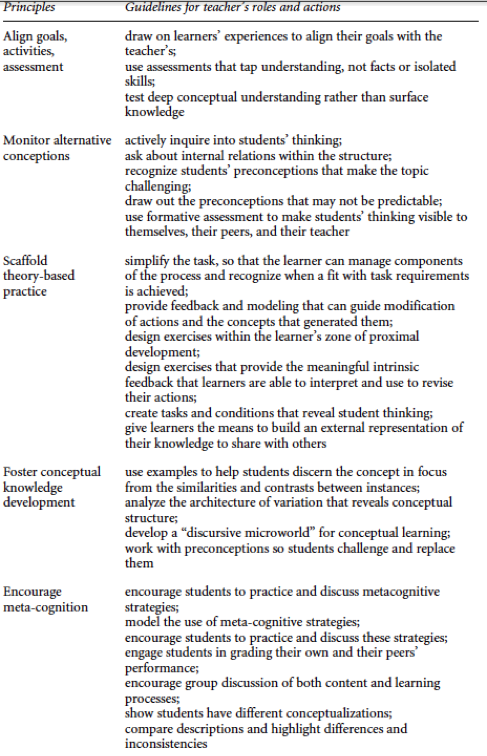
p68 Aligning learner goals with teacher goals - experiential vs didactic, Ausubel's “advance organiser” - use analogy in learner's own experience, intriguing issue, puzzling question. Dewey goes further: goals should be negotiated with learners.
p69 Aligning learning outcome, teaching method and form of assessment - generally agreed upon principle
p70 however, omits idea of learner's readiness to learn/ZPD. relate teaching directly to prior knowledge and to “understanding aims”
p71 From Bransford, Brown & Cocking, 2000Bransford, J. D., Brown, A. L., & Cocking, R. R. (2000). How people learn. DC National Academy Press Washington. :
Teacher needs to:
- actively inquire into students' thinking
- create tasks and conditions under which student thinking can be revealed
- use frequent formative assessment to make students' thinking visible to themselves, their peers, and their teacher
- provide feedback that can guide modification and refinement in thinking
- use assessments that tap understanding, not facts or isolated skills
- recognise students' preconceptions that make the topic challenging
- draw out preconceptions that are not predictable
- work with preconceptions so that students challenge and replace them
The idea expressed in SOTL that teachers should have an awareness of “the central position of the perceptions of the students” (Trigwell et al 2000).
Phenomenography as method to elicit and describe phenomena of learning from students' points of view.
p72 Deconstructing complex actions is the essence of scaffolding, the supporting structures the teacher creates (Bransford, Brown and Cocking 2003), “reducing the number of steps required to solve a problem by simplifying the task, so that the learner can manage components of the process and recognise when a fit with task requirements is achieved” Ibid 104.
“Time on task is a major indicator for learning and… deliberate practice is an efficient way to promote expertise (ibid)
p 73 The need for a coach who provides feedback for ways of optimising performance - not efficient if student spends most of the problem-solving time rehearsing procedures that are not optimal for promoting skilled performance. (ibid)
Two problems: fading support and giving over to student (Pea 2004) and logistics in a mass education system - how to receive detailed and timely feedback?
p74 Educational design literature proposes the use of “bridging”, “cognitive conflict”, “architecture of variation” - recreate in the teacher-student language-based dialogue the goal-action-feedback-modulate cycle of experiential learning.
Bridging: intermediate analogous examples to help students discern concept in focus as similarities between instances. Often in science topics.
Cognitive conflict: critical experiment, the one that is capable of deciding between two conflicting theories. “Predict-observe-explain” - teacher designed situation to confound students.
p75 Architecture of variation: students cannot discern anything without experiencing variation. - Making the right things salient.
p76 Teacher is not simply describing the concept, but setting up the learning environment as a king of languge-based micro world, designing the series of instances of the concept to afford the learning of the concept in general. Conceptual change process.
Meta-cognition and reflection (not mindless trying again) is encouraged. Effective way is to enable students to articulate and share, through peer-learning.
p78 The need for learning design patterns. “Teaching has to make use of what is known about learning and teaching from research, but must also develop heuristics, skills and practitioner knowledge to create effective learning designs, rather than relying on the science alone.”
Marton encourages “learning study” / “design experiment” for teachers. p79
p82 Motivating and enabling the learning cycle
Students need help with motivation to learn because formal learning has distant rewards, except for the intrinsic reward of intellectual curiosity. They need help with how to approach the learning of something that is the product of someone else's thinking, and teachers do not naturally provide an environment that affords learning of this kind.
What it takes to teach cannot be determined directly from what it takes to learn, which means that teachers must be willing to treat the process as essentially problematic, iterative, and always improvable. Stop assuming that teaching can be theorized like a natural science, and treat it as a design science.
p84 A framework for analysing formal learning
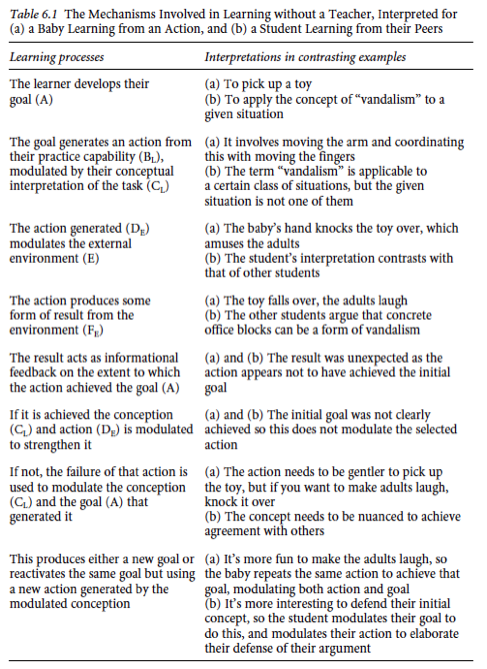
Successive stages involved in learning without a teacher, two contrasting interpretations (a) baby learning to grasp an object b) student learning to use new specialised concept appropriately in analysing socio-political situation in discussion with other students.
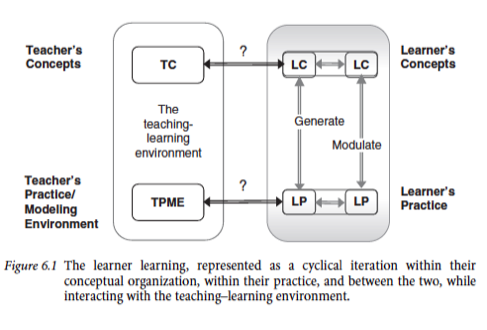
p86 In the cut and thrust of teachers and learners interacting with each other there will be many different ways in which iterative cycles work, over periods as short as a few minutes, or over several weeks. The teacher is not always present, so learner is working independently, supported by teacher represented in the form of presentations in books, documents, videos, working in practice/modeling environment the teacher has designed (practice exercises, labs)
p87 Three cycles of interaction between teacher and learner
Teacher communication cycle - aligning goals, monitoring conceptions, fostering conceptual knowledge
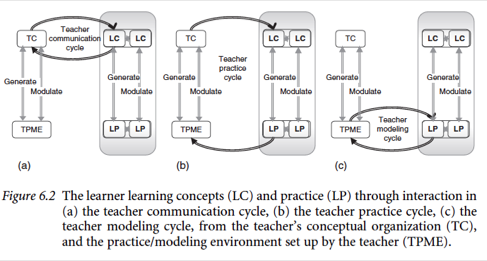
Arrows in diagram depict teacher influencing learner's internal cycle at the conceptual level by * explaining a concept through language or other forms of representation * eliciting learners' questions or the way they articulate their concept or reflect on their experience * responding to learners' questions and commenting on their articulations
p88 Teacher's conceptual organisation is representation in the curriculum - class presentation, book, handout, etc. Can be hints/guidance to students as they learn, comments on essay.
Iterative - how many cycles does it take to make sure each member of conversation shares the same idea?
Socratic discussion - but not possible in big classroom. Essay writing / iterative with feedback. Audience response systems…
p89 Teacher practice cycle
- design exercises within learners' ZPD
- create tasks/conditions under which student thinking can be revealed
- give learners means to build an external representation of their knowledge to share with others
practice environment - learner can generate action with feedback from teacher, modelling environment - can itself respond with meaningful feedback on actions taken
p90 Creating a modelling environment that models the task in such a way that the learner can see the result of their action sin comparison with the indented model is one of the most powerful ways of learning -enables the learner to “learn without being taught” - when tasks are within their capability, and they are able to interpret the feedback (it is meaningful to them)
p91 peer communication and modelling cycles each learner plays the same role for each other, eliciting the expression of an idea and its instantiation in practice - offer critique, ideas, alternative outputs, motivate iterative cycles between concepts and practice, assist each others meta-cognition.
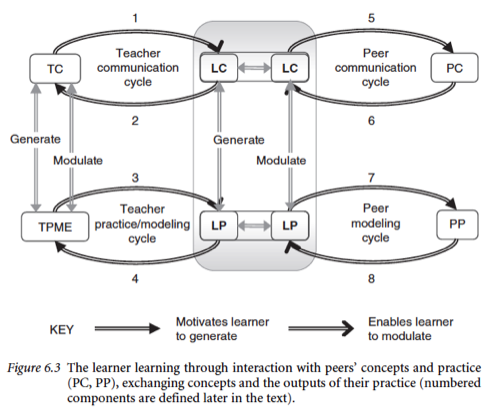
p93 Conversational Framework, inspired by Gordon Pask's Conversation Theory, cybernetic model of teaching and learning (Pask 1976). Way of challenging use of new tech in learning. Aim is to represent, as simply as possible, different kinds of roles played by teachers and learners in terms of requirements derived from conceptual learning, experiential learning etc etc, and the corresponding principles for designing teaching and learning activities in the ID literature.
Other models: Kolb's learning cycle, Senge's double-loop learning.
p94 Formalizing cycles from figure 6.3: Teacher's communication cycle (TCC)
| (1) | enables each learner to modulate their concept by giving them access to the teacher's concept |
|---|---|
| (2, 1) | motivates each learner to generate questions or articulations of their concept and practice because the teacher is giving them extrinsic feedback |
Teacher's practice cycle (TPC)
| (4, 1) | motivates each learner to modulate their practice by generating actions that elicit extrinsic feedback from the teacher |
|---|
Teacher's modelling cycle (TMC)
| (4, 3) | motivates each learner to modulate their practice by generating actions that elicit intrinsic feedback from the modelling environment |
|---|
Peer communication cycle (PCC)
| (6) | enables each learner to modulate their concept by providing access to their peer's concepts |
|---|---|
| (5, 6) | motivates each learner to generate articulations because they are getting extrinsic feedback from their peers |
Peer modelling cycle
| (4, 7) | motivates each learner to generate actions in the practice environment because they are sharing the output of their practice |
|---|---|
| (8) | enables each learner to modulate their practice by using the model of their peer's output |
Goal of teacher is to motivate or enable learner, generate their articulations and actions, that modulate their concepts and practice
p95 This framework proposes rich mix of activities to build more effective knowledge structure, more skilled ways of using it. For teacher as designer, explains why one design might be better than another in terms of mix of teaching-learning activities, and amount of iteration the design takes.
| Design elements for activities in the Conversational Framework | Cycles |
|---|---|
| Access to the teacher's concepts | TCC1 |
| The means to articulate their concepts and reflections on practice | TCC2 |
| Extrinsic feedback on questions or articulations of their concepts | TCC3 |
| A practice environment that facilitates their actions | TPC1 |
| Extrinsic feedback on their articulations of their actions | TPC2 |
| A modelling environment that elicits their actions | TMC1 |
| Intrinsic feedback on their actions from the model | TMC2 |
| Access to peers' concepts | PCC1 |
| The means to articulate their concepts and reflections on practice | PCC2 |
| Extrinsic feedback from peers on articulations of their concepts | PCC3 |
| Sharing practice outputs with peers | PMC1 |
| Access to peers' outputs as a model for their practice | PMC2 |
| Learning through | Conventional technology | Digital technology |
|---|---|---|
| Acquisition | Reading books, papers; Listening to teacher presentations f2f; lectures; watching demonstrations, master classes | Reading multimedia, websites, digital documents and resources, listening to podcasts, webcasts, watching animations, videos |
| Inquiry | Using text-based study guides, analysing the ideas and information in a range of materials and resources, using conventional methods to collect and analyse data, comparing texts, searching and evaluating information and ideas | Using online advice and guidance, analysing the ideas and information in a range of digital resources, using digital tools to collect and analyse data, comparing digital texts, using digital tools for searching and evaluating information and ideas |
| Practice | Practicing exercises, doing practice-based projects, labs, field trips, face-to-face role-play activities | Using models, simulations, micro worlds, virtual labs and frield trips, online role-play activities |
| Production | Producing articulations using statements, essays, reports, accounts, designs, performances, artefacts, animations, models, videos | Producing and storing digital documents, representations of designs, performances, artefacts, animations, models, resources, slideshows, photos, videos, blogs, portfolios |
| Discussion | Tutorials, seminars, email discussions, discussion groups, online discussion forums, class discussions, blog comments | Online tutorials, seminars, email discussions, discussion groups, web-conferencing tools, synchronous and asynchronous |
| Collaboration | Small group project, discussing others' outputs, building joint output | Small group project, using online forums, wikis, chat rooms etc for discussing others' outputs, building a joint digital output |
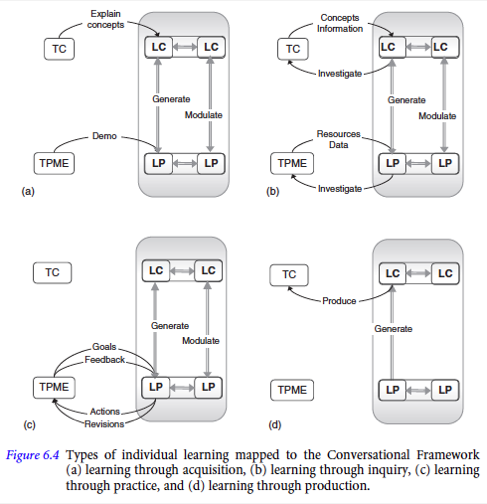
p97 learning through acquisition: learner is reading, hearing/watching explanation/teacher's model actions → learner modulates own concepts, sees demonstration of teacher practice, does not require generation of action/articulation by learner
inquiry: learner investigates texts/docs/resources that reflects concepts/ideas being taught. Learner in control, but guided to investigate, compare concepts, use resources/data, modulate conceptual organisation by generating investigations and using what they find to articulate changing concepts - “learning through finding out”
p 98 learning through practice, learners using developing concepts to improve actions, put theory into practice in working to a goal, generate action to achieve it, use feedback to modulate action or conception. Analyze poem, optimise climate model. Teacher: provides modelling environment that requires action and provides intrinsic feedback.
production: teacher motivates learner to consolidate what they have learned by articulating their current conceptual understanding, how they used it in practice. common, but hardly discussed by learning theorists. “Producing an essay, for example, is meant to motivate the learner to pull together and organise their exploration and critique of the literature, the project report motivates them to draw conclusions from their inquiry and practical work, and account for how they arrive at them…”
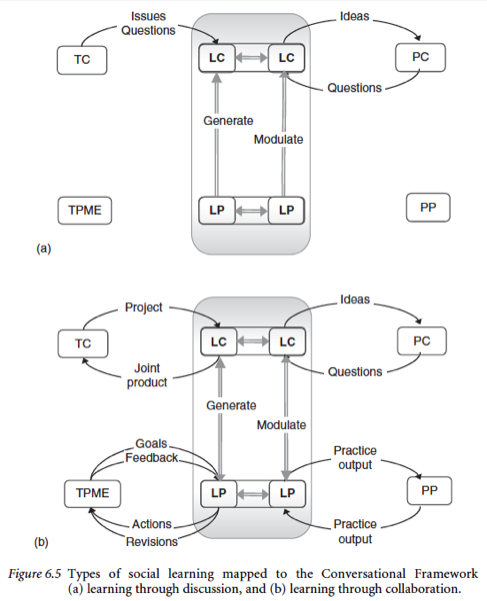
Social learning - discussion, teacher provides stimulus in form of question/issue, learners generate ideas/questions → demand for each learner to modulate their ideas, generate further ideas and questions.
Learning through collaboration incorporates learning through discussion, practice and production. Learners exchange the products or outputs from their practice, which motivates them not only to modulate their actions, but also to generate a discussion of the reasons for them. Teacher's role: provide means to create shareable output, task goal: produce joint product, practice/modeling environment for developing their output. (p99) This type of learning is likely to motivate more iteration between the learner's concept and practice than the other types discussed, because it combines both learning through practice and learning through discussion.
p 100 The framework as a Design Analysis Tool
since it describes what it takes to create an effective learning design, the Conversational Framework can also act as a design analysis tool. Way of analysing learning design in terms of mix of activities and likely amount of iteration it provides.
Example using framework to show why mobile tech able to enhance learning experience in public space (museum) compared with traditional (Laurillard 2007). Reason for using digital technology is clear from the improved coverage of Conversational Framework, and opportunities for learners to repeat learning cycles of generating and modulating concepts and practice.
Should be able to answer:
- What motivates learner to keep generating actions and articulations?
- What enables learner to keep modulating their concepts and practice?
Effectiveness of any teaching-learning design has to be tested with learners to see whether it succeeds in eliciting the intended activities from students, and whether they achieve the intended learning outcome.
p 101 Showing redesign - adding more opportunities for students to work individually, contribute ideas, share ideas with others, reflect
p 102 Design Criteria for Teaching-Learning Cycles to Motivate and Enable Learning What motivates the learner to generate actions and articulations? What enables the learner to modulate their concepts and practice?
| Teacher Communication Cycle (TCC) - learning through acquisition and production | Enables the learner to modulate their conception by providing access to the teacher's concept, and motivates them to generate an articulation that elicits extrinsic feedback |
|---|---|
| Teacher Practice Cycle (TPC) - learning through inquiry | Motivates the learner to generate an action that elicits extrinsic feedback, enabling them to modulate their concept |
| Peer Communication Cycle (PCC) - learning through discussion | Motivates the learner to generate a comment that elicits a comment from a peer, enabling them to modulate their concept |
| Teacher Modeling Cycle (TMC) - learning through practice | Motivates the learner to generate an action that elicits intrinsic feedback from the model, enabling them to modulate their concept and their practice |
| Peer Modeling Cycle (PMC) - learning through collaboration | Motivates each learner to generate an output to negotiate as a shared output, enabling each learner to modulate their concept and their practice |

