Cloud Computing and Creativity: Learning on a Massive Open Online Course
| Kop, R., & Carroll, F. (2011). Cloud Computing and Creativity: Learning on a Massive Open Online Course. European Journal of Open, Distance and E-Learning, Special Issue on Creativity and OER. |
BibTex
BibTex
@article{kop2011cloud,
author = {Kop, Rita and Carroll, Fiona},
date-added = {2012-01-10 17:28:40 +0000},
date-modified = {2012-04-09 01:02:04 +0000},
date-read = {2012-04-02 15:18:58 -0400},
journal = {European Journal of Open, Distance and E-Learning},
keywords = {1mooc},
notes = {1},
read = {1},
title = {Cloud Computing and Creativity: Learning on a Massive Open Online Course},
volume = {Special Issue on Creativity and OER},
year = {2011},
bdsk-file-1 = {YnBsaXN0MDDUAQIDBAUIJidUJHRvcFgkb2JqZWN0c1gkdmVyc2lvblkkYXJjaGl2ZXLRBgdUcm9vdIABqAkKFRYXGyIjVSRudWxs0wsMDQ4RElpOUy5vYmplY3RzViRjbGFzc1dOUy5rZXlzog8QgASABoAHohMUgAKAA1lhbGlhc0RhdGFccmVsYXRpdmVQYXRo0hgMGRpXTlMuZGF0YU8RAXAAAAAAAXAAAgAAB1NTREhvbWUAAAAAAAAAAAAAAAAAAAAAAAAAAMl5T9hIKwAAANrWUhBrb3AyMDExY2xvdWQucGRmAAAAAAAAAAAAAAAAAAAAAAAAAAAAAAAAAAAAAAAAAAAAAAAAAAAAAAAAAAAAAAAGdKc8y9dFY1BERiBDQVJPAAIAAgAACSAAAAAAAAAAAAAAAAAAAAAHQmliZGVzawAAEAAIAADJeZYoAAAAEQAIAADL132jAAAAAQAMANrWUgAXPTEAAZ9eAAIAL1NTREhvbWU6VXNlcnM6AFN0aWFuOgBCaWJkZXNrOgBrb3AyMDExY2xvdWQucGRmAAAOACIAEABrAG8AcAAyADAAMQAxAGMAbABvAHUAZAAuAHAAZABmAA8AEAAHAFMAUwBEAEgAbwBtAGUAEgAkVXNlcnMvU3RpYW4vYmliZGVzay9rb3AyMDExY2xvdWQucGRmABMAAS8AABUAAgAM//8AAIAF0hwdHh9YJGNsYXNzZXNaJGNsYXNzbmFtZaMfICFdTlNNdXRhYmxlRGF0YVZOU0RhdGFYTlNPYmplY3RfEB4uLi8uLi9iaWJkZXNrL2tvcDIwMTFjbG91ZC5wZGbSHB0kJaIlIVxOU0RpY3Rpb25hcnkSAAGGoF8QD05TS2V5ZWRBcmNoaXZlcgAIABEAFgAfACgAMgA1ADoAPABFAEsAUgBdAGQAbABvAHEAcwB1AHgAegB8AIYAkwCYAKACFAIWAhsCJAIvAjMCQQJIAlECcgJ3AnoChwKMAAAAAAAAAgEAAAAAAAAAKAAAAAAAAAAAAAAAAAAAAp4=}
}
Key ideas
Mainly rehashes material from other papers, framed in the context of “the cloud” and creativity
Creativity
Moved text to creativity
Prompts to produce
In the active participant survey it became clear that different people have different ideas on this.
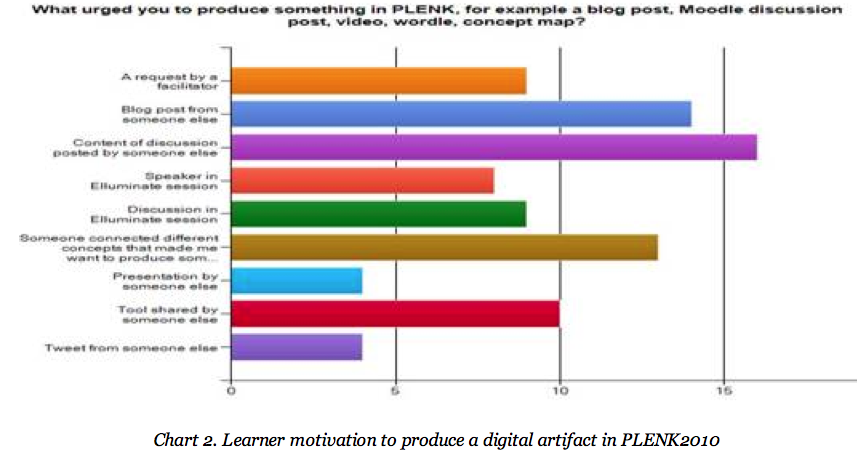
- 64% of respondents indicated that the content of a discussion post by someone else
- 56% a blog post from someone else were triggers for people to produce something themselves.
- 52% others would connect different concepts
- 40% others shared a particular Cloud-based tool
Links here
Highlights (11%)
Abstract This paper explores cloud computing and how it might advance learning and teaching, particularly in terms of social creativity and collaborative learning. We present a study of a Massive Open Online Course (MOOC) – a semi-autonomous learning environment mainly distributed on the cloud – in which Open Educational Resources were produced, researched and shared by participants worldwide. The objective of this research was to explore the level of importance of creativity for learning and then to closely investigate how this creativity might be fostered in such a ‘vast’ educational setting and what factors might be of importance to enhance creativity in open networked learning. Through the participants’ experiences, we discuss the various dynamics and profiles of the participants as they move from being consumers on the environment to becoming ‘producers’ and take creative steps in their learning. More importantly, we identify the elements of the course that need to be in place to encourage and support this move towards more effective creativity and learning. Finally further discussions and conclusions are presented. p. 1
This paper is interested in looking at the cloud as an accessible, scalable yet flexible on-demand form of computing, for any user with a network connection. It does this by defining the cloud with new perspectives on human cloud interaction, such as the point of contact where humans and clouds meet in order for exchange to take place, means that ease of use and accessibility are some of the key features to gain the attraction of a large number of users. p. 2
Warr (2007) brings these categories of creativity definitions together to form one more unified definition: ‘Creativity in design is the generation of ideas, which are a combination of two or more existing bundles of knowledge to produce a new knowledge structure. For this new generated idea to be considered creative it should be: novel – unusual or new to the mind in which it arose; and appropriate – conform to the characteristics of a desired/accepted solution. Such creative ideas may then be implemented and embodied in a creative product’ (Warr, 2007). p. 3
Creativity is the ability to come up with ideas or artifacts that are original, surprising, and valuable It has also been associated with a form of self-expression, which might be problematic in formal education as Runco, explains: By definition, self expression requires that the individual student him or herself decides what to express. That assumes that the individual himor herself first constructs an original idea. Otherwise it is not self-expression but the expression of someone else’s thinking. This is not as easy as it sounds. Educators tend to have groups of students in the classroom, and there is a curriculum–a plan, if you will. Original ideas and selfexpressions are often contrary to that plan. (Runco, 2008, p. 99.) p. 3
Fischer et al. (2005) believe that creative activity grows out of the relationship between individuals and their work, as well as from the interactions between individuals. In fact, Warr & O'Neill (2005) show how social creativity has the potential to support greater idea generation than individual creativity, i.e. real groups have the potential to generate more creative ideas than nominal groups by taking advantage of shared domains of knowledge. Much of our intelligence and creativity results from interaction and collaboration with other individuals as Csikszentmihalyi (1996) points out. Fischer et al. (2005) take it a little further when they state that individual creativity and social creativity do not represent a binary choice; they can and need to be integrated to for instance develop innovative solutions to complex design problems, such as how the different knowledge, expertise, and perspectives that exist among individuals provide opportunities to collaborate toward more creative and sustainable solutions. p. 3
PLENK2010 p. 4
If it is seen to be important to be creative producers on a course of this nature, based and distributed in the Cloud, it is also essential to find out what would tempt people into creating something. In the active participant survey it became clear that different people have different ideas on this. 64% of respondents indicated that the content of a discussion post by someone else and 56% a blog post from someone else were triggers for people to produce something themselves. It would also spur people into action when others would connect different concepts (52%), or shared a particular Cloud-based tool (40%) as shown in chart 2. In addition respondents highlighted issues such as the need for self reflection on what was being learnt from the various sources, inspiration from the connections the individual was making and the urge to share what was being learnt, in additional to examples of creative work by others. p. 8
References p. 10
Images
p. 8

