The challenges to connectivist learning on open online networks: Learning experiences during a massive open online course
| Kop, R. (2011). The challenges to connectivist learning on open online networks: Learning experiences during a massive open online course. The International Review of Research in Open and Distance Learning, 12(3), 19–38. |
BibTex
BibTex
@article{kop2011challenges,
author = {Kop, Rita},
date-added = {2011-07-22 08:02:40 +0000},
date-modified = {2012-04-08 16:28:14 +0000},
date-read = {2012-04-02 13:51:48 -0400},
journal = {The International Review of Research in Open and Distance Learning},
keywords = {1mooc},
number = {3},
pages = {19--38},
read = {1},
title = {The challenges to connectivist learning on open online networks: Learning experiences during a massive open online course},
volume = {12},
year = {2011},
bdsk-file-1 = {YnBsaXN0MDDUAQIDBAUIJidUJHRvcFgkb2JqZWN0c1gkdmVyc2lvblkkYXJjaGl2ZXLRBgdUcm9vdIABqAkKFRYXGyIjVSRudWxs0wsMDQ4RElpOUy5vYmplY3RzViRjbGFzc1dOUy5rZXlzog8QgASABoAHohMUgAKAA1lhbGlhc0RhdGFccmVsYXRpdmVQYXRo0hgMGRpXTlMuZGF0YU8RAYQAAAAAAYQAAgAAB1NTREhvbWUAAAAAAAAAAAAAAAAAAAAAAAAAAMl5T9hIKwAAANrWUhVrb3AyMDExY2hhbGxlbmdlcy5wZGYAAAAAAAAAAAAAAAAAAAAAAAAAAAAAAAAAAAAAAAAAAAAAAAAAAAAAAAAE9YP7yzHcmFBERiAAAAAAAAIAAgAACSAAAAAAAAAAAAAAAAAAAAAHQmliZGVzawAAEAAIAADJeZYoAAAAEQAIAADLMiLoAAAAAQAMANrWUgAXPTEAAZ9eAAIANFNTREhvbWU6VXNlcnM6AFN0aWFuOgBCaWJkZXNrOgBrb3AyMDExY2hhbGxlbmdlcy5wZGYADgAsABUAawBvAHAAMgAwADEAMQBjAGgAYQBsAGwAZQBuAGcAZQBzAC4AcABkAGYADwAQAAcAUwBTAEQASABvAG0AZQASAClVc2Vycy9TdGlhbi9iaWJkZXNrL2tvcDIwMTFjaGFsbGVuZ2VzLnBkZgAAEwABLwAAFQACAAz//wAAgAXSHB0eH1gkY2xhc3Nlc1okY2xhc3NuYW1lox8gIV1OU011dGFibGVEYXRhVk5TRGF0YVhOU09iamVjdF8QIy4uLy4uL2JpYmRlc2sva29wMjAxMWNoYWxsZW5nZXMucGRm0hwdJCWiJSFcTlNEaWN0aW9uYXJ5EgABhqBfEA9OU0tleWVkQXJjaGl2ZXIACAARABYAHwAoADIANQA6ADwARQBLAFIAXQBkAGwAbwBxAHMAdQB4AHoAfACGAJMAmACgAigCKgIvAjgCQwJHAlUCXAJlAosCkAKTAqACpQAAAAAAAAIBAAAAAAAAACgAAAAAAAAAAAAAAAAAAAK3}
}
Links here
Highlights (50%)
Abstract Self-directed learning on open online networks is now a possibility as communication and resources can be combined to create learning environments. But is it really? There are some challenges that might prevent learners from having a quality learning experience. This paper raises questions on levels of learner autonomy, presence, and critical literacies required in active connectivist learning. p. 1
In e-learning, two major traditions have been prevalent: one where connections are made with people and the other where they are made with resources (Weller, 2007). p. 1
These two distinct streams show a different emphasis: the first one has communication and interaction between people at the heart of learning, and the second focuses on engagement with resources. Of course these distinctions have always been present even in traditional classroom learning; there has always been a triangle between educator, learners, and course content, and depending on the p. 1
emphasis on one of the three, different teaching and learning strategies have been employed, related to the views of knowledge and learning. Since the 1980s, a fourth component has been added to the mix: the context in which people learn has had more emphasis in learning theories. Initially through the emergence of andragogy and experiential learning (Rogers, 2002) and communities of practice (Lave & Wenger, 2002), and more so, since the emergence and proliferation of information and communication technologies (ICTs) and their increasing encroachment on everyday life, boundaries between settings in which people learn and in which they use technology for other activities have blurred, and perspectives such as connectivism have emerged. p. 2
These different views of learning have at their heart different perspectives on knowledge development. The question of how people become more knowledgeable and reach understanding is an old one and has in past decades ranged from a process of transferring knowledge, or a process of aligning new knowledge with earlier experiences and knowledge, to a process of conceptualization, contextualization, and active construction of knowledge, or reflection in action. Some theorists emphasize the social aspect of learning, while others emphasize the personal one. p. 2
Sfard (1998) used two metaphors to clarify how people engage with knowledge while learning. The first one is of acquisition, where learners acquire knowledge, pre-packaged by educators, as in behaviourist and cognitive theories, which have been the norm in formal education settings for a long time. The other metaphor is one of participation, where learners are actively involved in a participatory endeavour. This metaphor relates to situated and social theories, such as social constructivism, action theory, and communities of practice. Participation in knowledge development activities is central in these theories. Connectivist developmental theories also fit in the latter category (Kop & Hill, 2008). p. 2
Siemens and Downes proposed teaching strategies without formal teaching and dynamics that allow the educator to have the role of facilitator or a total absenteeism from the learning process as they trialled in their connectivism courses (Siemens & Downes, 2008, 2009). The participation metaphor would be the most appropriate here as this type of learning event involves the active engagement of people with resources in communication with others, rather than the transfer of knowledge from educator to learner. Connectivists advocate a learning organization whereby there is not a body of knowledge to be transferred from educator to learner and where learning does not take place in a single environment; instead, knowledge is distributed across the Web, and people’s engagement with it constitutes learning. p. 2
It is envisaged that learning is enhanced by four major types of activity: 1) aggregation, access to and collection of a wide variety of resources to read, watch, or play; 2) relation, after reading, watching, or listening to some content, the learner might reflect and relate it to what he or she already knows or to earlier experiences; 3) creation, after this reflection and sense-making process, learners might create something of their own (i.e., a blog post, an account with a social 20 The Challenges to Connectivist Learning on Open Online Networks: Learning Experiences during a Massive Open Online Course Kop bookmarking site, a new entry in a Moodle discussion) using any service on the Internet, such as Flickr, Second Life, Yahoo Groups, Facebook, YouTube, iGoogle, NetVibes, etc.; 4) sharing, learners might share their work with others on the network. This participation in activities is seen to be vital to learning. p. 2
bookmarking site, a new entry in a Moodle discussion) using any service on the Internet, such as Flickr, Second Life, Yahoo Groups, Facebook, YouTube, iGoogle, NetVibes, etc.; 4) sharing, learners might share their work with others on the network. This participation in activities is seen to be vital to learning. p. 3
Downes (2009) claimed that people can create and use their own personal learning environment (PLE) and network to find information, make connections with knowledgeable others of their choice, and become actively engaged in the four activities suggested above to advance their learning. This paper will highlight three challenges to such an approach, critically assess the challenges of connectivist, informal, personal, and networked learning, and highlight learners’ perceptions and experiences related to these challenges on two connectivist courses. p. 3
Self-directed learning. p. 3
A connectivist learner has to be fairly autonomous to be able to learn independently, away from educational institutions, and to be engaged in aggregating, relating, creating, and sharing activities. Whereas in a traditional classroom/learning environment, the educator was responsible for providing information, organizing time, and structuring the learning activities and goals, in a networked environment the learner him or herself takes responsibility for this. Adult learners make choices about the level of control imposed by others on their learning, and Bouchard (2009) identified several factors that are significant. Some of these are related to motivation, initiative, and confidence; others are related to control over the learning activity or to issues of language and communication used in the learning and teaching processes. He also highlighted issues related to the value of learning to learners’ lives. p. 3
People learning on an informal network will choose the subject they want to learn about or the activity they want to engage in, but in a connectivist environment they have to make other choices as well. For instance, they have to manage time, set their own learning goals, find resources, and try out new tools and make them work. These choices would in a formal classroom be the instructor’s responsibility, but are in an autonomous learning environment linked to tasks that the learner will carry out independently, which could be problematic. The availability of particular semiotic features, such as multimedia, might motivate the learner to take on a learning project. Similarly, the language and multimedia used could play an important role in who would be engaged online and who would not. These are related to presence, which will be discussed as another challenge later on. p. 3
The motivational factors in a traditional adult education classroom are very important in learners either participating in learning or not. If confidence levels are low, it is not likely that a person will take up connectivist learning. The technology itself, or the activity the learner is taking on, p. 3
could form a barrier and will have to be engaging and interesting enough for the learner to work his or her way through the problems that will undoubtedly come up during the learning journey. A personal learning environment that would aid the learner in this endeavour could play a positive role (Kop, 2010). A big difference between learning informally, both away from an educational institution and within one, is the level of intrinsic motivation that the learner has. There is clearly a much higher level of motivation that must stem from the self in an informal learning situation as some of the motivational factors in a formal context would more often than not be external, for example getting a qualification or learning a skill for the workplace. p. 4
Presence. p. 4
Intrinsic motivation has an affective dimension, and the literature highlighting the importance of affective aspects to networked learning is growing (Picard et al., 2004; Zaharias & Poylymenakou, 2009). Other issues related to motivation have been highlighted by Lombard and Ditton (1997) and by Dron and Anderson (2007) in the form of “presence.” They argue that the closer the ties between the people involved, the higher the level of presence and the higher the level of engagement in the learning activity. p. 4
Lombard and Ditton (1997) emphasised as a main aspect of presence the illusion of nonmediation. In other words, there is a high level of presence when a participant in an online activity experiences the activity as if it were taking place in real life, without the mediation of the computer. Garrison, Anderson, and Archer (2000) argued that deep and meaningful learning results if three forms of presence play a role in education: “cognitive presence,” which ensures a certain level of depth in the educational process; “social presence”; and, in a formal educational environment, “teacher presence.” In PLE-based connectivist learning, the teacher would not necessarily be present, but one could argue that there are knowledgeable others on the Web who would take on that teacher role to a certain extent. For people to take an active, participative, and critical role in connectivist learning, they need communication and collaboration with and feedback from others, the same as in classroom-based learning. p. 4
The higher the level of presence, the higher the level of involvement in the online activity, which makes the level of presence in connectivist learning important as it should enhance the depth of learning and subsequently the learning experience. p. 4
Another important factor is people’s level of critical literacies. The lower the presence of others in the learning environment, supporting and providing scaffolds for learning, the higher the need for particular capabilities in the self-directed learner him or herself to find resources and information, create something with these, and push something out onto the Web for others to engage with and learn from. p. 4
Critical literacies. p. 4
It has been highlighted by several people in recent months that there are literacies critical to connectivist learning. Downes (2009) speaks of critical literacies, others of 21st century skills (Partnership for 21st Century Skills, 2009). To be able to make the most of a learning environment that is positioned outside the sphere of formal education and that fosters active engagement in p. 4
learning activities, learners need different competencies and abilities to feel comfortable. There is no overarching educator present to guide learners, to challenge their ideas and beliefs, or to help in aggregating information and in understanding the media and the way they represent information. The onus is on the learners themselves to make these judgments, to validate information and knowledge, and to find knowledgeable others who can help them. Moreover, the new learning environment requires learners to be active in their learning by editing and producing information themselves in a variety of formats and by communicating and collaborating with others in new ways. p. 5
A major concern is that because people need to aggregate information and resources autonomously, either by (RSS) feeds or through the use of human filters, they require a high level of critical analysis skills to be able to do so effectively. p. 5
Research shows that the Internet and the Web are not value-free and do not act as nonhierarchical networks (Barabasi, 2003; Mejias, 2009; Bouchard, 2010). Barabasi’s research shows that power relations prevent network “surfers” from having access to all information at the same level: p. 5
The most intriguing result of our Web-mapping project was the complete absence of democracy, fairness, and egalitarian values on the Web. We learned that the topology of the Web prevents us from seeing anything but a mere handful of the billion documents out there. (Barabasi, 2003, p. 56) p. 5
It becomes clear that if people are learning on these vast, disparate information networks, they need the ability to understand the intricacies of the networks in order to negotiate their structures. The need for high levels of critical capabilities, in addition to knowledge of the sub-systems of the Web, is important in order to be able to access the information and resources that are relevant and required. It should be questioned if all adult learners are able to do so without help from knowledgeable others. These knowledgeable others are their information brokers, and Boyd (2010) emphasized problems with free access to information even when it comes to these people. She states that the information brokers—rather than the creators of the Web content themselves— have the power, which means that an interpretation of the resources takes place. These free agents do not have a responsibility or an obligation to provide a critical point of view. One could argue that the way in which Twitter is developing might overcome this, as it is now possible to fairly simply aggregate information from a high number of people (Rusbridger, 2010). p. 5
Researching Connectivist MOOCs for the Design and Development of a PLE p. 6
The three challenges to connectivist learning highlighted previously are 1) the need for critical literacies and the power relations on the network; 2) the level of learner autonomy; and 3) the level of presence. These can all be overcome by what has in traditional formal educational practice been seen as crucial to teaching and learning: social interaction. p. 6
Carroll, Kop, and Woodward (2008) see as the crux to engaging learners in an online environment the creation of a place where people feel comfortable, trusted, and valued. The task would be to move toward a space that aggregates content and to imagine it as a community, a place where dialogue happens, where people feel comfortable and where interactions and content can be easily accessed and engaged with, a place where the personal meets the social with the specific purpose of learning. p. 6
The National Research Council of Canada’s Institute for Information Technology is currently engaged in the research and development of such a structure, a PLE named Plearn, by using a design-based research approach. The research investigates the development of a pedagogical platform that could support networked learning in all its facets outside formal education by combining (intelligent) information streams and editor and publishing tools and by providing scaffolding, communication, and support structures for learners. p. 6
The summer course was Critical Literacies (CritLit) (377 participants) and the fall course was Personal Learning Environments, Networks, and Knowledge (PLENK) (1610 participants). p. 6
One of the research questions was whether the four activities highlighted as being crucial to learning (aggregating, relating, creating, and sharing) were actually as important as envisaged by the course planners. Another was to see whether the challenges identified from the literature (critical literacies, presence, and self-directed learning) were actually perceived as being as problematic as identified in the literature. p. 7
Surveys were conducted, consisting of a mixture of quantitative and qualitative questions, while observations, discourse analysis, and secondary data analysis in the form of learning analytics were also carried out to capture data and analyse it p. 7
mixed-methods approach p. 7
A focus group of lurkers was also conducted as it was impossible to gain an understanding of their experiences from activities on the learning environment because they were invisible to the observer. p. 7
Data were collected on the Moodle course forums and wiki, the participant blogs, and Twitter posts, and on any other online activities using the #PLENK2010 tag. p. 7
Participants indicated that course resources such as the Daily newsletter, the Moodle, and the wiki were enough to make them understand what the course was all about before starting p. 8
During the first few weeks of the PLENK course, however, it was clear that especially participants who had not engaged in a p. 8
MOOC before found its distributed nature confusing and the high level of resources and contributions by participants overwhelming. In the words of one of the participants, p. 9
Facilitators provided support by producing videos on how applications and tools worked and by creating posts in the Moodle discussion area about the impossibility of reading and viewing all resources; this helped the learners. One of the participants also started a discussion thread with scaffolds and helpful hints that had 106 replies and that led to the participants’ development of a tools wiki and several groups outside the course learning environment (i.e., on Facebook, Friendfeed, & Flickr). p. 9
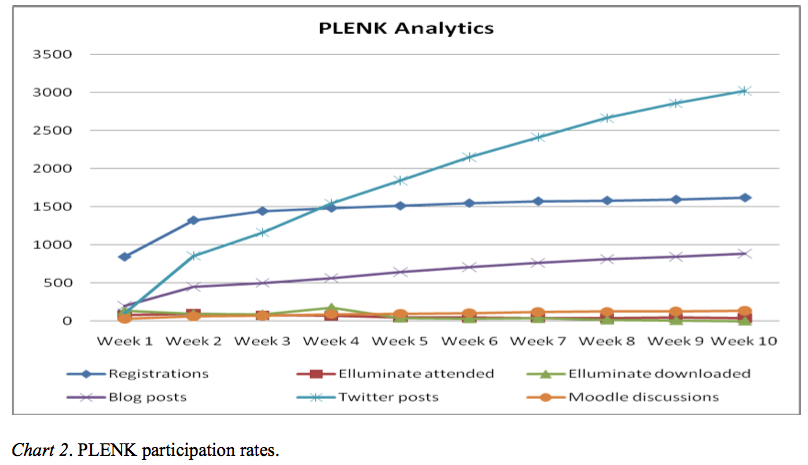
about 40–60 individuals on average contributed actively to the course on a regular basis, while others’ visible participation rate was much lower. p. 10
Not all participants contributed in a visibly active way. There was a high number of people “following the pulse of the event” rather than getting involved in producing digital artefacts such as blog posts or videos. They preferred to read, view, or dip in and out of the conversation, as this participant’s post shows: p. 11
My lurking provided me with a wealth of information and education into MOOC, PLE, PLN, PLC, and how information and knowledge will be shared by all—teachers, students, kids, adults. . . . PLENK has provided me an opportunity to listen to the experts. . .I come in and read the posts that are of most interest to me. I wanted to know how it affects my teaching efforts, my learning, and how to share this with others. The discussions did give me a clear idea of how they are used by different people. . .Thank you for allowing lurkers, who may not know enough to post, but have learned a great deal in just lurking. p. 11
yep let’s condemn modes of learning that are not conforming to some arbitrary personal standard, remain as ignorant as possible as to the forms & variations & motivations of those modes, hand out “names” & pronounce judgment - failure! Enforced active, energetic participation shall be the rule. Nothing good has ever come from someone quietly observing & going off to have a good think about it all. p. 12
And another participant on power relations in a social setting that might be detrimental to expressing oneself said, If one is highly socially sensitive and he or she feels included, accepted, and empowered, does that necessarily mean that participation in a collaborative work will result in creative and/or complex problem-solving and thinking? If one feels threatened, he or she might flee or fight back… or not. For example, one might decide to ignore provocation, reserve judgment, ask for clarification, take on the point of view of the other so as to understand the argument better, or just let that pony run and get on with life… p. 13
Significant benefit to course participants of creating PLE, building network etc - not obviously visible to other participants p. 13
We should also not underestimate the influence of people’s mother tongues on confidence levels in expressing themselves; several remarks were made about this. English was the dominant language on PLENK, although a Spanish-speaking and a German-language group were set up, and especially the Spanish group was visible in their own language on Twitter, in blog posts, and bilingually in the forums. Around two thirds of participants came from English-speaking countries, while the others came from countries where another language was spoken. p. 13
One learner suggested a buddy system to enhance presence: p. 14
There are some competencies, abilities, and skills required to thrive in a complex learning environment. People need the critical ability to not only use network resources, but also to look at them critically in order to “appropriate them and redesign them,” as one of the learners stressed. p. 15
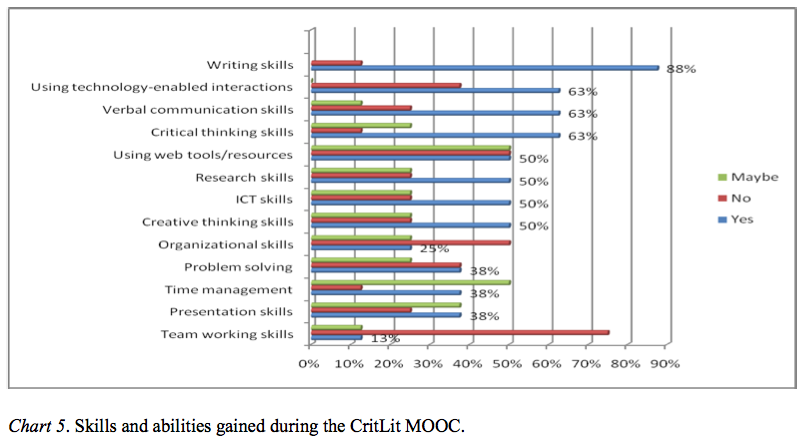
It is interesting to see here that the skills related to organizing and managing learning, which one would expect to be very important in self-directed learning, scored relatively low but that capacities for critical thinking, collaboration, research, and creativity—and especially writing— scored high. p. 16
It became clear during the research that the four activities mentioned in the introduction— aggregation, relation, creation, and sharing—were not achieved by the majority of participants. They mostly felt happy to aggregate, relate, and share resources, but only a minority of 40–60 PLENK participants were engaged in the creation of digital artefacts, such as blog posts and videos, and in the distribution of these. It seems that people needed time to feel comfortable and confident to get involved in this type of activity, while it also seems that people needed some time to digest readings and resources that were published and produced during the course before being able to get involved in this active production process themselves. Early indications from this preliminary research were that people were still learning without this type of activity. p. 17
Further research and analysis will be conducted to find out if this “creation” stage is really necessary to enhance learning in a connectivist learning environment and exactly how the challenges identified with connectivist learning might best be overcome. p. 17
Bouchard, P. (2009, June). Some factors to consider when designing semi-autonomous learning environments. Electronic Journal of e-Learning, 7(2), 93–100. Retrieved from http://www.ejel.org/Volume-7/v7-i2/v7-i2-art-2.htm p. 18
Carroll, F., Kop, R., & Woodward, C. (2008, November). Sowing the seeds of learner autonomy: Transforming the VLE into a third place through the use of Web 2.0 tools. In ECELEuropean Conference on e-Learning (pp. 152–160). Cyprus: University of Cyprus. p. 18
Conole, G., de Laat, M., Dillon, T., & Darby, J. (2008). Disruptive technologies, pedagogical innovation: What’s new? Findings from an in-depth study of students’ use and perception of technology. Computers & Education, 50, 511– 524. p. 18
Dron, J., & Anderson, T. (2007). Collectives, networks, and groups in social software for elearning. World Conference on E-Learning in Corporate, Government, Healthcare, and Higher Education (ELEARN) 2007, Quebec City, Quebec, Canada. p. 18
Garrison, D. R., Anderson, T., & Archer, W. (2000). Critical inquiry in a text-based environment: Computer conferencing in higher education. Internet and Higher Education, 2(2-3), 87– 105. p. 18
Lombard, M., & Ditton, T. (1997, September). At the heart of it all: The concept of presence. Journal of Computer-Mediated Communication, 3(2). p. 19
Picard, R., Papert, S., Bender, W., Blumberg, B., Breazeal, C., Cavallo, D., Machover, T., Resnick, M., Roy, D., & Strohecker, C. (2004). Affective learning–a manifesto. BT Technology Journal, 22(4), 253–269. p. 19
Rogers, A. (2002). Learning and adult education. In R. Harrison et al. (Eds.), Supporting lifelong learning, Volume 1, Perspectives on learning (pp. 8–24). London: Routledge Falmer. p. 19
Weller, M. (2007). Virtual learning environments: Using, choosing, and developing your VLE. Abingdon: Routledge. p. 19
Images
p. 10
p. 16

