The technological dimension of a massive open online course: The case of the CCK08 course tools

| Fini, A. (2009). The technological dimension of a massive open online course: The case of the CCK08 course tools. The International Review of Research in Open and Distance Learning, 10(5), Article–10. |
BibTex
BibTex
@article{fini2009technological,
author = {Fini, Antonio},
date-added = {2011-07-22 07:54:16 +0000},
date-modified = {2013-01-14 20:47:59 +0000},
date-read = {2012-04-02 15:54:53 -0400},
journal = {The International Review of Research in Open and Distance Learning},
keywords = {1mooc},
notes = {1},
number = {5},
oa-url = {http://www.irrodl.org/index.php/irrodl/article/view/643/1410},
pages = {Article--10},
read = {1},
title = {The technological dimension of a massive open online course: The case of the CCK08 course tools},
volume = {10},
year = {2009},
bdsk-file-1 = {YnBsaXN0MDDUAQIDBAUIJidUJHRvcFgkb2JqZWN0c1gkdmVyc2lvblkkYXJjaGl2ZXLRBgdUcm9vdIABqAkKFRYXGyIjVSRudWxs0wsMDQ4RElpOUy5vYmplY3RzViRjbGFzc1dOUy5rZXlzog8QgASABoAHohMUgAKAA1lhbGlhc0RhdGFccmVsYXRpdmVQYXRo0hgMGRpXTlMuZGF0YU8RAZQAAAAAAZQAAgAAB1NTREhvbWUAAAAAAAAAAAAAAAAAAAAAAAAAAMl5T9hIKwAAANrWUhlmaW5pMjAwOXRlY2hub2xvZ2ljYWwucGRmAAAAAAAAAAAAAAAAAAAAAAAAAAAAAAAAAAAAAAAAAAAAAAAAAAAGaNdky9b/2lBERiBDQVJPAAIAAgAACSAAAAAAAAAAAAAAAAAAAAAHQmliZGVzawAAEAAIAADJeZYoAAAAEQAIAADL1zgaAAAAAQAMANrWUgAXPTEAAZ9eAAIAOFNTREhvbWU6VXNlcnM6AFN0aWFuOgBCaWJkZXNrOgBmaW5pMjAwOXRlY2hub2xvZ2ljYWwucGRmAA4ANAAZAGYAaQBuAGkAMgAwADAAOQB0AGUAYwBoAG4AbwBsAG8AZwBpAGMAYQBsAC4AcABkAGYADwAQAAcAUwBTAEQASABvAG0AZQASAC1Vc2Vycy9TdGlhbi9iaWJkZXNrL2ZpbmkyMDA5dGVjaG5vbG9naWNhbC5wZGYAABMAAS8AABUAAgAM//8AAIAF0hwdHh9YJGNsYXNzZXNaJGNsYXNzbmFtZaMfICFdTlNNdXRhYmxlRGF0YVZOU0RhdGFYTlNPYmplY3RfECcuLi8uLi9iaWJkZXNrL2ZpbmkyMDA5dGVjaG5vbG9naWNhbC5wZGbSHB0kJaIlIVxOU0RpY3Rpb25hcnkSAAGGoF8QD05TS2V5ZWRBcmNoaXZlcgAIABEAFgAfACgAMgA1ADoAPABFAEsAUgBdAGQAbABvAHEAcwB1AHgAegB8AIYAkwCYAKACOAI6Aj8CSAJTAlcCZQJsAnUCnwKkAqcCtAK5AAAAAAAAAgEAAAAAAAAAKAAAAAAAAAAAAAAAAAAAAss=}
}
Key ideas
One of the first papers(?) about MOOCs, referring to CCK08. Based on a single survey (n=83).
Some very useful concepts:
- multi-tool learning environments
- situating open courses with OER
- Personal Knowledge Management
- motivation/time constraints in formal and informal online courses
- different personal motivations for success
Multi-tool learning environments
From the criticism of VLEs and other institution-managed platforms (Wilson, 2005) through the debate about personal learning environments (PLEs) (Attwell, 2007) to the concept of “loosely coupled teaching” (Leslie, 2007) there has been a shift from centralized, specialized, institutionally owned systems (VLE, LMS) towards distributed, general-purpose, user-centered, and user-owned systems, such as social software tools.
In the context of informal education, the integration of multiple and heterogeneous environments and tools may represent the starting point of a learner's knowledge construction quest. Many people are using blogs, wikis, social networks, messaging systems, etc. The underlying idea is that people are comfortable with tools they consider to be their own, and they may wish to continue to use them when engaged in learning activities. Therefore it becomes important to understand the extent to which multi-tool environments are effective in supporting education and learning and to derive some guidelines on their integration in order to optimize their effectiveness for learning.
Anderson (2008) proposes a model in which the “affordances of the net” play a key role and where it is possible to include the many different forms of teaching and learning supported by present web technologies, with an outlook for future semantic web capabilities.
This is an important point which I should investigate further - ways of articulating why enabling both a diversity of tools, and tools controlled by the learner him/herself, is important (and subsequently why there needs to be ways of "bringing it all back together again")
Tool use
In the literature, there are studies (for example, Liu et al., 2009) and guidelines for the effective use of VLEs (Weller, 2007) as well as comprehensive reviews of technology uses for education (for example, Mason & Rennie, 2007). The UK JISC published a study on the effective use of social software to support student learning and engagement (JISC, 2009)
Clarebout and Elen (2006) carried out a meta-analysis of research about the use of different tools in computer-based learning
Conceptualization of open courses (OOCs) as form of OER
As Siemens (2009) says, they are examples of shifting from a content-centered model towards “socialization as information objects.” An OOC can be attended potentially by a large number of students, all over the world, provided that there are sustainability plans for the instructors. For example, it is unreasonable to think that a teacher is able to evaluate hundreds or thousands of blog posts weekly. Thus the real potential of an OOC is to be found in the emergence of learning networks among participants in a many-to-many relationship, rather than the traditional one-to-many model of interactions between a teacher and his or her students.
Personal knowledge management
More recently, the idea of a “networked lifelong learner” is offered by studies on personal knowledge management (PKM). Recent literature connects learning-to-learn competencies with technologies under the umbrella of this term (Cigognini et al., 2009) and identifies the related required skills as a multi-faceted set of abilities (Martin, 2006), including digital literacy, information literacy, and the ability to effectively use social software to build one‟s own learning environment (Pettenati et al., 2009). Social and relational aspects of the knowing knowledge attitude in the connectivistic framework (Siemens 2004, 2006) inevitably highlight that mastering technology is but one among many complex skills
Definitively something I need to look up more literature on
Motivation/lack of time
Useful note that most writing about motivation and engagement in online learning has been concerned with formal courses
Although formal attendance seemed to be the main driver for completing assignments and the course, the main reason for not completing the course was a lack of time. Mostly by informal students - it seems that informal learning experiences compete with other activities for personal time allotment. Learners, in the absence of a stronger motivation, attend only partially.
Literature on engagement in distance higher education is mainly related to formal courses (for example, Angelino & Natvig, 2009).
Nash (2005) quotes several studies in which authors emphasize the impact of factors external to the academic environment to explain distance learners‟ drop-out rates. Ostman and Wagner (as cited in Nash, 2005) reported as early as 1987 a “lack of time” as the most commonly quoted reason by distance learners for course noncompletion. In the CCK08 case, it seems that the impact of technology was low since time still appears as the most important factor. Other authors, such as Miller, Rainer, and Corely (as cited in Nash, 2005), have analyzed the relationship between time and computer literacy in student attrition. p. 9
Different personal definitions of success
Nor can we consider participants who did not complete the course to be drop-outs. Because they have different aims and motivations, perhaps they do not consider course incompletion to be a defeat. Further investigation would be necessary to better understand if the very notion of a course really fits open course initiatives.
Filtering and the Daily
The daily was universally well-liked, however only the voice of one person - suggests in the future enhancing it with more voices. Underlines need for aggregation, and limiting information overflow.
Links here
Highlights (20%)
In 2008, a new term emerged in the already crowded e-learning landscape: MOOC, or massive open online course. Lifelong learners can now use various tools to build and manage their own learning networks, and MOOCs may provide opportunities to test such networks. This paper focuses on the technological aspects of one MOOC, the Connectivism and Connective Knowledge (CCK08) course, in order to investigate lifelong learners‟ attitudes towards learning network technologies. The research framework is represented by three perspectives: (a) lifelong learning in relation to open education, with a focus on the effective use of learning tools; (b) the more recent personal knowledge management (PKM) skills approach; and © the usability of web-based learning tools. p. 1
Findings from a survey of CCK08 participants show that the course attracted adult, informal learners, who were not concerned about course completion. Time constraints, language barriers, and ICT skills affected the participants‟ choice of tools; for example, learners favoured the passive, time-saving mailing list over interactive, time-consuming discussions forums. Some recommendations for future MOOCs include highlighting the purpose of the tools (e.g., skillbuilding) and stating clearly that the learners can choose their preferred tools. Further research on sustainability and facilitator workload should be conducted to determine the cost and effectiveness of MOOCs. Investigation is also necessary to understand MOOC participant profiles as they relate to course outcomes and retention and whether terms such as course and attrition are appropriate in this context. p. 1
Multi-tool learning environments are gaining momentum. From the criticism of VLEs and other institution-managed platforms (Wilson, 2005) through the debate about personal learning environments (PLEs) (Attwell, 2007) to the concept of “loosely coupled teaching” (Leslie, 2007), p. 1
there has been a shift from centralized, specialized, institutionally owned systems (VLE, LMS) towards distributed, general-purpose, user-centered, and user-owned systems, such as social software tools. In the context of informal education, the integration of multiple and heterogeneous environments and tools may represent the starting point of a learner‟s knowledge construction quest. Many people are using blogs, wikis, social networks, messaging systems, etc. The underlying idea is that people are comfortable with tools they consider to be their own, and they may wish to continue to use them when engaged in learning activities. Therefore it becomes important to understand the extent to which multi-tool environments are effective in supporting education and learning and to derive some guidelines on their integration in order to optimize their effectiveness for learning. p. 2
Connectivism and Connective Knowledge (CCK08) p. 2
Even though the course assignments required only the use of a personal blog and a tool to build concept maps, during the course more than 12 different tools and technological environments were used, from LMSs (Moodle) to 3D environments (Second Life). p. 2
Anderson (2008) proposes a model in which the “affordances of the net” play a key role and where it is possible to include the many different forms of teaching and learning supported by present web technologies, with an outlook for future semantic web capabilities. p. 3
The CCK08 is not the first open online course (OOC). For example, in 2007/08 the Social Media Open Education course by Alec Couros and the Introduction to Open Education course by David Wiley had international relevance (Fini et al., 2008). p. 3
Open online courses may be considered to be a special type of OER, which solves the problem of the lack of interaction that is typical of most OER initiatives. While OERs are merely content, OOCs are live courses, which include direct participation of teachers and rich and valuable interaction among participants. p. 3
As Siemens (2009) says, they are examples of shifting from a content-centered model towards “socialization as information objects.” An OOC can be attended potentially by a large number of students, all over the world, provided that there are sustainability plans for the instructors. For example, it is unreasonable to think that a teacher is able to evaluate hundreds or thousands of blog posts weekly. Thus the real potential of an OOC is to be found in the emergence of learning networks among participants in a many-to-many relationship, rather than the traditional one-to-many model of interactions between a teacher and his or her students. p. 3
Very useful with both definition of emerging multi-platform open courses, and situating open courses within framework of OER. p. 3
In the literature, there are studies (for example, Liu et al., 2009) and guidelines for the effective use of VLEs (Weller, 2007) as well as comprehensive reviews of technology uses for education (for example, Mason & Rennie, 2007). The UK JISC published a study on the effective use of social software to support student learning and engagement (JISC, 2009) p. 3
Clarebout and Elen (2006) carried out a meta-analysis of research about the use of different tools in computer-based learning p. 3
More recently, the idea of a “networked lifelong learner” is offered by studies on personal knowledge management (PKM). Recent literature connects learning-to-learn competencies with technologies under the umbrella of this term (Cigognini et al., 2009) and identifies the related required skills as a multi-faceted set of abilities (Martin, 2006), including digital literacy, information literacy, and the ability to effectively use social software to build one‟s own learning environment (Pettenati et al., 2009). Social and relational aspects of the knowing knowledge attitude in the connectivistic framework (Siemens 2004, 2006) inevitably highlight that mastering technology is but one among many complex skills. p. 3
Personal knowledge management as a field is something I need to look into. p. 3
1) Personal information: gender, age, nationality, mother tongue, level of proficiency in English, level of technological skills, profession; 2) General information about the CCK08 course: motivation, attendance type, completion, opinions about certification; 2a) General opinions about the toolset used in the course (most and least useful tools, level of comfort with the global toolset); 3) Detailed questions on each tool used in the course (frequency of use during the course, relevance, and comments). In some cases, questions were added. p. 4
Eighty-three people completed the survey p. 5
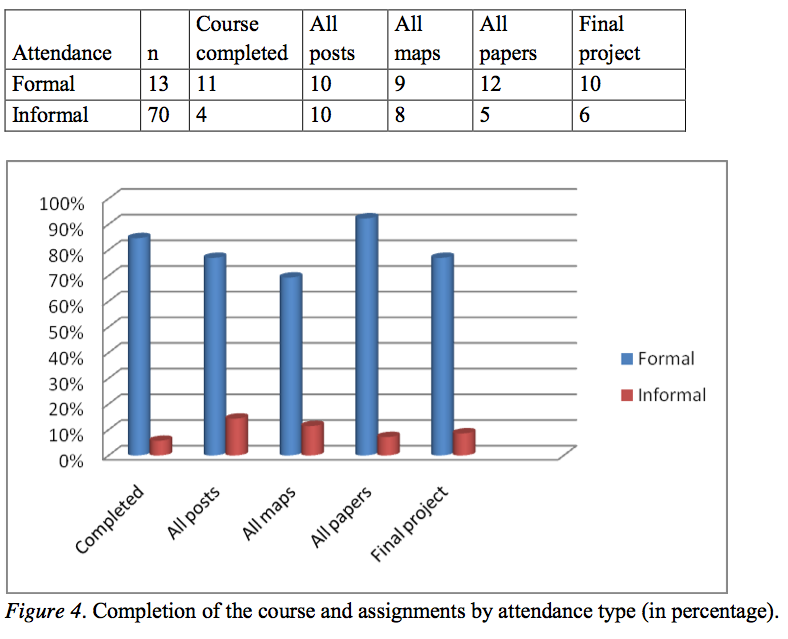
Literature on engagement in distance higher education is mainly related to  Attendance n Course completed All posts  All maps  All papers  Final project  Formal 13 11 10  9  12 10 Informal 70 4 10  8 5 6  p. 8
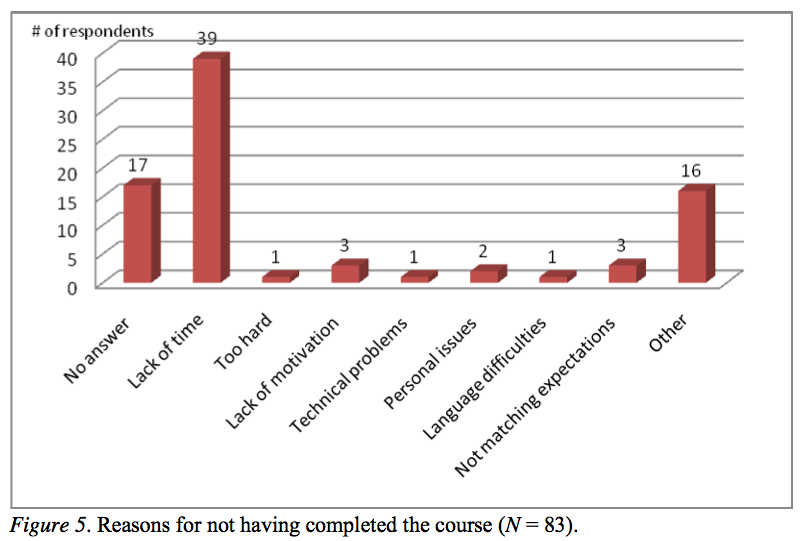
Although formal attendance seemed to be the main driver for completing assignments and the course, the main reason for not completing the course was a lack of time, as shown in Figure 5. Since this reason was reported mostly by informal students (it was selected by only one formal student who did not complete the course; the others reported that they obtained an extension), it seems that informal learning experiences such as the CCK08 course compete with other activities for personal time allotment. Learners, in the absence of a stronger motivation, attend only partially. p. 8
formal courses (for example, Angelino & Natvig, 2009). Nash (2005) quotes several studies in which authors emphasize the impact of factors external to the academic environment to explain distance learners‟ drop-out rates. Ostman and Wagner (as cited in Nash, 2005) reported as early as 1987 a “lack of time” as the most commonly quoted reason by distance learners for course noncompletion. In the CCK08 case, it seems that the impact of technology was low since time still appears as the most important factor. Other authors, such as Miller, Rainer, and Corely (as cited in Nash, 2005), have analyzed the relationship between time and computer literacy in student attrition. p. 9
Nor can we consider participants who did not complete the course to be drop-outs. Because they have different aims and motivations, perhaps they do not consider course incompletion to be a defeat. Further investigation would be necessary to better understand if the very notion of a course really fits open course initiatives. p. 9
Table 5 shows the results concerning the most useful tool (N = 73). The preferences converge on the most paradigmatic tools: the Daily (the “good old” mailing list) is at the top, followed by Moodle (a “traditional” LMS), and the wiki and Elluminate (a web conferencing system). It is quite surprising that a Web 1.0 tool, a mailing list, is the most preferred instrument. Some excerpts from the comments on the Daily can help us to better understand this preference: “gives a broad vision of the course,” “was a useful filter,” “gave me guidance,” “a good starting point to locate relevant information and viewpoints,” “concise and practical,” “useful for rapid update.” This tool seems to have high relevance for adult learners who are worried about time and information-filtering. In a MOOC, it is nearly impossible to read all of the posts and the contributions, so many participants choose to delegate effective filtering to the instructor. The Daily provided the “highlights” of the course by email, without any further intervention. In this case, the instructor performed the role of an information broker, not producing content but collecting, selecting, and proposing relevant (in his/her opinion) resources. p. 11
There is also some criticism of this tool; for example, some people commented, “it‟s the instructor‟s list of the course,” “the prejudices of the editor(s) were sometimes evident,” “steering only to certain sources,” and “it led to a kind of „gold star‟ mentality.” p. 12
Apart from the Daily, people differed strongly about which tools were useful or not p. 16
Idea of having a daily which was filtered by more voices - underlines importance of curation and selection, limiting information overflow. p. 17
Images
p. 8
p. 9

