Self-Directed Professionals & Autodidactic Choice

| Bouchard, P. (1994). Self-Directed Professionals & Autodidactic Choice. In H. Long & Associates (Eds.), (Tran.), New Ideas about Self-Directed Learning (121–137). University Press. |
BibTex
BibTex
@incollection{bouchard1994self-directed,
author = {Bouchard, Paul},
booktitle = {New Ideas about Self-Directed Learning},
date-added = {2012-03-11 13:05:39 +0000},
date-modified = {2013-01-14 21:10:19 +0000},
date-read = {2012-04-04 11:37:32 -0400},
editor = {Long, H. and Associates},
keywords = {self-regulated learning},
location = {Oklahoma, OK : Oklahoma},
notes = {1},
oa-url = {https://docs.google.com/file/d/0B5DH9rrvgAlgMWIyNmQyZmMtZmIyOS00ZjJiLWExOTUtMGRiM2VjMmY2NTFi/edit?authkey=CLzhnPwN&hl=en#},
pages = {121–137},
publisher = {University Press},
read = {1},
title = {Self-Directed Professionals & Autodidactic Choice},
year = {1994},
bdsk-file-1 = {YnBsaXN0MDDUAQIDBAUIJidUJHRvcFgkb2JqZWN0c1gkdmVyc2lvblkkYXJjaGl2ZXLRBgdUcm9vdIABqAkKFRYXGyIjVSRudWxs0wsMDQ4RElpOUy5vYmplY3RzViRjbGFzc1dOUy5rZXlzog8QgASABoAHohMUgAKAA1lhbGlhc0RhdGFccmVsYXRpdmVQYXRo0hgMGRpXTlMuZGF0YU8RAaQAAAAAAaQAAgAAB1NTREhvbWUAAAAAAAAAAAAAAAAAAAAAAAAAAMl5T9hIKwAAANrWUh1ib3VjaGFyZDE5OTRzZWxmLWRpcmVjdGVkLnBkZgAAAAAAAAAAAAAAAAAAAAAAAAAAAAAAAAAAAAAAAAAAAAAGZ6Wdy9bu0FBERiBDQVJPAAIAAgAACSAAAAAAAAAAAAAAAAAAAAAHQmliZGVzawAAEAAIAADJeZYoAAAAEQAIAADL1ycQAAAAAQAMANrWUgAXPTEAAZ9eAAIAPFNTREhvbWU6VXNlcnM6AFN0aWFuOgBCaWJkZXNrOgBib3VjaGFyZDE5OTRzZWxmLWRpcmVjdGVkLnBkZgAOADwAHQBiAG8AdQBjAGgAYQByAGQAMQA5ADkANABzAGUAbABmAC0AZABpAHIAZQBjAHQAZQBkAC4AcABkAGYADwAQAAcAUwBTAEQASABvAG0AZQASADFVc2Vycy9TdGlhbi9iaWJkZXNrL2JvdWNoYXJkMTk5NHNlbGYtZGlyZWN0ZWQucGRmAAATAAEvAAAVAAIADP//AACABdIcHR4fWCRjbGFzc2VzWiRjbGFzc25hbWWjHyAhXU5TTXV0YWJsZURhdGFWTlNEYXRhWE5TT2JqZWN0XxArLi4vLi4vYmliZGVzay9ib3VjaGFyZDE5OTRzZWxmLWRpcmVjdGVkLnBkZtIcHSQloiUhXE5TRGljdGlvbmFyeRIAAYagXxAPTlNLZXllZEFyY2hpdmVyAAgAEQAWAB8AKAAyADUAOgA8AEUASwBSAF0AZABsAG8AcQBzAHUAeAB6AHwAhgCTAJgAoAJIAkoCTwJYAmMCZwJ1AnwChQKzArgCuwLIAs0AAAAAAAACAQAAAAAAAAAoAAAAAAAAAAAAAAAAAAAC3w==}
}
Design of study
12 high-performing self-taught adults, very similar to study described in Bouchard, 1996Bouchard, P. (1996). A Study of Self-Directed Professionals of High Attainment. and Bouchard, 1996Bouchard, P. (1996). Towards an etiological model of self-directed professional development. Social Sciences and Humanities Research Council of Canada: Ottawa, Ont.
Opposing self-directed learners to other-directed learners, rather than non-learners.
Not sure I follow this argument - he is only interested in why someone who wants to study would choose SDL, whereas to most adults, who might want to study for interest, it's informal learning or nothing... I guess this is still an interesting, just a _different_ question
"Choice"
Even we ourselves cannot access the “true” reasons for making a choice - we might reformulate an explanation after the fact. However, this explanation might be important for us in how we see what we just did, and our future actions.
Human beings, in fact, “choose” the causes for their own behavior among a vast array of possible determinants every time they decide on a future course of action, or explain “why” they did something in the past. This is supported by Bandura's (1977, p. 39) contention that “self-generated influences operate deterministically on behavior in the same way as external sources”. These “chosen causes” vary widely from one individual to the next.
The only way, therefore, to have a clue as to the reasons behind someone's motives and purposes is to ask that person directly. Furthermore, the attribution by individuals of the “causes” of their behavior may well rank, in its own right, among the most influential determinants of that very behavior (Weiner, 1986). Perhaps this is another reason the question, “Why self-directed learners choose SDL” remains unanswered: it is basically a phenomenological question, and in this sense defies empirical investigation.
The question, “Why do some people choose to pursue their learning goals in a self-directed manner?”, supposes that it is possible to explain the reasons why anyone, indeed, chooses to do anything at all in the first place.
Three explanations
Three possible explanations:
Contingency control
(Ref Skinner) - behaviorist, engage in learning project because they consciously expect to derive some benefit from their learning.
Psychodynamic paradigm behaviour
Response to needs, inner impulses and innate instincts (Freudian). Linked to “individual's propensity for self-learning”
Systemic paradigm
Life field (Kurt Lewin), circumstances surrounding the events in a person's life at any given time.
Compare
Compared to three listed in Bouchard, 1996Bouchard, P. (1996). A Study of Self-Directed Professionals of High Attainment.:
- self-instructional proficiency (psychodynamic?)
- personal qualities (contingency control? - not really)
- environmental factors (systemic)
Seems to me that systemic factors and contingency control overlap - if you expect to derive some benefit, that's because of a situation that's external to you - for example that you need something for your work etc?
Links here
Highlights (52%)
The following is a proposed framework for analyzing the results of a series of interviews on the subject of autodidactic choice among self-directed professionals. A rationale will be offered for conducting a study among self-directed professionals, and the concept of autodidactic choice will be presented. A framework for analysis will be derived from the writings of three influential authors in the field of Self-Directed Learning. p. 3
Gibbons and others' (1980) landmark study of selfdirected experts has shown that certain “exceptional” individuals have become prominent authorities in their field, while eschewing formal training. While Gibbons' methodology involved the analysis of self-directed experts' biographies, the present study calls for interviews with “Self-Directed Professionals” who have acquired, outside formal learning situations, the knowledge and skills required for the exercise oftheir occupation. p. 3
12 individuals were identified as having acquired post-secondary level, work-related skills outside formal settings. p. 4
Tough (1971) submits that learners usually engage in learning activities because of the benefits they expect to derive by doing so. p. 4
considering the current state of available knowledge in the area of self-directed learning, this investigation may represent the ftrst documented account of the reasons why in some cases, for some people, pursuing non-fonnal learning is more desirable than pursuing fonnal learning. p. 5
SDL has been characterized, in turn, as a high-level skill (Martin, 1985), a personality trait (Guglielmino, 1977; Oddi, 1986), a useful technique (Knowles, 1975), and a learning goal (Mezirow, 1985; Brookfield, 1985). p. 5
In order to establish SDL's basic parameters, however, it would seem useful at the present to consider SDL as a tangible phenomenon that may, or may not in fact be brought about by individual learners' skills, personality, knowledge, values, or other unexplored variable. p. 5
Another observation is that recent research in the area of SDL is· based on the implicit premise that SDL represents, for individual learners, a desirable pursuit. This, however, has not been demonstrated. Indeed, a high proportion of self-directed learning projects are reported to have originated from the impossibility, for the learner, to have pursued learning in any other manner than SDL. From the point of view of the learner at least, this hardly points to SDL as a “more” desirable avenue than any other. p. 5
A third problem encountered when trying to articulate a workable definition of SDL is that it is sometimes construed as the result of a desire to learn, rather than of a desire to learn in a SDL manner, specifically. This makes it difficult to contrast SDL to its opposite, “Other-Directed Learning”. Bonhaln (1991, p.92) argues that there are in fact two possible opposites of self-directedness, p. 5
namely (1) a preference for other-directed learning, and (2) a desire to avoid learning altogether. Care must be taken to not oppose self-directed learners to non-learners, which in this context would be the equivalent of comparing apples to oranges. This type of confusion has arisen in the past, notably in the area of selfdirected learning “readiness”. p. 6
These three requirements of our definition– that SDL be construed as tangible, desirable and opposed to other-directed learning – are central to the study of SDL in general, and to this investigation in particular. Failure to meet any one of these requirements would evidently mean the loss of much of the appeal, interest and value of the study of SDL. p. 6
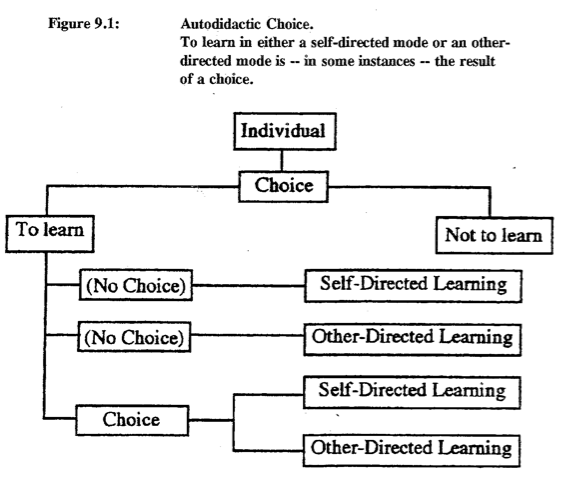
These problems may be circumvented by a characteristic shared by all the SDL episodes considered for the purpose of this study: the existence, known to the learners, of an alternative course of action which could have been pursued in place of the SDL project. In the presence of a formal alternative, opting for non-formal learning wo~ld seem to indicate a preference, or a “choice” in favor of SDL over formal methods. Thus, SDL may be contrasted specifically to “formal” learning, rather than to “nonlearning” in general, and may be said to represent, for the learner, some “advantage” over other alternatives. By considering those situations where SDL activities are the result of a choice in the presence of a real alternative, SDL may be construed as tangible, desirable and opposed to other-directed learning. p. 6
Figure 9.1 shows how learning may be construed in two ways (1) as resulting from a choice, on the part of the learner, in favor of either self-directed or “other-directed” learning; or (2) as resulting from a desire to learn, in a context where the learner has no other choice – if learning is to occur at all – but to pursue learning goals in either a self-directed, or an “other-directed” manner. p. 6
For every “profession” considered in the course of this investigation, a corresponding program of study was offered in a local postsecondary institution. p. 7
Autodidactic Choice The choice, not only between self-directedness and otherdirectedness, but also between formal and informal educational p. 7
Self-Directed Professionals settings, has been called elsewhere “Le choix autodidactique” (Bouchard, 1990), and will be referred to here, for the sake of consistency; as “Autodidactic Choice”. Within its framework, previous studies into the nature of SDL activities may be divided into two categories, one of which allows for the notion of choice, while the other does not 1. 2. The first category includes SDL activities undertaken in the pursuit of learning goals which are not accessible in any formal setting and for which, therefore, SDL represents the only available option. These are hobbies, recreational and cultural endeavors, and learning needs too specific to be included in formal learning situations. They represent the majority of self-directed learning projects identified in the literature (as tabulated by Johnstone & Rivera, 1965; Tough 1971, Serre, 1977; Ceszjkarevicz, 1990, and others). They are not the result of a choice in the presence of an alternative. p. 8
settings, has been called elsewhere “Le choix autodidactique” (Bouchard, 1990), and will be referred to here, for the sake of consistency; as “Autodidactic Choice”. Within its framework, previous studies into the nature of SDL activities may be divided into two categories, one of which allows for the notion of choice, while the other does not p. 8
The second category includes SDL activities carried out in order to acquire knowledge/skills which .!ill! offered in existing institutional curricula. If these situations do not actually place SDL on the same footing as formal settings as the basis for a conscious and deliberate “choice”, they at least represent a very real option in favor of one course of action (namely, SDL) at the exclusion of all others (including “formal” options). p. 8
Previous inquiries in the area of self-directed learning have concentrated mainly on “WHO” self-directed learners are (Guglielmino, 1977), on “WHAT” they learn (Johnstone & Rivera, 1965; Tough, 1978), and on “HOW”, Self-Directed Learning occurs (Tough, 1971; Danis & Tremblay, 1985). Little attention has been given to “WHY” individuals become self-directed learners – perhaps because this latter question has been presumed to be included in the former three. However, if SDL is construed as being learner-centered, then the learner must be given credit not only for pursuing his or her learning goals, but also for choosing to do so, and doing so in a self-directed manner. p. 9
As part of an inquiry into the needs of selfdirected learners (Tremblay, 1981), subjects were asked how they came to learn in a self-directed manner. Answers included perceived personality traits, a yearning for more creative freedom, some specific learning needs, and a need for more convenient pacing of activities. When asked a similar question, subjects in another study (Penland, 1978) invoked their learning style, their preference for self-paced activities, unwillingness to conform to rigid schedules, lack of free time, and pragmatic considerations such as related expenses and travelling time. p. 9
Human beings, in fact, “choose” the causes for their own behavior among a vast array of possible determinants every time they decide on a future course of action, or explain “why” they did something in the past. This is supported by Bandura's (1977, p. 39) contention that “self-generated influences operate determillistically on behavior in the same way as external sources”. These “chosen causes” vary widely from one individual to the next. p. 11
The only way, therefore, to have a clue as to the reasons behind someone's motives and purposes is to ask that person directly. Furthermore, the attribution by individuals of the “causes” of their behavior may well rank, in its own right, among the most influential determinants of that very behavior (Weiner, 1986). Perhaps this is another reason the question, “Why selfdirected learners choose SDL” remains unanswered: it is basically a phenomenological question, and in this sense defies empirical investigation. p. 11
Candy (1990), Long (1989), and Bonham (1989) have independently reached the conclusion that self-directed learning may occur in formal education settings as well as in non-formal settings. p. 11
To avoid this confusion, only those learning projects that have occurred outside formal institutional settings will p. 11
be considered or the purposes of this investigation. This should ensure that the observed phenomena account for some measure of self-directedness, which would not be the case if our sample provided also for formal situations. p. 12
Long (1989) has contended that self-directedness is measured by the degree o f both “psychological” and “pedagogical” control that the learner retains over the various dimensions of the learning project. p. 12
All professions to which access is not regulated by legislation or by the demands of a juridically mandated professional - organization include practitioners who have acquired their training in a self-directed manner as defmed above. They are engineering consultants, computer analysts, film-makers, tax accountants, journalists, managers, editors, librarians, etc. These “SelfDirected Professionals” constitute the population from which 12 individuals were identified and asked to participate in the study by means of in open-ended interviews. p. 12
Different views of SDL have been put forth respectively by Tough (1967), Guglielmino (1977) and Spear (1984, 1988). p. 13
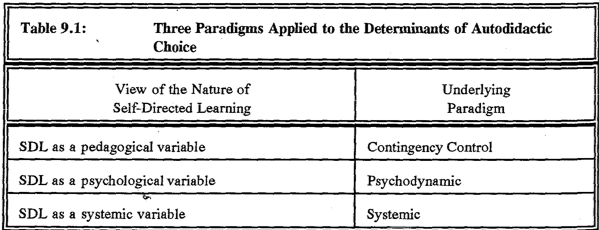
Tough focuses on SDL as an act of learning. His works have stressed the importance of the SDL phenomenon (Tough, 1967), the steps involved in planning and carrying out SDL projects (Tough, 1971) and the benefits learners expect to derive from their learning (Tough, 1979). Tough's view of SDL may be said to focus on the “learning” aspects of SDL projects, and to consider SDL as primarily a Pedagogical variable. p. 13
Guglielmino (1977) focuses on individuals' predisposition to espouse a self-directed orientation in their learning. According to this view, a person's likelihood to engage in SDL activities is linked to a personal propensity to do so. Guglielmino's SelfDirected Learning Readiness Scale (SDLRS) has been widely used to establish correlations between this particular trait and other p. 13
personal characteristics. This view of SDL is associated with individuals' inner character and disposition, and for this reason may be said to construe SDL as a Psychological variable. p. 14
Spear and Mocker (1984) have contributed the notion of Organizing Circumstance as a framework for SDL. According to their view, the consciously acknowledged learning need (as described by Tough) and the inner disposition of the individual (as expressed by Guglielmino) do not fully account for the emergence of SDL. What is needed in order to better grasp the phenomenon, these authors argue, is an understanding of the Life Field which encompasses it (this is a Lewinian concept: Lewin, 1951). According to this view, SDL exists within the larger system of interacting influences in a person's life, and may therefore be said to construe SDL as a Systemic variable. p. 14
Look up concept of "Life field" (Lewin) p. 14
The shift of focus from (1) the learning project, (2) to the individual learner, and rmally (3) to the circumstances surrounding SDL activities, illustrates the ongoing struggle to come to terms with the conceptual difficulties inherent in the notion of SDL. p. 14
What is of particular interest, however, is the epistemological position which may be associated with each of these differing approaches to SDL, specifically as regards the determinants of human behavior. As will be shown, each of the three perspectives can be traced to a distinct view of what actually determines human behavior, or, as one colleague put it: “What makes people tick.” These views are, respectively, the Contingency Control paradigm, the Psychodynamic paradigm, and the Systemic paradigm. p. 14
The question, "Why do some people choose to pursue their learning goals in a self-directed manner?", supposes that it is possible to explain the reasons why anyone, indeed, chooses to do anything at all in the first place. Bandura (1986) argued that, throughout the history of the human and social sciences, several different paradigms were used as a cqnceptual base by different authors in order to explore the determinants of human behavior. In a similar vein, three different paradigms may be associated with mainstream SDL literature. p. 15
The Contingency Control Paradigm One of the foremost tenets of behaviorist epistemology is the notion of contingency control (Skinner, 1969). This concept refers to the determinants of behavior as being contingent upon external forces. According to this view, non-genetically determined behavior is cued by stimuli that precedes it, and shaped by stimuli that reinforces it. Cognition allows for the added determinant of anticipated results (Bandura, 1977, p. 12). This view may be linked to Tough's often stated explanation of Why adults choose to learn. According to Tough (1968; 1971; 1979), adults engage in learning projects because they consciously expect to derive some benefit from their learning. Thus, the determinants of their decision to learn are akin to Skinner's behaviorist Contingency Control paradigm. p. 15
The Psychodynamic Paradigm Behavior also has been described as a response to needs, inner impulses and innate instincts, often acting at unconscious levels, as put forth by Freud (1935) and others. The determinants of human behavior, within this paradigm, are to be found in the inner self and innate characteristics of individuals. The psychodynamic view of human behavior may be linked to Guglielmino's under- p. 15
lying assumption which ascribes propensity towards Self-Directed Learning to individuals' inner disposition. p. 16
The Systemic Paradigm Finally, human experience has been depicted by Kurt Lewin (1951) as inseparable from the myriad factors and events which constitute a person's past and present Life Field. The circumstances surrounding the events in a person's life at any given time may be endowed by the individual with a positive or negative valence according to the individual's own perception. This global perception of the world will serve, in tum, to determine the next course of action to be undertaken (DeRivera, 1976). Spear and Mocker's (1984, p.1) acknowledged debt to Lewin's Field Theory · indicates that for the purpose of defming the determinants of SelfDirected Learning, they have adopted a paradigm analogous to Lewin's Field Theory. p. 16
In allowing for individuals' perceived motives and purposes in pursuing learning goals in a self-directed manner, the present study acknowledges the importance of personal attribution not only as a legitimate and important factor for establishing the determinants of Autodidactic Choice, but also as an additional determining factor informing that very choice. According to Weiner (1986), attribution of causality by individuals to their own behavior not only points to real causal relationships between behavior and its determinants, but also serves to influence future decisions and actions. For example, we are much less likely to initiate a demanding project when convinced that we lack the necessary aptitudes for the job, or that circumstances do not lend themselves to that course of action. Thus, our perception of the reasons behind our past actions may well serve as an important determinant for our future ones. In this way, a link may be established between the perceived nature of the determinants of Autodidactic Choice, and the actual making of that choice. p. 17
REFERENCES p. 17
Lots of really interesting (but quite old) references on SDL and SDL learners) p. 17
Images
p. 7
p. 16

