Key ideas
Presents four aspects of self-control in self-directed learning: algorithmic, conative, semiotic and economic
History
Long (1992): Two dimensions along which self-directedness could vary.
Psychologically driven
Predisposed to SDL. Or just highly motivated to learn. Someone enrolling in a course in university, because they really want to learn, have high level of psychological control over act of learning, but not pedagogical.
Pedagogical
The planning and carrying out of learning activities. The sum of activities that are normally the responsibility of an instructor in teacher-directed learning, such as:
- formulating goals
- planning activities
- selecting resources
- setting deadlines
(an example of someone with high pedagogical but low psychological control might be someone in a workplace who are forced to learn something, but given no direction about how to do it)
Critique
Conative is better than psychological, since psychological means “everything to do with the mind”.
Pedagogy is usually used to describe what teachers do, algorithmic dimension is better (inspired by Danis and Tremblay 1986).
Can also call tasks autonomous learning strategies, distinct from non-autonomous strategies such as memorizing for an exam, or writing a paper that a teacher wants to read.
Study
Interviews with 40 employees who were “knowledge workers”.
Finding / framework
Conative dimension
Relates to psychological issues such as drive, motivation, initiative and confidence. Also aspects of context and transitions, how these influence people’s urges to take up learning, and the social networks that people are involved in and which act as affective support and resources. Past learning experiences might also influence autonomous learning strategies.
- Initiative
- Motive
- Motivation
- Context and Transitions
- Social Environment
- Past Experiences
Algorithmic dimension
Relates to pedagogical issues, for instance the sequencing, pacing and goal setting in learning, the evaluation of progress, and final evaluation and preparation for validation. Tasks that in the past were carried out by the educator; in an autonomous learning environment, they become issues that learners themselves have to resolve.
- Sequencing
- Pacing
- Formulating Objectives
- Finding Resources
- Following Up
- Evaluating
Semiotics of learning
Related to the delivery model of resources. This model has drastically changed in recent years and moved from the use of resources such as books and paper to electronic texts and multimedia
- Use of Printed Text
- Use of NonPrint Text
- Use of Hypertext
- Data Collection
- Social Networks
Aspects of economy
The perceived and actual value of the learning, the choice to learn for personal gain such as for future employment, and the possible cost of other study options.
The learner is faced with choices that must be evaluated on the basis of their intrinsic worth. Several interesting questions arise such as the following:
- Is informal learning less valuable than what is officially recognized for credit learning?
- If so, is this counterbalanced by the fact that it is also less expensive?
- Which of the two variables has most intrinsic value, the knowledge itself, or its official sanction by an institution?
Dimensions:
- Actual Value of Knowledge
- Perceived Value of Knowledge
- Cost of Learning
- Cost-Benefit Ratio of Learning
- Opportunity Costs
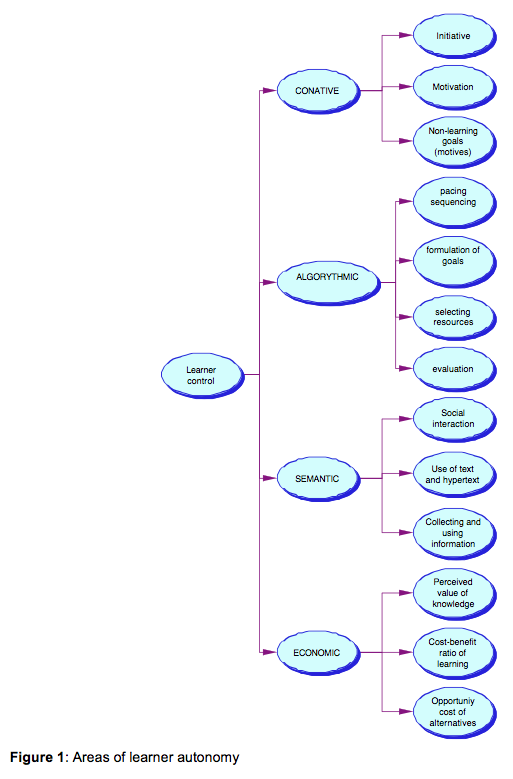 Illustration from Bouchard, 2008Bouchard, P. (2008). Some factors to consider when designing semi-autonomous learning environments. In The Proceedings of the 7th European Conference on e-Learning, Agia Napa, Cyprus, 6-7 November 2008 (120).

