Teaching for deeper and lifelong learning
by Christopher Knapper, Celebration of Teaching at UTSC, April 11, 2003

What sort of learning are we aiming for?
- knowledge and understanding
- skill acquisition, disciplinary and generic
- changed attitudes and values
- lifelong and life-wide learning, “learning to learn”, deep learning
Lifelong learning - doesn't mean lifelong schooling, but giving people the skills to enable them to learn by themselves, without us, for the rest of their lives.
How do students conceive of learning
How many have asked students “What do you think learning is?” - you'd be surprised.
Incoming students have very idealistic notions of learning - upper-year students are more cynical.
How much learning is due to the influence of teachers and institution?
Education versus
- relocation
- moving away to go to university, living independently
- maturation
- people going from 18 to 21 are going to change, even without any help from us
- socialization
- new friends, community
- acculturation
(other effects of going to university, not related to classes and teaching)
Fox's four teaching approaches
Ask a lot of educators to finish the phrase “Teaching to me involves…”
- transfer
- knowledge passed from one vessel to another (imparting, conveying)
- shaping and moulding
- teacher as a sculptor (developing, producing, modelling)
- travelling
- terrain to be explored with expert guide (leading, guiding)
- growing/horticultural
- learner development, both cognitive and emotional (encouraging, facilitating, nurturing)
Most respondents in Britain 40 years ago almost entirely in transfer category.
Comments:
- The first two assume a passive learner
- The second two involve us learning as well
- The first two are very teacher-dominant
Empirical research on T&L in universities
There is a body of research on learning that focuses on university students, many university professors are unaware of this.
Began: Marton and Saljö in Sweden (see this). Half of our students totally misunderstood what we want them to learn. Can we operationalize this? Ask students to summarize a text in a paragraph.
Students approaches to learning
| Approach | Motivation | Processes |
|---|---|---|
| Deep (Meaning Orientation) | Intrinsic: interest in learning for its own sake | Incorporates new ideas with existing knowledge, own experience |
| Surface (Reproducing orientation) | Extrinsic: fear of failure | Rote learning from syllabus |
| Non-Academic | Peer affiliation | Disorganized |
Empirical studies
- Students over time
- Watkins and Hattie (1981, Australia)
- deep learning declines over time in university, “not what teacher wants”
- Effects of learning climate
- Entwistle and Ramsden (1981: 2000+ students in 66 UK departments)
- similar effect as above, for most people, BUT some notable exceptions - some departments where the opposite thing was happening (see factors below)
- Influence of teachers
- Kember (1977, HK)
- Effects of institution
- Astin (1993: 20,000 students, 25,000 faculty in 200 US colleges)
- Pascarella and Terenzini 1991 (meta-analysis of 2,600 US studies)
Factors that promote deep learning
(Reported by students, Entwistle and Ramsden above)
- good teaching: staff are well prepared, confident (teachers who liked to teach, liked students)
- openness to students: staff friendly, flexible, helpful
- freedom in learning: students have a choice in what they study
- clear goals and standards: assessment standards, expectations are clearly defined
- vocational relevance: courses seen as relevant to future careers
- social climate: good relations between students, staff (social, academic)
- workload: negative: heavy demands for content coverage, many assessment tasks
- formal teaching: negative: perception that formal classes (vs. individual study) are main source of learning (related to control)
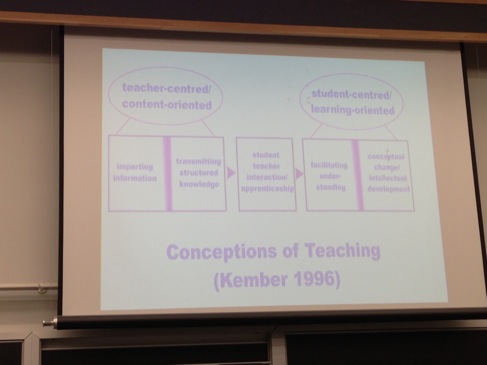
Conceptions of teaching
Kember 1996
Q&A
- We learn things by tasks, although some amount of listening is necessary. What did you set out to learn during the last 12 months? How did you go about it? How do you know if you succeeded or not?
- Do you like “flipping the classroom”?
- if you are meeting in a group of more than 30, you might as well be meeting electronically - now advantage to being in a class of 500 people - but yes, given the limitations, flipped classrooms might be a good idea

