Knowledge Practices Environment
Connected to theories about trialogical learning, funded by EU's KP-Lab project.
An open source collaborative learning environment, called Knowledge Practices Environment (KPE), has been developed in (see Lakkala et al, 2009). KPE is based on a visual desktop metaphor. Thus, allowing an easy manner to freely organise, re-structure and move the shared objects and chronological tasks as the users wish. Furthermore, there are no restricted rights according to preset categories, such as a teacher versus students. The users define themselves the rights and restrictions they need in their work. The already well- established features of collaborative environments are obviously present in KPE also. Such are: facilities for interacting with knowledge artefacts, processes, users, and reflective tools during a trialogical learning or working process.
The visual metaphor offers different perspectives to the same elements, called views:
- The Process View presents students with a GANTT chart type of chronological display, which specifies the tasks students have set for themselves, milestones and allocated responsibilities. The Alternative Process View gives means for grouping the process more freely with elements chosen by the participants and tagging these, which allows filtering according to the tags.
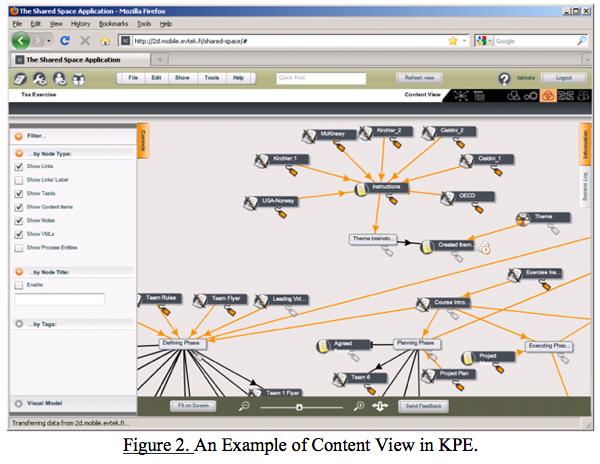
- The Content View presents users with a graphical representation of all the artefacts and their linkages, metadata and tags describing these artefacts, plus “tasks” provided by the users. Content items can be documents, wiki pages, web links, notes, sketches, and visual models, which can be commented as well as chatted by the users.
- The Community View allows displaying the members visually in groups if the users have formed such groups. It also provides a description of all members of the particular shared space, explicating the tasks and content items created and responsibilities allocated for each member.
(from (from Paavola, et al. (2011) Trialogical Learning Supported by Knowledge Practices Environment. CSCL 2011)
Main reference
Lakkala, M., Paavola, S., Kosonen, K., Muukkonen, H., Bauters, M., & Markkanen, H. (2009). Main functionalities of the Knowledge Practices Environment (KPE) affording knowledge creation practices in education. In C. O'Malley, D. Suthers, P. Reimann, & A. Dimitracopoulou (Eds.), Computer Supported Collaborative Learning Practices: CSCL2009 Conference Proceedings (pp. 297-306). Rhodes, Creek: International Society of the Learning Sciences (ISLS).

