On Two Metaphors for Learning and the Dangers of Choosing Just One
| Sfard, A. (1998). On Two Metaphors for Learning and the Dangers of Choosing Just One. Educational Researcher, 27(2). doi: 10.3102/0013189×027002004. |
BibTex
BibTex
BibTex
@article{sfard1998metaphors,
author = {Sfard, Anna},
date-added = {2011-06-17 10:21:45 +0800},
date-modified = {2012-04-09 01:02:05 +0000},
doi = {10.3102/0013189X027002004},
journal = {Educational Researcher},
notes = {1},
number = {2},
read = {1},
title = {On Two Metaphors for Learning and the Dangers of Choosing Just One},
volume = {27},
year = {1998},
bdsk-file-1 = {YnBsaXN0MDDUAQIDBAUIJidUJHRvcFgkb2JqZWN0c1gkdmVyc2lvblkkYXJjaGl2ZXLRBgdUcm9vdIABqAkKFRYXGyIjVSRudWxs0wsMDQ4RElpOUy5vYmplY3RzViRjbGFzc1dOUy5rZXlzog8QgASABoAHohMUgAKAA1lhbGlhc0RhdGFccmVsYXRpdmVQYXRo0hgMGRpXTlMuZGF0YU8RAYgAAAAAAYgAAgAAB1NTREhvbWUAAAAAAAAAAAAAAAAAAAAAAAAAAMl5T9hIKwAAANrWUhZzZmFyZDE5OThtZXRhcGhvcnMucGRmAAAAAAAAAAAAAAAAAAAAAAAAAAAAAAAAAAAAAAAAAAAAAAAAAAAAAAAGdcfVy9dI0FBERiBDQVJPAAIAAgAACSAAAAAAAAAAAAAAAAAAAAAHQmliZGVzawAAEAAIAADJeZYoAAAAEQAIAADL14EQAAAAAQAMANrWUgAXPTEAAZ9eAAIANVNTREhvbWU6VXNlcnM6AFN0aWFuOgBCaWJkZXNrOgBzZmFyZDE5OThtZXRhcGhvcnMucGRmAAAOAC4AFgBzAGYAYQByAGQAMQA5ADkAOABtAGUAdABhAHAAaABvAHIAcwAuAHAAZABmAA8AEAAHAFMAUwBEAEgAbwBtAGUAEgAqVXNlcnMvU3RpYW4vYmliZGVzay9zZmFyZDE5OThtZXRhcGhvcnMucGRmABMAAS8AABUAAgAM//8AAIAF0hwdHh9YJGNsYXNzZXNaJGNsYXNzbmFtZaMfICFdTlNNdXRhYmxlRGF0YVZOU0RhdGFYTlNPYmplY3RfECQuLi8uLi9iaWJkZXNrL3NmYXJkMTk5OG1ldGFwaG9ycy5wZGbSHB0kJaIlIVxOU0RpY3Rpb25hcnkSAAGGoF8QD05TS2V5ZWRBcmNoaXZlcgAIABEAFgAfACgAMgA1ADoAPABFAEsAUgBdAGQAbABvAHEAcwB1AHgAegB8AIYAkwCYAKACLAIuAjMCPAJHAksCWQJgAmkCkAKVApgCpQKqAAAAAAAAAgEAAAAAAAAAKAAAAAAAAAAAAAAAAAAAArw=}
}
Key ideas
Lot's about role of metaphors in theory forming.
Two metaphors for learning
- acquisition (before, we didn't know this was only a metaphor, thought it was everything)
- participation (new)
Separates between individualistic and social approaches - can be social and still acquisition. Ontological - what is knowledge.
Need both
Both are rich and useful. Don't throw the baby out with the bathwater.
Links here
Highlights
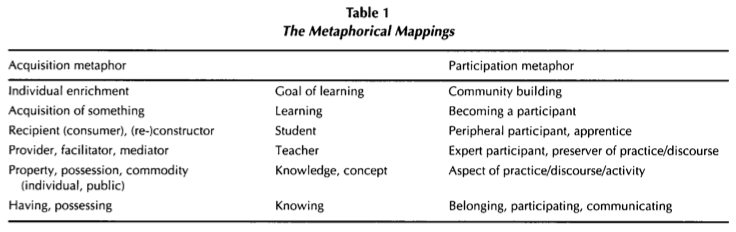
This article is a sequel to the conversation on learning initiated by the editors of Educational Researcher in volume 25, number 4. The author's first aim is to elicit the metaphors for learning that guide our work as learners, teachers, and researc/1ers. Two such metaphors are identified: the acquisition metaphor and the partic- ipation metaphor. Subsequently, their entailments are discussed and evaluated. Although some of the implications are deemed de- sirable and others are regarded as harmful, the article neither speaks against a particular metaphor nor tries to make a case for the other. Rather, these interpretations and applications of the metaphors undergo critical evaluation. In the end, the question of theoretical unification of the research on learning is addressed, wherein the purpose is to show how too great a devotion to one particular metaphor can lead to theoretical distortions and to un- desirable practices. p. 2
One glance at the current discourse on learn- ing should be enough to realize that nowadays educational research is caught between two metaphors that, in this arti- cle, will be called the acquisition metaphor and the participa- tion metaphor. Both of these metaphors are simultaneously present in most recent texts, but while the acquisition metaphor is likely to be more prominent in older writings, more recent studies are often dominated by the participation metaphor. p. 3
Since the dawn of civilization, human learning is conceived of as an acquisition of something. p. 3
Since the time of Piaget and Vygotski, the growth of knowledge in the process of learning has been analyzed in terms of concept development. Concepts are to be under- stood as basic units of knowledge that can be accumulated, gradually refined, and combined to form ever richer cogni- tive structures. The picture is not much different when we talk about the learner as a person who constructs meaning. This approach, which today seems natural and self-evident, brings to mind the activity of accumulating material goods. The language of “knowledge acquisition” and “concept de- velopment” makes us think about the human mind as a container to be filled with certain materials and about the learner as becoming an owner of these materials. p. 3
One finds a great variety of relevant terms among the key words of the frameworks generated by the acquisition metaphor: knowledge, concept, conception, idea, notion, misconception, meaning, sense, schema, fact, representation, material, contents. There are as many terms that denote the action of making such entities one's own: re- ception, acquisition, construction, internalization, appro- priation, transmission, attainment, development, accumu- lation, grasp. The teacher may help the student to attain his or her goal by delivering, conveying, facilitating, mediat- ing, p. 3
and social mediation. The set of new key words that, along with the noun “practice,” prominently features the terms “discourse” and “communication” suggests that the Ieamer should be viewed as a person interested in participation in certain kinds of activities rather than in accumulating pri- vate possessions. p. 4
To put it differently, learning a subject is now conceived of as a process of becoming a member of a certain commu- nity. This entails, above all, the ability to communicate in the language of this community and act according to its par- ticular norms. p. 4
eventually, they envisioned learning as a never-ending, self-regulating process of emergence in a continuing inter- action with peers, teachers, and texts. p. 4
A quest after its roots will lead us, once again, to the world of physical objects. “Participation” is al- most synonymous with “taking part” and “being a part,” and both of these expressions signalize that learning should be viewed as a process of becoming a part of a greater whole. p. 4
The new researcher talks about learning as a legitimate peripheral participation (Lave & Wenger, 1991) or as an apprenticeship in thinking (Rogoff, 1990). p. 4
A far-reaching change is signaled by the fact that al- though all of these titles and expressions refer to learning, none of them mentions either “concept” or “knowledge.” The terms that imply the existence of some permanent en- tities have been replaced with the noun “knowing,” which indicates action. This seemingly minor linguistic modifica- tion marks a remarkable foundational shift (cf. Cobb, 1995; Smith, 1995). The talk about states has been replaced with attention to activities. In the image of learning that emerges from this linguistic turn, the permanence of having gives way to the constant flux of doing. While the concept of ac- quisition implies that there is a clear end point to the process of learning, the new terminology leaves no room for halting signals. Moreover, the ongoing learning activities are never considered separately from the context within which they take place. The context, in its turn, is rich and multifarious, and its importance is pronounced by talk about situatedness, contextuality, cultural embeddedness, p. 4
Second, one may oppose the above classification of theo- ries of learning by saying that most conceptual frameworks cannot be regarded as either purely “acquisitional” or purely “participational.” The act of acquisition is often tan- tamount to the act of becoming a participant, and if so, one can find it difficult to consider AM and PM separately, let alone as mutually exclusive.4 No claim on exclusivity of the metaphors has been made in this article, however. Later, I p. 4
will argue for the inherent impossibility of freeing the dis- course on learning from either of the two metaphors. Theo- ries can be classified as acquisition-oriented or participa- tion-oriented only if they disclose a clear preference for one metaphorical ingredient over the other. p. 5
Probably the best-known foundational dilemma obviously inherent to the AM was first signaled by Plato in his dia- logue Meno and came to be known later as “the learning paradox” (Bereiter, 1985; Cobb, Yackel, & Wood, 1992). Al- though brought up in many different disguises throughout history, the quandary is always the same: How can we want to acquire a knowledge of something that is not yet known to us? Indeed, if this something does not yet belong to the repertoire of the things we know, then, being unaware of its existence, we cannot possibly inquire about it. Or, to put it differently, if we can only become cognizant of something by recognizing it on the basis of the knowledge we already possess, then nothing that does not yet belong to the as- sortment of the things we know can ever become one of them. Conclusion: Learning new things is inherently im- possible. p. 5
Finally, the dichotomy between acquisition and partici- pation should not be mistaken for the well-known dis- tinction between individualist and social perspectives on learning. The examples here have shown that the former division crosses the demarcation lines established by the latter. According to the distinction proposed in this article, theories that speak about reception of knowledge and those that view learning as internalization of socially established concepts belong to the same category (AM), whereas on the individualIsocial axis, they must be placed at opposite poles. Whereas the social dimension is salient in the PM, it is not necessarily absent from the theories dominated by the AM. It is important to understand that the two distinctions were made according to different criteria: While the acqui- sition/participation division is ontological in nature and draws on two radically different answers to the fundamen- tal question, “What is this thing called learning?,” the indi- vidual I social dichotomy does not imply a controversy as to the definition of learning, but rather rests on differing visions of the mechanism of learning. p. 5
Thinking about the epistemological and ontological foundations of our conception of learning intensified a few decades ago, when the doctrine of radical constructivism entangled the psychologists in a new dilemma. Without questioning the thrust of the AM, the constructivists offered a new conception of the mechanism that turns knowledge into one's private possession. It is the central constructivist idea of learners as the builders of their own conceptual structures that, at a closer look, turns problematic. What- ever version of constructivism is concerned-the moderate, the radical, or the social-the same dilemma must eventu- ally pop up: How do we account for the fact that learners are able to build for themselves concepts that seem fully congruent with those of others? Or, to put it differently, how do people bridge individual and public possessions? p. 5
munity speaks of intellectual achievement, no wonder that incidents of scientific fraud become more and more fre- quent in the increasingly crowded academia. While these are certainly extreme cases, there are symptoms much milder than obvious misconduct that can count as conse- quences of the acquisitionist approach. A not-altogether- infrequent occurrence of self-centered, asocial attitude to- ward knowing, creating, and learning is certainly a case in point. If people are valued and segregated according to what they have, the metaphor of intellectual property is more likely to feed rivalry than collaboration. p. 6
If knowledge is conceived of as a commodity,5 it is only natural that attitudes toward learning reflect the way the given society thinks about material wealth. When figura- tively equated, knowledge and material possessions are likely to play similar roles in establishing people's identities and in defining their social positions. In the class-ridden capitalist society, for example, knowledge understood as property is likely to turn into an additional attribute of po- sition and power. Like material goods, knowledge has the permanent quality that makes the privileged position of its owner equally permanent. As a result, learning-according-to-AM may draw people apart rather than bring them together. As in a society driven by a pursuit of material goods, so in the AM-based ap- proach to learning, learners and scientists are likely to put forward competition and solitary achievement. The Amer- ican sociologist of science R. K. Morton notes that a scien- tist who just arrived at what may count as an important result “will be under pressure to make his contribution to knowledge known to other scientists and … they, in turn, will be under pressure to acknowledge his rights to his intel- lectual property” (Morton, 1973, p. 294, emphases added). In a footnote to this description, Morton seems to be apolo- gizing for the vocabulary he uses, stating that ”[b]orrowing, trespassing, poaching, credit, stealing, a concept which 'be- longs' to us-these are only a few of the many terms in the lexicon of property adopted by scientists as matter of course” (p. 295). If this is the language in which this com- p. 6
pared to face the ultimate consequences of the new vision of learning, go only halfway: They bring empirical evidence to refute the claims about the possibility of transfer rather than admit that the notion, at least as it is traditionally un- derstood, is intractable within their framework. By doing so, they unwittingly succumb to the rules of AM-based dis- course. p. 7
It may well be that the most important merit of the PM is that it serves as an eye-opening device with respect to the acquisi- tion metaphor. This relation, by the way, is symmetric: The social implications of the PM, listed above-far from being the only possible-are brought into full relief against the contrasting background of common beliefs induced by the AM and could be much harder to see without it. p. 7
Our ability to prepare ourselves today to deal with new situations we are going to encounter tomorrow is the very essence of learning. Com- petence means being able to repeat what can be repeated while changing what needs to be changed. How is all of this accounted for if we are not allowed to talk about carrying anything with us from one situation to another?? p. 7
One such attempt has been presented by Greeno (1997) in his contribution to the present discussion. Greeno's central idea is to provide the old notion with a new interpretation.8 Defining learning as “improved par- ticipation in interactive systems,” he proceeds to account “for transfer in terms of transformations of constraints, af- fordances, and attunements” (p. 12). This description, ori- ented toward interactions between learners and situations, may indeed be regarded as compatible with the PM frame- work. p. 7
The refusal to reify knowledge seems to go hand in hand with wondering about the notion of transfer. There are two ways in which the opponents of objectifying and abstract- ing argue against this notion. Some of them claim that, based on empirical evidence, transfer is a rare event, and the most extreme among them would simply deny its exis- tence. Others reject the very idea of transfer, saying that it is “seriously misconceived” (Lave, 1988, p. 39). Many oppo- nents of the PM argue against the former type of claim (Anderson eta!., 1996), but, in fact, only the latter line of rea- soning is truly consistent with the PM-based frameworks. As Greeno (1997, p. 5) aptly notices in his contribution to the present discussion, those who overlook this point may, · as a result, “talk and write past each other because they ad- dress different questions.” A persistent follower of the PM must realize, sooner or later, that from a purely analytical point of view, the metaphorical message of the notion of transfer does not fit into PM-generated conceptual frameworks. Learning trans- fer means carrying knowledge across contextual bound- aries; therefore, when one refuses to view knowledge as a stand-alone entity and rejects the idea of context as a clearly delineated “area,” there is simply nothing to be carried over, and there are no definite boundaries to be crossed. It is only natural that when it comes to the centrally important controversy over transfer, many PM adherents, not yet pre- p. 7
is offered by those who suggest that the student should become a member of a “community of practice” (Lave & Wenger, 1991), within which he or she would have a chance to act as a (beginning) practitioner. According to Ball (1991, p. 35), “the goal [of teaching mathematics] is to help stu- dents . . . become active participants in mathematics as a system of human thought,” whereas Schoenfeld (1996) pro- motes the idea of turning mathematics class into a “com- munity of inquiry.” At a closer look, this approach also turns quite problematic, as it is far from clear how we should construe the term “community of practice” and whom we should view as ·”expert practitioners” and the shapers of a given “practice.” p. 8
As was emphasized before, the metaphors we use should not be held responsible for unsatisfactory practices, but rather their interpretations. When a theory is translated into an instructional prescription, exclusivity becomes the worst enemy of success. Educational practices have an overpow- ering propensity for extreme, one-for-all practical recipes. A trendy mixture of constructivist, social-interactionist, and situationist approaches-which has much to do with the participation metaphor-is often translated into a total ban- ishment of “teaching by telling,” an imperative to make “cooperative learning” mandatory to all, and a complete delegitimatization of instruction that is not “problem- based” or not situated in a real-life context. But this means p. 8
Within the science and mathematics education communities, the claims about in- herent contextuality of knowledge are often construed as contentions that scientific and mathematical concepts can be meaningfully learned only within a “real-life” context (see, e.g., Heckman & Weissglass, 1994). As it now becomes clear, however, real-life situations that would be likely to become for mathematics or science students what a crafts- man's workshop is for the apprentice are extremely dif- ficult to find. Another translation of PM-engendered theoretical ideas into the language of instructional practice p. 8
putting too much of a good thing into one pot. Because no two students have the same needs and no two teachers ar- rive at their best performance in the same way, theoretical exclusivity and didactic single-mindedness can be trusted to make even the best of educational ideas fail. p. 9
Images
p. 5

