E-moderation of synchronous discussions in educational settings: A nascent practice
| Schwarz, B. B., & Asterhan, C. S. C. (2011). E-moderation of synchronous discussions in educational settings: A nascent practice. Journal of the Learning Sciences, 99999(1), 1–1. Routledge. |
BibTex
BibTex
@article{schwarz2011moderation,
author = {Schwarz, Baruch B. and Asterhan, Christa S. C.},
date-added = {2011-06-05 15:46:40 +0800},
date-modified = {2011-06-16 18:38:10 +0800},
journal = {Journal of the Learning Sciences},
keywords = {cmc; toread; synchronous},
number = {1},
pages = {1--1},
publisher = {Routledge},
read = {1},
title = {E-moderation of synchronous discussions in educational settings: A nascent practice},
volume = {99999},
year = {2011},
bdsk-file-1 = {YnBsaXN0MDDUAQIDBAUIJidUJHRvcFgkb2JqZWN0c1gkdmVyc2lvblkkYXJjaGl2ZXLRBgdUcm9vdIABqAkKFRYXGyIjVSRudWxs0wsMDQ4RElpOUy5vYmplY3RzViRjbGFzc1dOUy5rZXlzog8QgASABoAHohMUgAKAA1lhbGlhc0RhdGFccmVsYXRpdmVQYXRo0hgMGRpXTlMuZGF0YU8RAZQAAAAAAZQAAgAAB1NTREhvbWUAAAAAAAAAAAAAAAAAAAAAAAAAAMl5T9hIKwAAANrWUhlzY2h3YXJ6MjAxMW1vZGVyYXRpb24ucGRmAAAAAAAAAAAAAAAAAAAAAAAAAAAAAAAAAAAAAAAAAAAAAAAAAAAGdcZ+y9dIvFBERiBDQVJPAAIAAgAACSAAAAAAAAAAAAAAAAAAAAAHQmliZGVzawAAEAAIAADJeZYoAAAAEQAIAADL14D8AAAAAQAMANrWUgAXPTEAAZ9eAAIAOFNTREhvbWU6VXNlcnM6AFN0aWFuOgBCaWJkZXNrOgBzY2h3YXJ6MjAxMW1vZGVyYXRpb24ucGRmAA4ANAAZAHMAYwBoAHcAYQByAHoAMgAwADEAMQBtAG8AZABlAHIAYQB0AGkAbwBuAC4AcABkAGYADwAQAAcAUwBTAEQASABvAG0AZQASAC1Vc2Vycy9TdGlhbi9iaWJkZXNrL3NjaHdhcnoyMDExbW9kZXJhdGlvbi5wZGYAABMAAS8AABUAAgAM//8AAIAF0hwdHh9YJGNsYXNzZXNaJGNsYXNzbmFtZaMfICFdTlNNdXRhYmxlRGF0YVZOU0RhdGFYTlNPYmplY3RfECcuLi8uLi9iaWJkZXNrL3NjaHdhcnoyMDExbW9kZXJhdGlvbi5wZGbSHB0kJaIlIVxOU0RpY3Rpb25hcnkSAAGGoF8QD05TS2V5ZWRBcmNoaXZlcgAIABEAFgAfACgAMgA1ADoAPABFAEsAUgBdAGQAbABvAHEAcwB1AHgAegB8AIYAkwCYAKACOAI6Aj8CSAJTAlcCZQJsAnUCnwKkAqcCtAK5AAAAAAAAAgEAAAAAAAAAKAAAAAAAAAAAAAAAAAAAAss=}
}
Links here
Highlights
E-moderation has been a common practice in asynchronous discussions of postsec- ondary courses. We consider here e-moderation of synchronous discussions in the school context. We adopt a design research approach to elaborate an environment, the Argunaut system, that fits the reality of classrooms in which moderation of sev- eral small-group synchronous discussions in parallel is desirable. We describe the Argunaut system and then describe an experiment in which a moderator could elab- orate several strategies in 2 synchronous discussions (1 with 2 groups in parallel and 1 with 4 groups in parallel). Through the technique of cued retrospective reporting, we could identify those strategies and could show how technology and moderation are interwoven. We then assessed whether the actions of the moderator had some positive impact on the flow of the discussions. The positive findings that emerge from this study indicate that teachers can enact this novel practice in classrooms, enabling by such proper guidance for productive engagement in the synchronous discussions of many students in the same class. p. 2
The goal of this article is to understand e-moderation in multiple synchronous discussions aimed at promoting collaborative reasoning. E-moderation is the car- ing but non-intrusive electronic guidance of multiple discussions. E-moderation is an enormously difficult task because of the temporal and cognitive demands on the moderator. To be effective, e-moderation of collaborative discussion requires technological support for the moderator. In this study, a design research approach was adopted to create and study an environment, the Argunaut system, that fits the reality of classrooms with multiple small groups and that provides real-time support for a human moderator to facilitate group functioning. We adopted a phe- nomenological approach and describe here the process of moderation; moderation p. 2
tactics; and the interactions between the moderator, discussants, and system features. Toward this goal, we provide a general framework for the facilitation of small-group work that focuses on the promotion of critical reasoning through small-group discussions. We stress the potential of technology but show that it is not sufficient by itself. These theoretical underpinnings constitute the starting point for the design research program described in this article. p. 3
Despite increasing knowledge about peer learning and the recognition of the importance of guidance, little is known about how teachers facilitate student dia- logue during group work (Webb, 2009). In one of the few systematic studies of discourse facilitation, Chiu (2004) investigated whether the teacher’s explicit content-related help improved group performance. Chiu found that explicit content-related help was ineffective. He showed that teachers did not evaluate the group progression of ideas before giving help, and when they provided content- related help they consequently lost students’ thread of thought. Chiu concluded that a key element in determining the effectiveness of teacher interventions in group work in general is whether teachers tie their help to the progress of the group. For most teachers, this is not an easy task (Yackel, 2002) p. 3
Some researchers have adopted a phenomenological approach and observed how expert teachers facilitate group learning in specific contexts. For example, Hmelo-Silver and Barrows (2006, 2008) described the different strategies an expert physician adopted to help medical students explain a patient’s disease in a problem-based learning context. The physician supported knowledge construc- tion though asking open-ended, meta-cognitive questions and catalyzing group processes. His questions served meta-functions (e.g., definition and interpretation questions), helped students to focus on the relevant conceptual space, and elicited knowledge displays that helped students recognize what content required the most p. 3
focus. For students, questions were central for understanding the problem, for initiating the generation of new ideas, and for further building upon these ideas. The physician and his students coconstructed an agenda building upon group thinking and facilitation. p. 4
In another study, Zhang, Scardamalia, Reeve, and Messina (2009) studied the facilitation of small groups of Grade 4 students learning optics using Knowledge Forum software (Scardamalia & Bereiter, 2006). The teacher progressively dele- gated control to the students, who took the initiative in reading other groups’ notes, engaging in knowledge advancement, summarizing and elaborating on knowledge advances, and even forming groups for group work. Given that the teacher in Zhang et al. could learn over the 3 years of the study how to be less dominant in classroom talk and to progressively delegate responsibilities to learners suggests how sophisticated he was fading out his interventions, yet he was always aware of students’ advancements through Knowledge Forum. p. 4
These studies are important as they show not only the complexity of small- group facilitation but also that such facilitation is possible. They open new directions for research on small-group facilitation within school contexts. A natu- ral direction is to explore how non-expert teachers can approach the challenges of ascertaining student thinking during small-group work. Given that in most learn- ing contexts several groups are active concurrently, another research direction is to explore how teachers can simultaneously facilitate several discussion groups. Hmelo-Silver and Barrows (2008) saw this scaling up as a challenge. Zhang and his colleagues (2009) suggested that tools such as Knowledge Forum may help in this facilitation. Our goal in the present article is to show that it is possible to develop a suitable environment that tackles both of these challenges. p. 4
The tools that are used to promote and realize productive discussion practices in the classroom vary. Some approaches focus on teacher techniques to guide whole- classroom discussion (e.g., Alexander, 2008; Resnick, Michaels, & O’Connor, 2010; Wells, 2007). Others use communication skill training to improve dialogue practices (e.g., Gillies, 2004; Gillies & Khan, 2009), the use of ground rules p. 4
for peer-to-peer talk (Mercer, 1995, 2000; Schwarz & De Groot, 2007), or basic elements of argumentation (e.g., Kuhn et al., 1997; Reznitskaya, Anderson, & Kuo, 2007; Reznitskaya et al., 2001). p. 5
Extrapolating from these approaches, we have identified a common set of three basic criteria for promoting productive dialogue practices for small-group work: (a) active and egalitarian participation in discussions, (b) reasoning and argumen- tation (i.e., providing justifications, arguments, challenges, and so forth toward the development of ideas1), and © interactive coconstruction (i.e., referring to and building others’ contributions in a civil manner). In this article, we borrow the term collaborative reasoning from Richard Anderson and his colleagues (e.g., Clark et al., 2003) to refer to verbal interactions between equal-status peers that meet these three criteria for productive peer talk in classrooms. p. 5
There are a number of affordances associated with using CMC for promoting crit- ical discourse in general (including collaborative reasoning). First, there is the ability to reread and revise contributions and increased time to consider response encourages reflection (e.g., Guiller, Durndell, & Ross, 2008). Second, whereas in face-to-face conversation verbal cues can be used to assess social status, in CMC these verbal cues are absent, thus allowing for more democratic and less inhib- ited participation (Herring, 2004; Suler, 2004). Third, the ability to post messages simultaneously may promote egalitarian participation, especially of more reserved students (Asterhan & Eisenmann, 2009). Fourth, the lack of nonverbal cues may force discussants to become more explicit and provide more reasoned argu- ments (Kim, Anderson, Nguyen-Jahiel, & Archodidou, 2007; Newman, Webb, & Cochrane, 1995). Finally, visual representations of co-actors’ actions may support awareness of important features of collaboration (Suthers, 2003). p. 5
Many scaffolds have been developed to support collaborative reasoning in CMC environments. One possibility is to provide sentence openers. Results on their effectiveness are mixed (Cho & Jonassen, 2002; Jeong & Joung, 2007), depending on the design of the activity. Diagram-based interfaces are another tool for promoting knowledge building (Scardamalia, 2004) or argumentation (Andriessen, Baker, & Suthers, 2003). p. 5
Belvedere (Suthers, 2003), support argumentation by providing specific categories of argumentative moves and sentence openers in a shared graphical space. p. 6
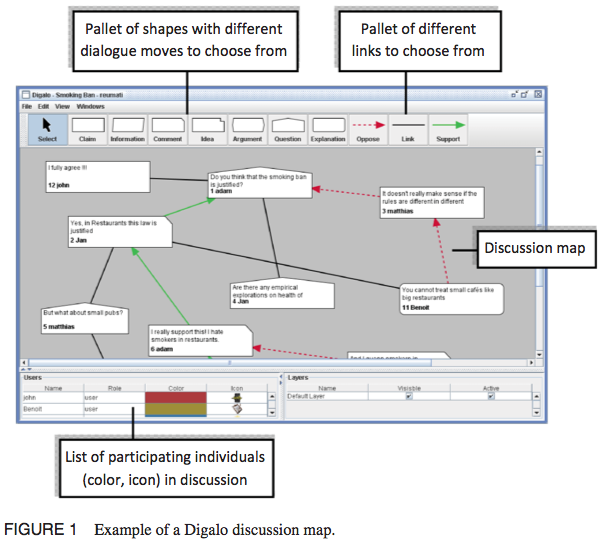
To scaffold the devel- opment of collaborative reasoning, the Kishurim group initiated the development of a shared, computer-supported discussion space called Digalo. In Digalo, dis- course moves are represented by geometrical shapes and organized in diagrams in order to help students recognize key distinctions between argument moves and participation structures. Figure 1 shows a discussion (Digalo) map produced by four discussants. The upper row displays the argument ontologies used, including claim, argument, explanation, and question. In addition, three types of links were used: reference, support, and opposition. The lower left window lists the icons of each discussant tagged to all shapes. In this article, we report on part of a design-based research program built around the use of Digalo for small-group argumentation in classrooms. As part of this program of design research, Schwarz and Glassner (2007) examined the p. 6
effects of categories of argumentative moves and of synchronicity in students who engaged in e-discussions with Digalo. They found that by providing both informal category tags for each contribution and control over turn taking, stu- dents expressed less off-topic chat-like expressions and more relevant claims and arguments. In addition, unconstrained synchronous discussions often went astray from the topic to be discussed and were less favorable for productive group rea- soning than was controlled turn taking. However, students in that study preferred unconstrained synchronicity to controlled turn taking in further activities because remaining idle during a discussion was often unbearable for them. In another study (Schwarz & De Groot, 2007), students participated in successive synchronous Digalo discussions alternating with individual essays and demonstrated advanced and critical discussion. p. 7
Research has focused on two approaches to supporting real-time e-discussion: computer-supported collaboration scripts and human facilitation. Computer- supported collaboration scripts aim to directly influence the interaction patterns of collaborative learners with software-embedded guidance rather than to train or instruct learners prior to the actual collaboration (Rummel & Spada, 2005). In a series of studies, Weinberger and colleagues (Weinberger, Ertl, Fischer, & Mandl, 2005; Weinberger, Stegmann, & Fischer, 2005) examined how collabora- tion script components embedded within asynchronous discussion environments facilitate collective peer argumentation. They found that different kinds of collab- oration scripts (epistemic, argumentative, or social) improved student interactions during problem solving. However, collaboration scripts have also been criticized: One critical issue is the coercive way in which scripts often dictate interac- tion. This coercion may dampen student motivation (Rummel, Spada, & Hauser, 2009); it may interfere with their personal, possibly highly functioning collab- oration scripts (Hesse, 2007); and it may prevent their independent, playful, and exploratory thinking (Dillenbourg, 2002). Also, software-embedded scripts are not well adapted to the immediate, dynamic, and simultaneous nature of synchronous CMC (Schwarz, Asterhan, & Gil, 2009). p. 7
Human guidance during discussion has been primarily studied in the context of asynchronous discussion boards in adult online courses in which almost p. 7
all instructor–learner and learner–learner communication is computer medi- ated (Salmon, 2004). Several pedagogical approaches have been developed that describe the desirable roles of instructors in these environments (e.g., Goodyear, Salmon, Spector, Steeples, & Tickner, 2001; Salmon, 2004). Salmon (2004), for example, proposed a model of e-courses and e-moderation based on different stages with different goals, such as, for example, preliminary stages of Access & Motivation and Socialization, which are considered crucial for the formation of a community of learners and the sustaining of active participation. p. 8
two seemingly conflicting ideas in the moderation of e-courses are relevant to co-located, synchronous discussions: First, moderators are not intru- sive or directive; rather, they facilitate and scaffold group processes. Second, mod- erators aim to provide a supportive and caring environment in which students feel comfortable generating, expressing, and criticizing ideas. p. 8
Moderating collaborative reasoning or argumentation is particularly demanding because it requires both monitoring argumentative moves and following the devel- opment of ideas. Therefore, moderating a single discussion is demanding in terms of both time pressure and cognitive load (Packham, Jones, Thomas, & Miller, 2006). Moderating multiple synchronous discussions is likely an enormous chal- lenge. These challenges led us to adopt a design research approach for developing an environment to support teachers in their effort to guide multiple synchronous discussions. p. 8
The present study is part of a larger design research program. It included the elab- oration of an environment in several iterations of design, formative assessments in ecologically valid settings, and implementation of changes and improvements (Collins, Joseph, & Bielaczyc, 2004). p. 8
To envision characteristics of a tool for supporting e-moderation, we first observed e-moderation with Digalo without a moderation support component. In our first study, we analyzed both moderators’ facilitation strategies and discussants’ expec- tations and evaluations. We observed e-moderators who each presided over a single group of three to four discussants (Gil, Schwarz, & Asterhan, 2007). p. 9
We found that moderators often distanced themselves from the flow of ideas that developed: They orchestrated the discussion superficially, they observed, they participated as regular discussants, or they adopted an authoritative but detached style. However, they did not fully endorse their role of moderator to consider the set of all ideas as a whole for helping in their advancement. Such behav- iors resemble the findings of previous research examining the difficulties teachers experienced in following individual and group processes (e.g., Chiu, 2004). p. 9
link to asterhan2010online p. 9
First, the difficulty moderators encountered in tracing students’ ideas and actions and tying interventions to these ideas and actions suggest that moderators needed awareness tools for overcoming these shortcomings. Because the moderator is committed to facilitating collaborative reasoning, this means that the aware- ness tools should display information on (a) participation, (b) argumentative moves and development, and © reference to the contributions of the other discussants. Second, to allow for less intrusive moderation styles to be effective, sepa- rate channels for moderator–discussant communication should be created through which the moderator may send messages to target students. This recommen- dation is consistent with our theoretical vision of e-moderation as caring but non-intrusive. p. 10
With these insights, the Argunaut project was created to develop a system that enhances the Digalo tool to enable moderation practices by providing modera- tors with awareness indicators and alerts, a remote control intervention panel, and classifications of important dialogue features. These aids were envisioned to help moderators monitor, evaluate, and guide discussion without disrupting the flow of the ongoing collective argumentation. The design of the tools was based on a participatory, user-centered approach. Teachers experienced in conducting or moderating Digalo discussions in classrooms were asked to evaluate screenshots of different awareness displays. Teachers were also asked to evaluate discussion maps to identify critical moments during which they would like to intervene. They also participated in a focus group discussion (for a complete description, p. 10
see Asterhan et al., 2008). This led to the identification of different categories of information sources that would be potentially helpful in supporting in-line moder- ation, such as information on the discussant participation rate, reactions between discussants, and the quality of reasoning at the local and global levels. p. 11
Most teachers focused on tracking the performance and development of indi- vidual students within the group discussion (e.g., they assessed whether individual students provided adequate reasons for their claims, responded to their classmates, and demonstrated improved reasoning over the course of the discussion). The focus group discussion further revealed that the scattering over a screen of individ- ual contributions made e-moderation a very difficult task, given the time pressure of synchronous discussions, and that teachers had doubts about their ability to be good moderators. We took these requests and beliefs into consideration in the next step of the design research—the design of the Argunaut system. p. 11
The Argunaut system (De Groot et al., 2007; http://www.argunaut.org) is a plat- form that combines two graphical discussion environments, Digalo (Schwarz & Glassner, 2007) and FreeStyler (Hoppe & Gaßner, 2002), a separate moderation environment and a module for user and session management. In this article we refer to two of these components: (a) the Digalo v.2 discussion environment, in which students log in to and participate in preassigned discussion sessions (see Figure 1); and (b) the Moderator’s Interface (MI), from which teachers or tutors can monitor discussions and intervene when necessary. The MI is a multipur- pose tool that can be used for real-time moderation of ongoing discussions as well as offline analysis of completed discussions. Despite these multiple uses, the main design goal was to generate a user interface for real-time moderation. The MI is capable of supporting simultaneous moderation of parallel discussions. It was designed in a collaborative, iterative design process involving pedagogical experts, technological experts, and teachers from five different countries (Hoppe, De Groot, & Hever, 2009). p. 11
The main user interface is a single window with a predefined layout. A typi- cal view is shown in Figure 2. The window contains four main components: the session and user list (left column), the main focus view (center), the remote con- trol panel (bottom center, collapsed to a button), and aggregated miniature views (right column). We describe the first three components in the next sections. p. 11
This list includes tools for monitoring presence and for selecting groups or indi- viduals within groups to be shown in the main focus view. Switching between p. 11
different group discussions is executed through this list. This list also alerts users of important events occurring in other groups’ sessions (Hever et al., 2007).2 p. 12
This focus view shows detailed information on the selected discussion with the help of a range of awareness displays. The displays concern participation, argumentation, and references to the other actors. They are designed to provide quick and accurate updates on group and individual processes. By default it shows the session’s discussion graph, which is almost identical to the discussants’ Digalo interface. Navigation through the main discussion graph enables the moderator to p. 12
2The alerting options that the MI offers range from the detection of superficial discussion features (based on keywords, inactivity, participation, responsiveness, etc.) to alerts based on content-related dialogue analyses (e.g., patterns of reasoning, of interaction) implemented by Artificial Intelligence (e.g., McLaren et al., 2007). Because the alerting features were not operated in this study, we do not report any further on them here. p. 12
read the content of contribution (tooltip) and see how it is arranged. The moderator can resize and rearrange maps to follow the discussion as well as make patterns in the discussion appear clearer, all without affecting the discussants’ environment. Because it is difficult to rely exclusively on the discussion graph to get a quick but detailed idea of what is going on in discussions, the moderator may choose from an array of different awareness displays that highlight different aspects of the interaction. A switch bar at the top of the focus view is used to select the display. These displays provide a broad range of visualizations with detailed infor- mation that are continuously updated in real time. We briefly describe the four main Awareness Display tabs. p. 13
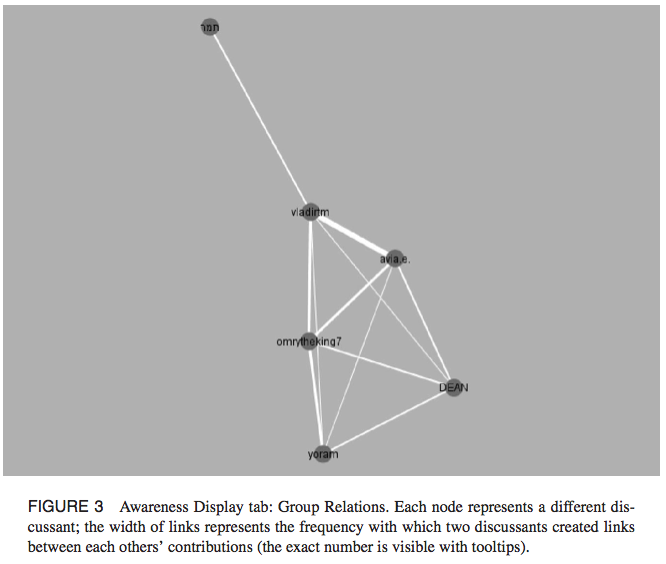
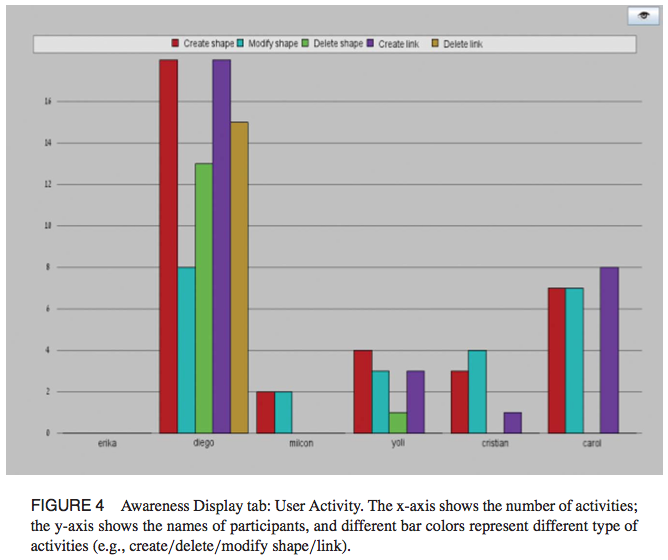
The Group Relations tab (see Figure 3) shows a Social Network diagram, which depicts the relationships or linking patterns between users. The modera- tor can use this tab to assess the extent to which discussants referred to each other and to easily locate ignored users, focal users, or subgroups. The User Activity tab (see Figure 4) displays a histogram-based repre- sentation that reflects the frequency of different discussion operations (e.g., posting/deleting contribution, creating links) by group or by individual. This tab allows the moderator to get a general idea of the level of participation among p. 13
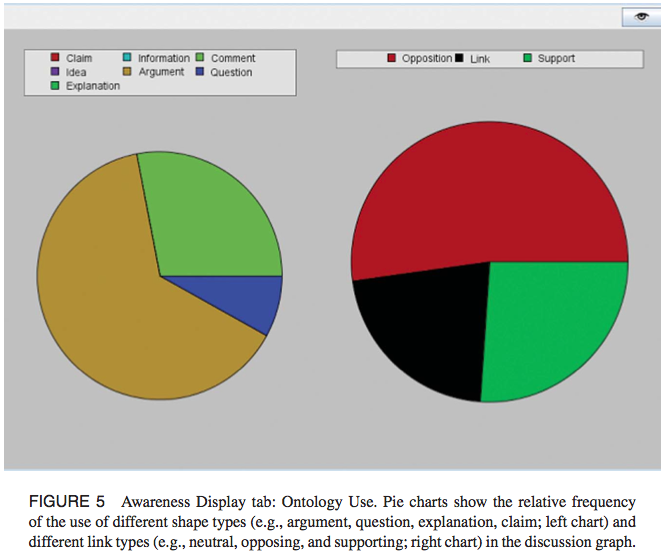
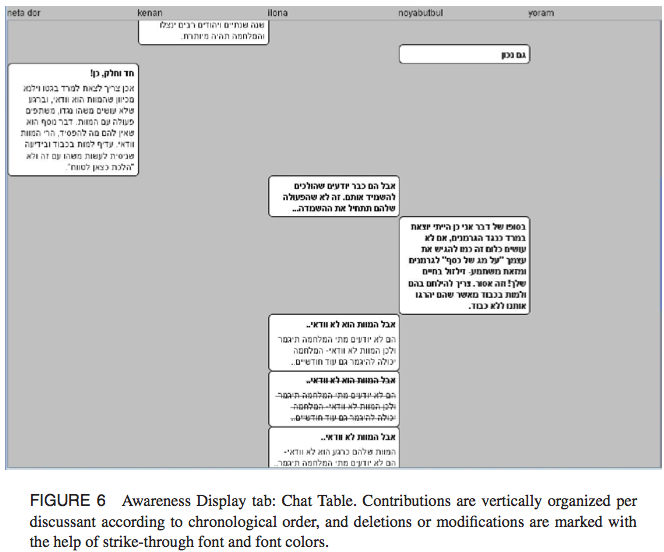
The Ontology Use tab (see Figure 5) contains two pie charts. One pie chart describes the relative distribution of the different dialogue shapes used in a Digalo discussion (e.g., argument, question, or clarification), and the other pie chart describes the distribution of the use of different types of links (e.g., opposition, support, or neutral). These provide the moderator with information on whether students use all different dialogue shapes and whether the extent of agreement or disagreement is consistent with the expectations of acceptable group reasoning. The Chat Table (see Figure 6) gives a textual, chronological representation of the contributions of each discussant in a separate column and can be used to track the course of the discussion over time as well as the development of each participant’s reasoning over the course of the discussion. It also allows the moderator to quickly read the most recent contributions. Each Awareness Display tab may be configured by the moderator (e.g., display by group or by individ- ual). Guidance and more detailed information can be obtained with the help of tooltips. p. 14
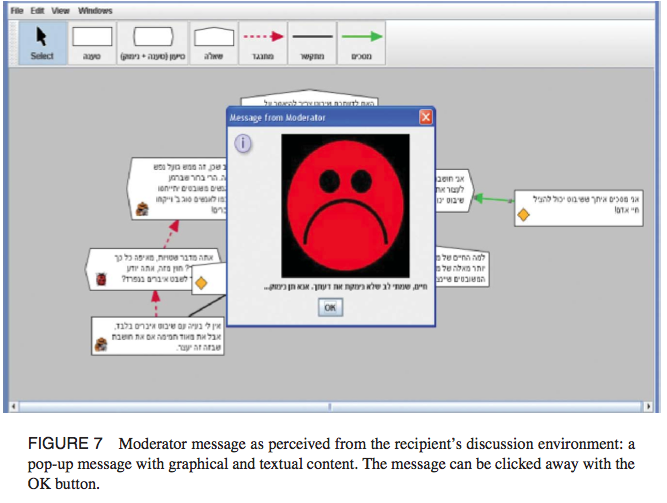
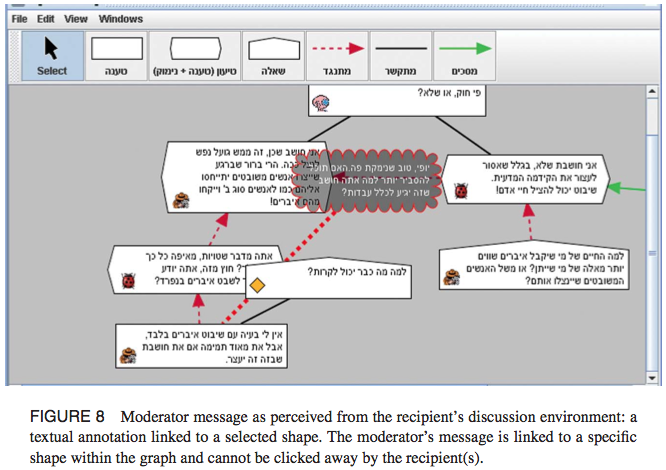
The remote control panel enables real-time moderation of discussions (see bottom row in Figure 2). It offers a collection of tools for intervening in the discussion without actually being defined as one of the map’s discussants and without acting from within the discussion map. The moderator can choose to send these inter- ventions to all groups, selected groups, or selected individuals. This enables both private and public communication, because the interventions are shown on the screens of selected users only. There are three particularly relevant interventions. First, the moderator can send pop-up messages with graphical or textual content to selected users. Pop- up windows do not disappear from the discussant’s screen until the discussant clicks the OK button (see Figure 7 for an example). Second, the moderator may also attach annotated notes to one or more selected contribution shapes so that selected students will see the notes on their own discussion maps (see Figure 8 for an example). The notes are visually distinguishable from the discussants’ contributions. Third, the moderator may highlight shapes in order to draw the p. 15
attention of discussants to a specific shape or group of shapes in the discussion environment. p. 16
● What are the strategies of e-moderation in parallel synchronous discus- sions? ● What are the Argunaut functionalities that mediate the enactment of these strategies? ● Do the e-moderation strategies have some impact on the flow of discussions? p. 16
chose to apply the technique of cued retrospective reporting3 (Van Gog, Kester, Nievelstein, Giesbers, & Paas, 2009) to the study of e-moderation. Accordingly, the actions of moderators and discussants were recorded with the help of screen recordings that showed how participants navigated through the system as well as all of their mouse and keyboard actions. After a short time period (1 or 2 weeks), all moderators and some students were asked to retrospectively report on their thoughts during physical actions of moderation while looking at the screen recording of their behavior in that session. p. 18
Following the warm-up session, each discussant par- ticipated in seven discussions on seven different topics (three discussions were completed during the first meeting, and four discussions were completed during the second meeting). During the first three sessions, group formation was not changed. For the remainder of the sessions (Sessions 3–7), group composition was altered so that each discussant worked with each of the other 11 discussants at least twice. The two first moderators moderated two sessions with Digalo (sin- gle group), three sessions of a single group using the MI, and one session in which they moderated two groups simultaneously with the MI. The third mod- erator, Rhonna, moderated two sessions with two groups working simultaneously (Sessions 5 and 6) and one group with four groups simultaneously (Session 8). p. 19
Our general instruction to the moderators was to intervene whenever participa- tion was not satisfactory, discussants were not critical enough, and/or discussants did not refer to the ideas of their peers. p. 20
Two moderation sessions (one two-group and one four-group session) by Rhonna were recorded with screen-recording software and converted to video files. These video files then displayed all of the moderator actions and all of the information received by the moderator within a given session. In addition, the actions of several discussants were videotaped with the same screen-recording technique. Immediately after the experiment, Rhonna wrote a self-report in her notebook (although she was not asked to do so). Two weeks following the experiment we interviewed Rhonna and asked her to retrospectively com- ment on her actions while looking at the video files of her sessions. Rhonna’s comments were audio-recorded in synchronization with the screen-recording files. p. 21
We focus on Rhonna’s moderation of two sessions concerning the advantages and disadvantages of organized Holocaust education trips for teenagers to Poland (hereafter, TP) and whether the Gay Parade should be held in Jerusalem (hereafter, GP). We looked at the two video files (screen recordings and verbal comments by Rhonna). The duration of these two files was 35 min for TP and 32 min for GP. We first transcribed them and identified critical moments. We adopted both a top- down and a bottom-up approach for identifying the critical moments. Concerning the top-down approach, we searched for moments of collaborative reasoning, such as moments in which Rhonna encouraged participation, fostered the enactment of argumentative moves and the development of arguments, and made reference to peers’ arguments. From a bottom-up approach, we searched for moments in which it was possible to identify sequences of moderation actions in the video screen that were explicitly mentioned by Rhonna in her cued retrospective reporting sessions to help discussants in attaining a specific goal. We then invited students who were part of these critical e-moderation moments for follow-up interviews. We present our analysis of TP (which involved two groups) and of GP (which involved four groups) in two separate analyses. p. 21
After a little more than 1 min, Rhonna noticed that one of the students, Sohier, who was a Christian Arab, had difficulties engaging in the discussion. Rhonna made an effort to include her through a private care strategy. p. 22
Encouraging groups to open new perspectives with generic prompts. The new strategy that developed is described in Table 3. It emerged from the impression that Rhonna developed while quickly skimming over the discussion graph of group3 (2.a). She saw that the color of the links were black (3.1), some- thing that suggested that discussants were referring to others to further elaborate on their own ideas but that they were not confronting their peers’ ideas. She then decided to send a pop-up message to all of the discussants in the group to invite them to be more dialectic (3.b). Before sending the message, she confirmed her impression through hovering over the contributions in the discussion map (3.c), only to recognize that the participants of this group had already dealt with solutions and concessions around the contribution of Guy—a secular and liberal student (3.2)—instead of really discussing the issue. Because Rhonna had partici- pated in parallel discussions, she turned to group4 without waiting to see whether discussants were responsive to her invitation. As in group3, she quickly recog- nized a global characteristic of the discussion—in this case, premature agreement (3.3) and arguments exclusively relying on the value of memory to commemorate the Holocaust (3.4). Here also she estimated that the discussion was not dialectical enough and intervened in a generic and general way to ask for more perspectives using a pop-up message sent to all discussants (3.d). p. 23
The complexity of the discussion was growing rapidly with more contributions and more links between them. Rhonna faced a difficult challenge, especially as she intermittently traced the development of each discussion. However, as shown in Table 5, the different awareness tools helped at that point of the discussion to deepen the discussion space: Rhonna, who had initially gotten an impression of the course of the discussion by hovering over shapes of the discussion map, now used other awareness tools. She scrolled the Chat Table (5.a) to cope with the increasing complexity involved in grasping the development of ideas (5.1) for each discussant. In her interview, the terms she used to explain this way to browse the discussion was “to see what’s going on” (5.1), “to confirm my impression” (5.2), and “let’s see in depth” (5.3). p. 26
Interesting that facilitator also brings ideas between sessions. p. 28
This critical moment exemplifies the fact that the MI enables highlighting and annotating but leaves the discussion map intact and allows for a distance between the moderator and discussants that is midway between not intruding and caring. p. 28
The next step in Rhonna’s moderation was to check that her actions had been effective. Such an action is natural when a teacher leads face-to-face discussions. But checking effectiveness is a complicated endeavor in multiple synchronous discussions because jumping from one discussion to the other cre- ates natural discontinuities in the teacher’s monitoring of single discussions, and synchronicity makes it difficult to trace the development of even a single discus- sion because of overlaps and independent contributions. In the more advanced stage of the TP discussions we see how Rhonna managed to trace the effective- ness of her interventions. p. 30
Describing the moderation of the four synchronous discussions in parallel is a complex endeavor. Even describing critical moments only would be impossible because of space limitations. Also, describing critical moments has, by defini- tion, a local character that cannot render the passage between different discussion groups. It was therefore decided to describe this complex activity using a graphi- cal representation displaying global features. The graphical representation appears in Figure 9. It is organized in four bars, and each bar represents a particular dis- cussion group. The vertical axis represents time. Each rectangle within the bars represents a category of certain moderator actions. The list of action categories and their distinctive graphical displays appears in the legend of Figure 9. To simplify the list, we often gathered several actions within the same category. For example, the category Skimming over a map view includes, among other things, scrolling the map view up and down, selecting a (group of) discussant(s) from the User list, skimming over the contributions of the selected discussants in the map view, and hovering over shapes to read the content of the contributions belonging to the same category. We also gathered all uses of all graphical Awareness Display p. 34
tabs (Group Relations, User Activity, Ontology Use) under the same category. The extent of intrusion reflected in the moderator’s actions is expressed by the degree of darkness inside the rectangle. For example, skimming over a map, scrolling up and down a Chat Table, or using graphical awareness tools are actions without any intrusive character, and they are therefore white. Interventions such as highlight- ing, sending a pop-up, sending an annotated message, and combining a message with highlighting are colored with increasingly darker gray tones, in that order. The thickness of the borders expresses the degree to which an awareness tab is able to explicitly display the content and development of ideas. The Chat Table is the most explicit and therefore has the thickest border, followed (in decreas- ing order) by the Discussion Graph tab and the Ontology (pie charts) and Group Relations tabs, which display only global discussion characteristics. p. 35
Not clear what has been added while moderator was away - makes it harder to get back in the flow. p. 35
She adopted a new strategy, which consisted of tempering cer- tain explicit student postings that might have been offensive (e.g., “The religious have the nerve of imposing their views on secular citizens”) or unfounded over- generalizations (e.g., “Most people in Jerusalem are against the Gay Parade”). For this purpose, she capitalized on the personal one-to-one communication chan- nels that the MI offered. Such a strategy cooled down the discussion and directed energies toward critical yet constructive thinking. It is remarkable that Rhonna did not disclose her personal opinion on the issue and functioned as a moderator. p. 38
But we should say that an aspect of this synergy is self- evident: The MI is central in all the strategies deployed by Rhonna in her two multiple discussions. The trivial function afforded by the MI—the ability to smoothly and instantly move between groups combined with the persistence of previous contributions—is the context of all acts of moderation. Another leitmotif in our review of moderation strategies is that those strategies reflect our design decisions—developing a system to support e-moderation of collaborative reason- ing in its three dimensions (egalitarian participation, interactional coconstruction, and dialectical argumentation). Similar to synergy, the use of the Argunaut system conveys the fact that the design research program helped the moderator facilitate collaborative reasoning. For example, reference to peers was fostered through the use of the Ontology tab, which afforded the facilitation of collaborative reasoning as it assisted Rhonna in identifying deficiencies in reference to peer contribu- tions. Also, Rhonna identified deficiencies in dialectical argumentation through the Link Pie Chart in which she noticed that only (green) arrows of agreement had been used. This identification led her to open new perspectives in students with the help of generic prompts. Specificity, we believe, is nevertheless necessary to evi- dence more clearly that the e-moderation strategies deployed realized a synergy between the moderator and the Argunaut system and were aimed at promoting collaborative reasoning. p. 39
The other moderation strategies, putting public focus on problematic or sub- stantial contributions and checking the effectiveness of previous moderation actions and possibly acting if needed, are inconceivable in face-to-face teacher- led discussions without bringing to a halt the discussion. The different functions of Argunaut that allow for highlighting specific contributions and directing the attention of group members to potentially pivotal contributions afford these strategies and concretize principles of dialectical argumentation and interactional coconstruction. p. 40
Beyond the idea of synergy and the evidence that the moderator aimed at pro- moting collective reasoning, the description of the strategies shows an important idea—the fact that good moderators realize a balance between care and non- intrusiveness. p. 40
Therefore, the protocols showed that Rhonna incessantly checked whether her past interventions had a further impact on the current development of the discus- sion. Some cases showed clear evidence of success (e.g., the progressive inclusion of Sohier in the discussion or the fact that one student raised an argument on TP that was not linked to collective memory). Some cases showed failures, such as students’ persistent agreement in spite of Rhonna’s interjections to consider new perspectives. Paradoxically, it seemed that the intermittence of her monitoring led her to be attentive to the impact of her interventions. We can conclude that, although we showed on several occasions that the e-moderation actions did not affect the flow of discussions, on all occasions Rhonna’s actions were tied to the students’ ideas, and she always monitored the impact of her moderation. p. 41
We envision that in the next round of the design research cycle, teachers will be able to work with up to 8 groups of 3–4 students and that e-moderation will be partly triggered by alerts such as “X has not been active for 5 min,” “Discussants seem not to challenge each other,” or “The discussion is off topic.” This further step, including artificial intelligence techniques enabling the alerts (McLaren, Scheuer, & Mikšátko, 2010), is beyond the scope of this article. p. 42
This fundamental property of what we would call approximate attunement of the moderator’s actions to the discussants’ ideas, which has been reported to be so difficult to achieve (Yackel, 2002) yet fundamen- tal for effective support of group work (Chiu, 2004), characterizes the potential of moderator support systems such as Argunaut. p. 43
We have carefully added the term approximate to the more commonly used attunement. The latter has good press in cultural and developmental psychology to describe the relations between caregivers and infants in their development (e.g., Rogoff, 1998). Attunement refers to a coordination of actions and to mutuality. It is usually reserved for describing one-on-one interactions with caregivers and is p. 43
not often used to refer to teacher-led classroom discussions. Teachers support- ing small-group student talk cannot monitor and take into consideration the full complexity of group and individual functioning at the same time. They then often enact strategies as ready-to-use scripts that cannot fit the needs of all students. The affordances in systems such as Argunaut allow teachers to attain an approx- imate form of attunement: They may not be able to attain the perfect attunement that is possible in one-on-one interactions, but they can accompany students in the development of their ideas. They can observe; wait; ponder whether to be explicit; ponder whether and when to help; and ponder whether to turn to a whole group, to a subgroup, or to one discussant. p. 44
In a study that compared student-to-student dia- logue with and without teacher intervention, Hogan, Nastasi, and Pressley (2000) found teachers used a variety of questions that aimed at eliciting students’ think- ing about how to create a mental model of the nature of matter. When teachers did make statements, they were repetitions or restatements of students’ ideas and were meant to clarify students’ proposals or to emphasize certain points in students’ statements. Hogan and colleagues found that the benefits of this intense probing of students’ ideas for their scientific reasoning were dependent on the groups’ collab- orative practices when the teacher was not present: Although all groups exhibited a moderate level of scientific reasoning when the teacher intervened, the groups that produced a higher level of reasoning when the teacher was not present were those who benefited from the teacher’s intervention in their further reasoning. p. 44
we should emphasize in light of Hogan et al. (2000) and the present study that the moderation of parallel discussions should be expected to be especially effective for students who have been trained to collaborate in learning tasks. p. 44
A final lesson that can be drawn from our experience concerns the interplay between private and public communication that the system enables. Face-to-face classroom interactions often expose students to challenging events in which lack of knowledge, competence, or motivation become publicly apparent. This may lead to loss of face or undesirable reactions motivated by avoidance of this loss. The Argunaut system provides a new space for supporting classroom group work in which the flexibility in using both private and public communication channels enables instructors to avoid the potential pitfalls of each and to gain from their p. 44
respective advantages: To capitalize on ideas from vivid brainstorming or critical discussions, to capitalize on the public space for broadcasting positive appraisal, to convey managerial communication, and to highlight critical aspects of argu- mentation on the one hand, and to give, receive, and take advantage of personally tailored teacher support without public exposure and potential loss of face on the other. Also, it seems that this flexibility may aid in the delegation of sense-making responsibilities: Rhonna helped boost the commitment of the individual to the col- lective through the private channel. She also committed the collective to selected particular individual contributions because they included worthy ideas or because of their author. p. 45
ch reported here and the development of the Argunaut system was supported by the 6th Framework Program of the European Community (Project 027728). We are grateful to Reuma De Groot and Raul Drachman for coordinating all of the project efforts; to Andreas Harrer, Ulrich Hoppe, Adam Giemza, Rakheli Hever, Matthias Krauβ, Bruce McLaren, and many others for their part in devel- oping the Argunaut system; and to Reuma De Groot, Rupert Wegerif, Maarten de Laat, and Astrid Wichmann for implementing pedagogies in educational settings. REFERENCES Alexander, T. (2008). Towards dialogic teaching: Rethinking classroom talk. North Yorkshire, England: Dialogos. Andriessen, J. E. B., Baker, M. J., & Suthers, D. (2003). Arguing to learn: Confronting cognitions in computer-supported collaborative learning environments. Dordrecht, The Netherlands: Kluwer Academic. Asterhan, C. S. C., & Eisenmann, T. (2009). p. 45
Alexander, T. (2008). Towards dialogic teaching: Rethinking classroom talk. North Yorkshire, England: Dialogos. Andriessen, J. E. B., Baker, M. J., & Suthers, D. (2003). Arguing to learn: Confronting cognitions in computer-supported collaborative learning environments. Dordrecht, The Netherlands: Kluwer Academic. Asterhan, C. S. C., & Eisenmann, T. (2009). Online and face-to-face discussions in the classroom: A study on the experiences of “active” and “silent” students. In C. O’Malley, D. Suthers, P. Reimann, p. 45
Online and face-to-face discussions in the classroom: A study on the experiences of “active” and “silent” students p. 45
nline and face-to-face discussions in the classroom: A study on the experiences of “active” and “silent” students. p. 45
& A. Dimitracopoulou (Eds.), Computer supported collaborative learning practices: CSCL2009 conference proceedings (pp. 132–136). Rhodes, Greece. Asterhan, C. S. C., & Schwarz, B. B. (2007). The effects of monological and dialogical argumentation on concept learning in evolutionary theory. Journal of Educational Psychology, 99, 626–639. Asterhan, C. S. C., & Schwarz, B. B. (2009a). The role of argumentation and explanation in con- ceptual change: Indications from protocol analyses of peer-to-peer dialogue. Cognitive Science, 33, 373–399. Asterhan, C. S. C., & Schwarz, B. B. (2009b). Transformation of robust misconceptions through peer argumentation. In B. B. Schwarz, T. Dreyfus, & R. Hershkowitz (Eds.), Transformation of knowledge through classroom interaction (pp. 159–172). New York, NY: Routledge. Asterhan, C. S. C., & Schwarz, B. B. (2010). On-line moderation of small group discussions. International Journal of Computer-Supported Collaborative Learning, 5, 259–282. Asterhan, C. S. C., Wichmann, A., Mansour, N., Wegerif, R., Hever, R., Schwarz, B., & Williams, M. (2008). ARGUNAUT deliverable D6.3: Evaluation report on the pedagogical content of the Argunaut system. Retrieved from http://www.argunaut.org/publications/publications/argunautpublications Chi, M. T. H., Siler, S., Jeong, H., Yamauchi, T., & Hausmann, R. (2001). Learning from human tutoring. Cognitive Science, 25, 471–534. Chin, C., & Osborne, J. (2010). Supporting argumentation through students’ questions: Case studies in science classrooms. Journal of the Learning Sciences, 19, 230–284. Chiu, M. M. (2004). Adapting teacher interventions to student needs during cooperative learning: How to improve student problem solving and time on-task. American Educational Research Journal, 41, 365–399. Cho, K. L., & Jonassen, D. H. (2002). The effects of argumentation scaffolds on argumentation and problem solving. Educational Technology: Research & Development, 50, 5–22. Clark, A. M., Anderson, R. C., Archodidou, A., Nguyen-Jahiel, K., Kuo, L.-J., & Kim, I. (2003). Collaborative reasoning: Expanding ways for children to talk and think in the classroom. Educational Psychology Review, 15, 181–198. Collins, A., Joseph, D., & Bielaczyc, K. (2004). Design research: Theoretical and methodological issues. Journal of the Learning Sciences, 13, 15–42. Cress, U., Kimmerle, J., & Hesse, F. W. (2009). Impact of temporal extension, synchronicity, and group size on computer-supported information exchange. Computers in Human Behavior, 25, 731–737. De Groot, R., Drachman, R., Hever, R., Schwarz, B. B., Hoppe, U., Harrer, A., . . . Baurens, B. (2007). Computer supported moderation of e-discussions: The ARGUNAUT approach. In C. A. Chinn, G. Erkens, & S. Puntambekar (Eds.), Mice, minds, and society: Proceedings of the 2007 Computer Supported Collaborative Learning (CSCL) Conference (pp. 165–167). New Brunswick, NJ: Rutgers University. Dillenbourg, P. (2002). Over-scripting CSCL: The risks of blending collaborative learning with instructional design. In P. A. Kirschner (Ed.), Three worlds of CSCL: Can we support CSCL? (pp. 61–91). Heerlen, The Netherlands: Open Universiteit Nederland. Gil, J., Schwarz, B. B., & Asterhan, C. S. C. (2007). Intuitive moderation styles and beliefs of teachers in CSCL-based argumentation. In C. A. Chinn, G. Erkens, & S. Puntambekar (Eds.), Mice, minds, and society: Proceedings of the 2007 Computer Supported Collaborative Learning (CSCL) Conference (pp. 219–229). New Brunswick, NJ: Rutgers University. Gillies, R. M. (2004). The effects of communication training on teachers’ and students’ verbal behaviors during cooperative learning. International Journal of Educational Research, 41, 257–279. Gillies, R. M., & Khan, A. (2009). Promoting reasoned argumentation, problem-solving and learning during small-group work. Cambridge Journal of Education, 39, 7–27. Goodyear, P., Salmon, G., Spector, J., Steeples, C., & Tickner, S. (2001). Competencies for online teaching: A special report. Educational Technology Research and Development, 1, 65–72. p. 46
Guiller, J., Durndell, A., & Ross, A. (2008). Peer interaction and critical thinking: Face-to-face or online discussion. Learning and Instruction, 18, 187–200. Herring, S. C. (2004). Computer-mediated discourse analysis: An approach to researching online behavior. In S. A. Barab, R. Kling, & J. H. Gray (Eds.), Designing for virtual communities in the service of learning (pp. 338–376). New York, NY: Cambridge University Press. Hesse, F. W. (2007). Being told to do something or just being aware of something? An alternative approach to scripting in CSCL. In F. Fischer, I. Kollar, H. Mandl, & J. Haake (Eds.), Scripting computer-supported collaborative learning: Cognitive, computational and educational perspectives (pp. 91–98). New York, NY: Springer-Verlag. Hever, R., De Groot, R., De Laat, M., Harrer, A., Hoppe, U., McLaren, B. M., & Scheuer, O. (2007). Combining structural, process-oriented and textual elements to generate alerts for graph- ical e-discussions. In C. A. Chinn, G. Erkens, & S. Puntambekar (Eds.), Mice, minds, and society: The 2007 Computer Supported Collaborative Learning (CSCL) Conference (pp. 286–288). New Brunswick, NJ: Rutgers University. Hmelo-Silver, C. E., & Barrows, H. S. (2006). Goals and strategies of a problem-based learning facilitator. Interdisciplinary Journal of Problem-Based Learning, 1(1), 21–39. Hmelo-Silver, C. E., & Barrows, H. S. (2008). Facilitating collaborative knowledge building. Cognition and Instruction, 26, 48–94. Hogan, K., Nastasi, B. K., & Pressley, M. (2000). Discourse patterns and collaborative scientific reasoning in peer and teacher-guided discussions. Cognition and Instruction, 17, 379–432. Hoppe, H. U., De Groot, R., & Hever, R. (2009). Implementing technology-facilitated collaboration and awareness in the classroom: Roles for teachers, educational and technology researchers. In B. B. Schwarz, T. Dreyfus, & R. Hershkowitz (Eds.), Transformation of knowledge through classroom interaction: New perspectives in learning and instruction (pp. 130–142). New York, NY: Routledge. Hoppe, H. U., & Gaßner, K. (2002). Integrating collaborative concept mapping tools with group mem- ory and retrieval functions. In G. Stahl (Ed.), Proceedings of the CSCL conference: Foundations for a CSCL community (pp. 716–725). Boulder, CO: Erlbaum. Jeong, A., & Joung, S. (2007). Scaffolding collaborative argumentation in asynchronous discussions with message constraints and message labels. Computers & Education, 48, 427–445. Kim, I-H., Anderson, R. C., Nguyen-Jahiel, K., & Archodidou, A. (2007). Discourse patterns during children’s collaborative online discussions. Journal of the Learning Sciences, 16, 333–370. Kuhn, D., Shaw, V., & Felton, M. (1997). Effects of dyadic interaction on argumentative reasoning. Cognition & Instruction, 15, 287–315. Lipman, M. (1991). Thinking in education. New York, NY: Cambridge University Press. McLaren, B. M., Scheuer, O., De Laat, M., Hever, R., De Groot, R., & Rosé, C. P. (2007). Using machine learning techniques to analyze and support mediation of student e-discussions. In R. Luckin, K. R. Koedinger, & J. Greer (Eds.), Proceedings of the 13th International Conference on Artificial Intelligence in Education (AIED-07), Artificial Intelligence in Education: Building Technology Rich Learning Contexts That Work (pp. 331–338). Amsterdam, The Netherlands: IOS Press. McLaren, B. M., Scheuer, O., & Mikšátko, J. (2010). Supporting collaborative learning and e-discussions using artificial intelligence techniques. International Journal of Artificial Intelligence in Education, 20, 1–46. Mercer, N. (1995). The guided construction of knowledge: Talk amongst teachers and learners. Clevedon, England: Multilingual Matters. Mercer, N. (2000). Words and minds: How we use language to think together. New York, NY: Routledge. Mercer, N., Wegerif, R., & Dawes, L. (1999). Children’s talk and the development of reasoning in the classroom. British Educational Research Journal, 25(1), 95–111. Mollo, V., & Falzon, P. (2004). Auto- and allo-confrontation as tools for reflective activities. Applied Ergonomics, 35, 531–540. p. 47
Newman, G., Webb, B., & Cochrane, C. (1995). A content analysis method to measure critical thinking in face-to-face and computer supported group learning. Interpersonal Computing and Technology, 3(2), 56–77. O’Donnell, A. M. (2006). The role of peers and group learning. In P. Alexander & P. Winne (Eds.), Handbook of educational psychology (2nd ed.) (pp. 781–802). Mahwah, NJ: Erlbaum. Packham, G., Jones, P., Thomas, B., & Miller, C. (2006). Student and tutor perspectives of on-line moderation. Education & Training, 48(4), 241–251. Resnick, L. B., Michaels, S., & O’Connor, C. (2010). How (well structured) talk builds the mind. In D. Preiss & R. Sternberg (Eds.), Innovations in educational psychology: Perspectives on learning, teaching and human development (pp. 163–194). New York, NY: Springer. Reznitskaya, A., Anderson, R. C., & Kuo, L-J. (2007). Teaching and learning argumentation. Elementary School Journal, 107, 449–472. Reznitskaya, A., Anderson, R. C., McNurlen, B., Nguyen-Jahiel, K., Archodidou, A., & Kim, S. (2001). Influence of oral discussion on written argument. Discourse Processes, 32, 155–157. Rogoff, B. (1998). Cognition as a collaborative process. In W. Damon & D. Kuhn (Eds.), Handbook of child psychology (5th ed., Vol. 4, pp. 679–744). New York, NY: Wiley. Rummel, N., & Spada, H. (2005). Learning to collaborate: An instructional approach to promoting collaborative problem-solving in computer-mediated settings. Journal of the Learning Sciences, 14, 201–241. Rummel, N., Spada, H., & Hauser, S. (2009). Learning to collaborate while being scripted or by observing a model. International Journal of Computer-Supported Collaborative Learning, 4, 69–92. Salmon, G. (2004). E-moderating: The key to teaching and learning online. London, England: Taylor & Francis. Scardamalia, M. (2004). CSILE/Knowledge Forum®. In A. Kovalchick & K. Dawson (Eds.), Education and technology: An encyclopedia (pp. 183–192). Santa Barbara, CA: ABC-CLIO. Scardamalia, M., & Bereiter, K. (2006). Knowledge building: Theory, pedagogy and technology. In K. Sawyer (Ed.), Cambridge handbook of the learning sciences (pp. 97–118). New York, NY: Cambridge University Press. Schwarz, B. B., Asterhan, C. S. C., & Gil, J. (2009). Human guidance of synchronous e-discussions: The effects of different moderation scripts on peer argumentation. In C. O’Malley, D. Suthers, P. Reimann, & A. Dimitracopoulou (Eds.), Computer supported collaborative learning practices: CSCL2009 conference proceedings (pp. 497–506). Rhodes, Greece. Schwarz, B. B., & De Groot, R. (2007). Argumentation in a changing world. International Journal of Computer-Supported Collaborative Learning, 2, 297–313. Schwarz, B. B., & Glassner, A. (2007). The role of floor control and of ontology in argumentative activities with discussion-based tools. International Journal of Computer Supported Collaborative Learning, 2, 449–478. Schwarz, B. B., Neuman, Y., & Biezuner, S. (2000). Two “wrongs” may make a right . . . If they argue together! Cognition & Instruction, 18, 461–494. Schwarz, B. B., Neuman, Y., Gil, J., & Ilya, M. (2003). Construction of collective and individual knowledge in argumentative activity: An empirical study. Journal of the Learning Sciences, 12, 219–256. Slavin, R. E. (1995). Cooperative learning (2nd ed.). Boston, MA: Allyn & Bacon. Suler, J. (2004). The online disinhibition effect. Cyberpsychology & Behavior, 7, 321–326. Suthers, D. D. (2003). Representational guidance for collaborative inquiry. In J. Andriessen, M. Baker, & D. Suthers (Eds.), Arguing to learn: Confronting cognitions in computer-supported collaborative learning environments (pp. 27–46). Dordrecht, The Netherlands: Kluwer Academic. Tolmie, A. K., Topping, K. J., Christie, D., Donaldson, C., Howe, C., Jessiman, E., . . . Thurston, K. (2010). Social effects of collaborative learning in primary school. Learning & Instruction, 20, 177–191. p. 48
Van Gog, T., Kester, L., Nievelstein, F., Giesbers, B., & Paas, F. (2009). Uncovering cognitive processes: Different techniques that can contribute to cognitive load research and instruction. Computers in Human Behavior, 25, 325–331. Webb, N. M. (2009). The teacher’s role in promoting collaborative dialogue in the classroom. British Journal of Educational Psychology, 79, 1–28. Webb, N. M., & Palincsar, A. S. (1996). Group processes in the classroom. In D. Berliner & R. Calfee (Eds.), Handbook of educational psychology (pp. 841–873). New York, NY: Macmillan. Wegerif, R. (1996). Using computers to help coach exploratory talk across the curriculum. Computers and Education, 26, 51–60. Weinberger, A., Ertl, B., Fischer, F., & Mandl, H. (2005). Epistemic and social scripts in computer- supported collaborative learning. Instructional Science, 33(1), 1–30. Weinberger, A., Stegmann, K., & Fischer, F. (2005). Computer-supported collaborative learning in higher education: Scripts for argumentative knowledge construction in distributed groups. In T. Koschmann, D. Suthers, & T. W. Chan (Eds.), Computer supported collaborative learning 2005: The next 10 years! (pp. 717–726). Mahwah, NJ: Erlbaum. Wells, G. (2007). Semiotic mediation, dialogue and the construction of knowledge. Human Development, 50, 244–274. Yackel, E. (2002). What we can learn from analyzing the teacher’s role in collective argumentation. Journal of Mathematical Behavior, 21, 423–440. Zhang, J., Scardamalia, M., Reeve, M., & Messina, R. (2009). Designs for collective cognitive responsibility in knowledge-building communities. Journal of the Learning Sciences, 18, 7–44. p. 49
Images
p. 6
p. 13
p. 14
p. 15
p. 16
p. 17
p. 17

