Capturing and representing deliberation in participatory planning practices
| Liddo, A. D., & Buckingham Shum, S. (2010, July). Capturing and representing deliberation in participatory planning practices. Retrieved from http://oro.open.ac.uk/22279/. |
BibTex
BibTex
@misc{liddo2010capturing,
author = {Liddo, Anna De and Buckingham Shum, Simon},
date-added = {2011-04-24 17:23:42 -0400},
date-modified = {2011-08-25 10:57:23 +0000},
howpublished = {http://oro.open.ac.uk/22279/},
keywords = {sensemaking},
month = {jul},
note = {In this paper we argue for the importance of capturing and representing deliberation in participatory planning practices. We discuss the concept of deliberation in planning theory, and argue for a paradigm that puts deliberation at the centre of public participation to planning decision. We argue that in order to enable effective participation, the normally ephemeral delib- eration process needs to be captured and represented so that the information and knowledge gathered during deliberation is visible for all, can be effectively traced, reused, and can actively influence planning decisions. To scaffold this we describe the integration of three technologies to create a collective project memory structured against five dimensions of participatory plan- ning processes: dialogical, social, spatial, temporal and causal. Based on several authentic par- ticipatory planning cases, we report that this supported deliberation across planning tasks, communication modes, time and environments. The coupled use of online and offline group- ware technologies created a more expressive and transparent participatory knowledge base than is possible with conventional media, and enhanced participatory planning by: supporting the effective capture and representation of deliberation processes and products; providing a rich picture of the social setting in which planning decision develops and supporting reflection in and on planning actions.},
read = {1},
title = {Capturing and representing deliberation in participatory planning practices},
type = {Conference Item},
url = {http://oro.open.ac.uk/22279/},
year = {2010},
bdsk-file-1 = {YnBsaXN0MDDUAQIDBAUIJidUJHRvcFgkb2JqZWN0c1gkdmVyc2lvblkkYXJjaGl2ZXLRBgdUcm9vdIABqAkKFRYXGyIjVSRudWxs0wsMDQ4RElpOUy5vYmplY3RzViRjbGFzc1dOUy5rZXlzog8QgASABoAHohMUgAKAA1lhbGlhc0RhdGFccmVsYXRpdmVQYXRo0hgMGRpXTlMuZGF0YU8RAYgAAAAAAYgAAgAAB1NTREhvbWUAAAAAAAAAAAAAAAAAAAAAAAAAAMl5T9hIKwAAANrWUhZsaWRkbzIwMTBjYXB0dXJpbmcucGRmAAAAAAAAAAAAAAAAAAAAAAAAAAAAAAAAAAAAAAAAAAAAAAAAAAAAAAAGdKvPy9dGOVBERiBDQVJPAAIAAgAACSAAAAAAAAAAAAAAAAAAAAAHQmliZGVzawAAEAAIAADJeZYoAAAAEQAIAADL1355AAAAAQAMANrWUgAXPTEAAZ9eAAIANVNTREhvbWU6VXNlcnM6AFN0aWFuOgBCaWJkZXNrOgBsaWRkbzIwMTBjYXB0dXJpbmcucGRmAAAOAC4AFgBsAGkAZABkAG8AMgAwADEAMABjAGEAcAB0AHUAcgBpAG4AZwAuAHAAZABmAA8AEAAHAFMAUwBEAEgAbwBtAGUAEgAqVXNlcnMvU3RpYW4vYmliZGVzay9saWRkbzIwMTBjYXB0dXJpbmcucGRmABMAAS8AABUAAgAM//8AAIAF0hwdHh9YJGNsYXNzZXNaJGNsYXNzbmFtZaMfICFdTlNNdXRhYmxlRGF0YVZOU0RhdGFYTlNPYmplY3RfECQuLi8uLi9iaWJkZXNrL2xpZGRvMjAxMGNhcHR1cmluZy5wZGbSHB0kJaIlIVxOU0RpY3Rpb25hcnkSAAGGoF8QD05TS2V5ZWRBcmNoaXZlcgAIABEAFgAfACgAMgA1ADoAPABFAEsAUgBdAGQAbABvAHEAcwB1AHgAegB8AIYAkwCYAKACLAIuAjMCPAJHAksCWQJgAmkCkAKVApgCpQKqAAAAAAAAAgEAAAAAAAAAKAAAAAAAAAAAAAAAAAAAArw=}
}
Links here
Highlights (20%)
Abstract: In this paper we argue for the importance of capturing and representing deliberation in participatory planning practices. We discuss the concept of deliberation in planning theory, and argue for a paradigm that puts deliberation at the centre of public participation to planning decision. We argue that in order to enable effective participation, the normally ephemeral delib- eration process needs to be captured and represented so that the information and knowledge gathered during deliberation is visible for all, can be effectively traced, reused, and can actively influence planning decisions. To scaffold this we describe the integration of three technologies to create a collective project memory structured against five dimensions of participatory plan- ning processes: dialogical, social, spatial, temporal and causal. Based on several authentic par- ticipatory planning cases, we report that this supported deliberation across planning tasks, communication modes, time and environments. The coupled use of online and offline group- ware technologies created a more expressive and transparent participatory knowledge base than is possible with conventional media, and enhanced participatory planning by: supporting the effective capture and representation of deliberation processes and products; providing a rich picture of the social setting in which planning decision develops and supporting reflection in and on planning actions. p. 2
A growing body of evidence confirms that in the hands of appropriately skilled facilitators and analysts, software tools for mapping the structure of deliberations and arguments can be used successfully to add value to policy consultations by clarifying the relationships between key issues, positions and arguments (e.g. Renton and Macintosh 2007; Ohl 2008; van Gelder 2003). p. 2
In particular the concept of planning as communicative process dates back to Haber- mas’s communicative rationality. Habermas introduced a utopian model of communicative ar- ena in which all participants know and share communication rules and objectives, and have ac- cess to the same exhaustive base of information (Habermas 1981). These conditions are not realistic in a genuine deliberative arena, where information and power are non-homogeneously distributed, rules are unknown or misunderstood, and objectives are often hidden and adversary. Based on this assumption, we consider Habermas’s point of departure, at the most, as a utopian vision to which planning as communicative process could aim. p. 3
Our approach builds on the idea of deliberative arenas but takes a more practical metaphor of design as “making sense together in practical conversation” (Forester 1984). This metaphor was first proposed by Forester in the early 1980s, and argues that planning should be construed as sensemaking, aiming to build mutual understanding through a process of design deliberation which involves diverse expertise, organizations, interests groups and community members. In such an approach, participation and citizen involvement should not manifest as a mere ‘transla- tion’ of community knowledge into technical language, nor should it be an attempt to devolve planning tasks and responsibilities to the community level. Participation is, rather, part of the design process conceived as “sensemaking”, that is an interpretative process of problem- definition and problem-setting, a process of making sense together in practical planning conver- sation. p. 3
Compendium p. 5
The use of the tool we describe in this paper is more as knowledge management system for deliberation rather than argument visualization. p. 5
Each contribution is represented as a node in the hypermedia database, and is indexed according to key descriptors of the deliberation process, which are organized coherently against five dimensions of participa- tory planning processes: dialogical, social, spatial, temporal and causal. p. 5
Social Dimension: Since one of the main advantages of structuring and representing deliber- ation is the possibility to draw a picture of the social setting in which planning develops, it is important to trace which stakeholders are making the claim and in which organizational con- texts they are involved. p. 5
Temporal Dimension: Since deliberation is a process that spans the entire participatory planning process, time is considered key to contextualize deliberation contents to planning actions, so we can track when in the planning process something was said. p. 5
Spatial Dimension: The spatial dimension is considered constitutive because in participatory planning processes, people’s statements often need to be linked to geographical areas or to spa- tial objects. p. 5
Dialogical Dimension: The dialogical dimension represent dialogues and arguments. This di- mension shows the dialogical and argumentative content of the statement and the context of discussion in which it has been raised. p. 5
Causal Dimension or Rationale: It refers to the causal chains of arguments that motivate deci- sions and offers a representation of the planning design rationale. p. 6
If planning is intended to be participatory and empowering, who controls the records (whether maps or conventional notes) is clearly a significant issue. The work of Bowker and Star (1999) reminds us that classification schemes can be used to erase from collective memory, as well as to assist it: material which cannot be easily classified in an information system or controlled vo- cabulary may not be recorded at all. Thus, we can envisage that if it was cognitively hard to classify and connect a stakeholder’s contribution using a particular discourse modelling scheme, there would be the risk that it was not recorded. Cartography is never neutral, whether spatial, or in the above case, conceptual. The mapping process introduces an important level of discretion as the mapper interprets deliberations (either live, or in this case post hoc) in order to create hy- permedia maps, e.g. naming, classifying, linking, summarising — there is an unavoidable ethi- cal dimension to this practice (for detailed analyses of what constitutes the practice of ‘know- ledge cartography’, see Buckingham Shum, et al. 1997; Selvin, et al. 2010). p. 7
Although FM was designed to support online video- conferences, we also used FM to create reusable deliberation records from face-to-face meet- ings, since it provides a set of useful features:
- Meeting recording and replay (within a web browser)
- Who is speaking at any moment
- How many times and for how long they spoke (generating analytics for the moderator)
- Annotation of important moments of the meeting (sharing this with the stakeholders live during the meeting and/or making it available in the replay)
- Annotation of spatial object on maps collaboratively manipulated during the meeting (possibility to take different snapshots of the same map, taking trace of the different an- notations along the meeting, taking trace of the map evolution) p. 8
Enabling asynchronous online deliberation: Compendium-CoPe_it! integration p. 9
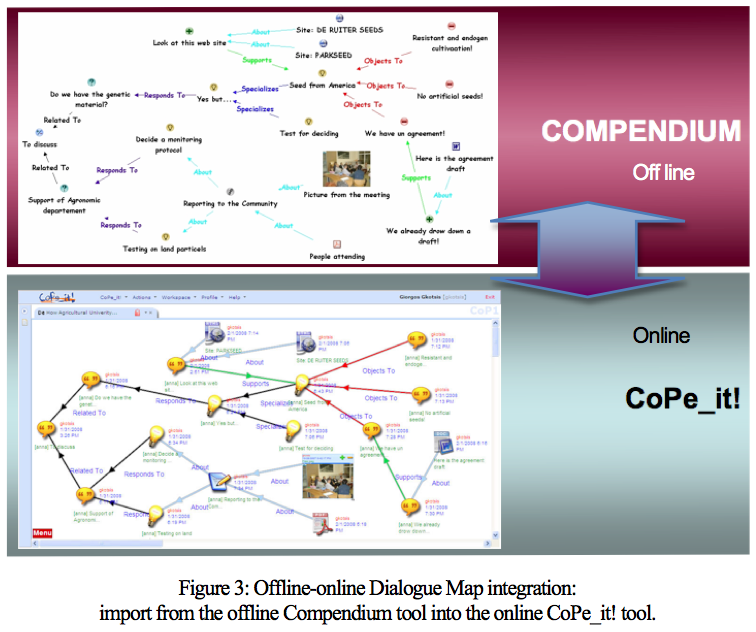
We therefore integrated the offline Compendium tool with CoPe_it!, a web-based tool support- ing collaborative argumentation and decision-making in online communities of practice (Karacapilidis and Tzagarakis 2007). CoPe_it! supports the definition of alternative solutions and the analysis and evaluation of the contents in order to drive groups through decision making processes. We developed an import-export of Compendium hypermedia maps for CoPe_it!, enabling online users to contribute statements and arguments (claims, comments or ideas) to the Compendium maps (Figure 3). p. 9
In this paper we have argued that the deliberation process is central to an authentic understand- ing of participatory planning practices. This has motivated a series of discourse technology inte- gration projects to make deliberation more transparent, that is, recording discourse digitally to make it possible to interrogate the planning project memory in ways not possible with conven- tional documentation, thus making it more rigorous, useful, and accountable. p. 11
We propose that the work summarised in this paper provides evidence that hypermedia dis- course tools help move us from a deliberation process which is often ephemeral, ill-structured and disempowering, to deliberation which is persistent, more coherently structured and partici- patory. p. 12
9. References p. 12
Images
p. 9

