Knowledge media tools for capturing deliberation in participatory spatial planning
| Liddo, A. D., & Buckingham Shum, S. (2008, July). Knowledge media tools for capturing deliberation in participatory spatial planning. Retrieved from http://oro.open.ac.uk/22295/. |
BibTex
BibTex
@misc{liddo2008knowledge,
author = {Liddo, Anna De and Buckingham Shum, Simon},
date-added = {2011-04-24 17:41:02 -0400},
date-modified = {2011-08-20 14:28:27 +0000},
howpublished = {http://oro.open.ac.uk/22295/},
month = {jul},
read = {1},
title = {Knowledge media tools for capturing deliberation in participatory spatial planning},
type = {Conference Item},
url = {http://oro.open.ac.uk/22295/},
year = {2008},
bdsk-file-1 = {YnBsaXN0MDDUAQIDBAUIJidUJHRvcFgkb2JqZWN0c1gkdmVyc2lvblkkYXJjaGl2ZXLRBgdUcm9vdIABqAkKFRYXGyIjVSRudWxs0wsMDQ4RElpOUy5vYmplY3RzViRjbGFzc1dOUy5rZXlzog8QgASABoAHohMUgAKAA1lhbGlhc0RhdGFccmVsYXRpdmVQYXRo0hgMGRpXTlMuZGF0YU8RAYgAAAAAAYgAAgAAB1NTREhvbWUAAAAAAAAAAAAAAAAAAAAAAAAAAMl5T9hIKwAAANrWUhZsaWRkbzIwMDhrbm93bGVkZ2UucGRmAAAAAAAAAAAAAAAAAAAAAAAAAAAAAAAAAAAAAAAAAAAAAAAAAAAAAAAGdKvMy9dGOVBERiBDQVJPAAIAAgAACSAAAAAAAAAAAAAAAAAAAAAHQmliZGVzawAAEAAIAADJeZYoAAAAEQAIAADL1355AAAAAQAMANrWUgAXPTEAAZ9eAAIANVNTREhvbWU6VXNlcnM6AFN0aWFuOgBCaWJkZXNrOgBsaWRkbzIwMDhrbm93bGVkZ2UucGRmAAAOAC4AFgBsAGkAZABkAG8AMgAwADAAOABrAG4AbwB3AGwAZQBkAGcAZQAuAHAAZABmAA8AEAAHAFMAUwBEAEgAbwBtAGUAEgAqVXNlcnMvU3RpYW4vYmliZGVzay9saWRkbzIwMDhrbm93bGVkZ2UucGRmABMAAS8AABUAAgAM//8AAIAF0hwdHh9YJGNsYXNzZXNaJGNsYXNzbmFtZaMfICFdTlNNdXRhYmxlRGF0YVZOU0RhdGFYTlNPYmplY3RfECQuLi8uLi9iaWJkZXNrL2xpZGRvMjAwOGtub3dsZWRnZS5wZGbSHB0kJaIlIVxOU0RpY3Rpb25hcnkSAAGGoF8QD05TS2V5ZWRBcmNoaXZlcgAIABEAFgAfACgAMgA1ADoAPABFAEsAUgBdAGQAbABvAHEAcwB1AHgAegB8AIYAkwCYAKACLAIuAjMCPAJHAksCWQJgAmkCkAKVApgCpQKqAAAAAAAAAgEAAAAAAAAAKAAAAAAAAAAAAAAAAAAAArw=}
}
Links here
Highlights (22%)
Participatory Spatial Planning is a collaborative governance practice in which different stakeholders, from different organizational levels are involved in a collaborative decision-making process. Capturing deliberation along collaborative decision-making processes is a challenging task. Several stakeholders deliberate in different moments, trying to accomplish different tasks, collaborating and communicating with different people and working in different environments. Knowledge derived from parallel processes, driven and interpreted by different actors, needs to be captured, managed and shared in order to make decision-making transparent, shared and accepted by the local communities. p. 2
The main objective of Compenium-CoPe_it! integration is to extend discussions and deliberation started during consultation meetings to a wider community on the web. CoPe_it! is a on line argumentation tool that offers different ways to represent argumentative discussions (for further info please visit http://copeit.cti.gr/site/index.html). CoPe_it! provides on line workspaces in which community members post and share ideas, resources, and arguments collaboratively generating argumentative maps. Users can add different knowledge items: ideas, comments, notes and any local file on his machine like (word files, pdf, jpg images etc). Knowledge items can be also changed and connected with personalized links. Nodes can be arranged and moved freely in the workspace, and they can also be clustered using adornments. p. 4
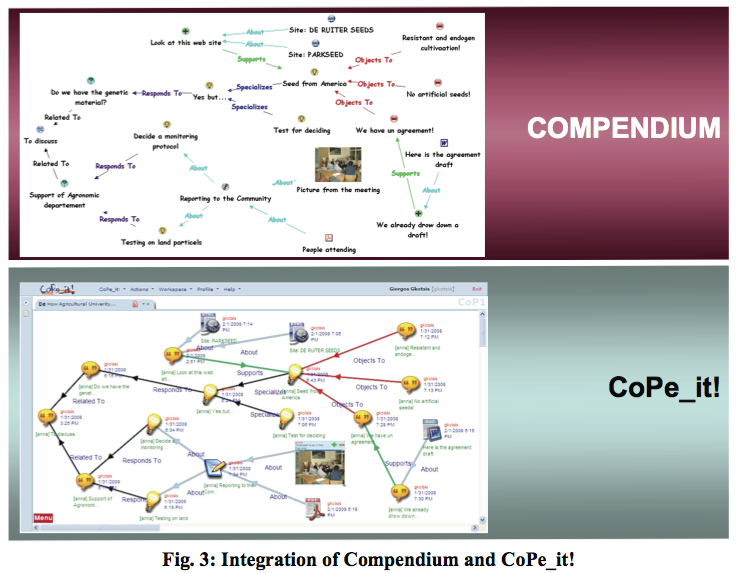
Although addressing different tasks, Compendium and CoPe_it! show high integration potentials mainly because, they share similar communication principles and visualization means. As we see in the following image (Fig. 3) Compendium and Cope_it! provide environments in which knowledge objects like statements, narratives, images, documents can be represented and organized as nodes and links in a graph like structure. In essence, CoPe_it! makes some Compendium features available on line [3]. p. 4
References p. 5
Images
p. 5

