From participatory to contributory simulations: changing the game in the classroom

| Kreitmayer, S., Rogers, Y., Laney, R., & Peake, S. (2012). From participatory to contributory simulations: changing the game in the classroom. In Proceedings of the SIGCHI Conference on Human Factors in Computing Systems (49–58). |
BibTex
BibTex
@inproceedings{kreitmayer2012participatory,
author = {Kreitmayer, Stefan and Rogers, Yvonne and Laney, Robin and Peake, Stephen},
booktitle = {Proceedings of the SIGCHI Conference on Human Factors in Computing Systems},
date-added = {2013-10-11 16:42:57 +0000},
date-modified = {2013-10-11 16:57:40 +0000},
date-read = {2013-10-11 12:57:40 -0400},
keywords = {encore-discuss},
oa-url = {http://oro.open.ac.uk/33544/1/kreitmayer_CHI2012_contributory.pdf},
organization = {ACM},
pages = {49--58},
read = {1},
title = {From participatory to contributory simulations: changing the game in the classroom},
year = {2012},
bdsk-file-1 = {YnBsaXN0MDDUAQIDBAUGJCVYJHZlcnNpb25YJG9iamVjdHNZJGFyY2hpdmVyVCR0b3ASAAGGoKgHCBMUFRYaIVUkbnVsbNMJCgsMDxJXTlMua2V5c1pOUy5vYmplY3RzViRjbGFzc6INDoACgAOiEBGABIAFgAdccmVsYXRpdmVQYXRoWWFsaWFzRGF0YV8QLS4uLy4uL0JpYmRlc2sva3JlaXRtYXllcjIwMTJwYXJ0aWNpcGF0b3J5LnBkZtIXCxgZV05TLmRhdGFPEQGsAAAAAAGsAAIAAAdTU0RIb21lAAAAAAAAAAAAAAAAAAAAAAAAAADJeU/YSCsAAADa1lIfa3JlaXRtYXllcjIwMTJwYXJ0aWNpcGF0b3J5LnBkZgAAAAAAAAAAAAAAAAAAAAAAAAAAAAAAAAAAAAAAAAAADmyhEs59okRQREYgAAAAAAACAAIAAAkgAAAAAAAAAAAAAAAAAAAAB0JpYmRlc2sAABAACAAAyXmWKAAAABEACAAAzn3ahAAAAAEADADa1lIAFz0xAAGfXgACAD5TU0RIb21lOlVzZXJzOgBTdGlhbjoAQmliZGVzazoAa3JlaXRtYXllcjIwMTJwYXJ0aWNpcGF0b3J5LnBkZgAOAEAAHwBrAHIAZQBpAHQAbQBhAHkAZQByADIAMAAxADIAcABhAHIAdABpAGMAaQBwAGEAdABvAHIAeQAuAHAAZABmAA8AEAAHAFMAUwBEAEgAbwBtAGUAEgAzVXNlcnMvU3RpYW4vQmliZGVzay9rcmVpdG1heWVyMjAxMnBhcnRpY2lwYXRvcnkucGRmAAATAAEvAAAVAAIADP//AACABtIbHB0eWiRjbGFzc25hbWVYJGNsYXNzZXNdTlNNdXRhYmxlRGF0YaMdHyBWTlNEYXRhWE5TT2JqZWN00hscIiNcTlNEaWN0aW9uYXJ5oiIgXxAPTlNLZXllZEFyY2hpdmVy0SYnVHJvb3SAAQAIABEAGgAjAC0AMgA3AEAARgBNAFUAYABnAGoAbABuAHEAcwB1AHcAhACOAL4AwwDLAnsCfQKCAo0ClgKkAqgCrwK4Ar0CygLNAt8C4gLnAAAAAAAAAgEAAAAAAAAAKAAAAAAAAAAAAAAAAAAAAuk=}
}
Paper discussed at Encore lab Oct 11, 2013. Design paper discussing interface for environmental game simulation with multiple tablets
Key ideas
Supporting collaborative learning with interactive computer simulations, focusing on 4Decades game, environmental simulation for executives at conferences.
Literature review
Model of simulations
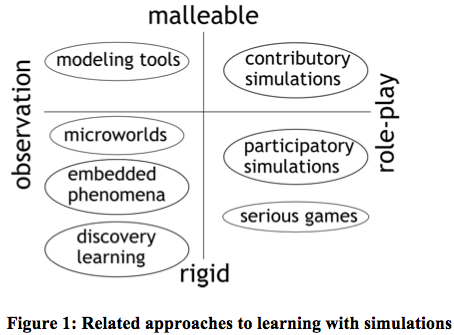
Previous examples
- Participatory Simulations [2,16]
- allow learners to explore a model from the perspective of virtual elements within the simulation
- it has been suggested that Participatory Simulations may be best suited for illustrating the basic idea of a topic, rather than a detailed account [2]. p. 2
- microworlds that were developed in the 1980s [4]
- Scientific Discovery Learning, based on predesigned computational models, in the 1990s [3]
- software tools that allow students to design and test their own systems models, such as
- NetLogo
- StarLogo TNG [9]
- Massively Multiplayer Online Role-Playing Games (MMORPGs)
- Serious Games – again largely played on single user desktop machines. p. 2
- Scientific Discovery Learning [3] is the instructional paradigm which Embedded Phenomena inherit from Participatory Simulations
Transparency
Is the micro-word/simulation a black box to learners, or are the conditions/algorithms exposed, and maybe even changeable?
Learners are presented with predesigned models and predesigned ways of interacting with them or observing their autonomous progression over time. In the context of entertainment oriented simulations of urban planning and biology, Turkle [15] warns that certain ways of interacting with predefined simulations can result in superficial understanding or factually wrong conclusions about the topic, particularly when the underlying models are not revealed to learners.
This call for transparency is inline with Jonassen’s [8] distinction between the black box approach typically taken in microworlds (which Participatory Simulations are a form of [2]) and the glass box approach where the underlying models are explicated and can potentially be modified by learners. Wilensky and Reisman [17] describe such a glass box approach to teaching biological phenomena through scientific modeling. Their approach allows individual students to reflect on emergent properties of complex systems (e.g. the dynamics of predator-prey populations) by manipulating models of local elements (e.g., the behavior of individual animals). p. 2
Technologies
Began with using individual computers - can lead to small groups around each computer. Move to interlinked tablets and ambient displays, “Multiple Linked Representations” which support peer-collaboration as well as individual agency.
Study
At a conference for executives to learn about climate change and mitigation.
Goals
- to give participants concrete experience with concepts and numbers that are central to the workshop curriculum
- to highlight some of the challenges surrounding decision-making under complexity and uncertainty and to provoke a critical discussion about the simulated topic
Key question
What will be the cost of anthropogenic climate change and how should policy makers balance investments between greenhouse gas mitigation, adaptation to climate change and residual repairs within the next 40 years?
Model
Mitigation and adaptation of CO2, across multiple regions. Balancing investment over repeated cycles (decades), goal is to maximize income.
Tech
Network of 8 shareable tablet devices, same simulation in real time (four per time). Large ambient display for each team - score keeping/result of actions.
Constraints
A number of constraints on awareness, control and the availability of information [18] were used with the goal of increasing collaboration.
- The forecast was placed below the four manipulation buttons, so that participants could see the values change directly.
- The rationale was that this would incentivize them to remove their hands immediately after touching it, thus freeing the screen for other collaborators to use.
- A deliberate delay of one second was imposed on the responsiveness of the buttons
- in order to slow down the exploration process, such that other participants could follow the changes more easily.
Runs
Initial run at a conference, participants had already gone through subject material (knew terminology etc). Went well, participants very engaged, but treated simulation as “black box”, felt that it was a “game” where they were “punished/rewarded” by the algorithm. Affordances of the technology worked well to encourage group work.
Second run was in the beginning of a conference (as an ice-breaker), so players needed more time to exchange knowledge of terminology and concepts. This time, they had the opportunity to manipulate final goals (at one point asking for a complex goal, maximize revenue, but if temperature rises above 3C, you lose immediately). Quite successful.
Conclusion
According to the article, key design features that contributed to the success of using the contributory simulation include:
- the transparent interface and distributed system of displays not requiring prior learning or knowledge
- the constraints of the tablet interface (only giving local, short-term information and control), so participants needed to collaborate beyond the tablets in order to effect strategies on a global and long-term level
- the gradual increase of real-time data on the team-shared ambient displays (availability of information)
- no absolute winning condition, but criteria that require teams to compare, interpret and discuss each other’s results
Links here
Highlights (29%)
There is much potential for supporting collaborative learning with interactive computer simulations in formal education and professional training. A number of simulations have been developed for single user and remote interaction. In contrast, our research is concerned with how such learning activities can be designed to fit into colocated large group settings, such as whole classrooms. This paper reports on the iterative design process and two in-thewild evaluations of the 4Decades game, which was developed for a whole classroom of students to engage with a climate simulation. The system allows students to play and change the rules of the simulation, thereby enabling them to be actively engaged at different levels. The notion of Contributory Simulations is proposed as an instructional model that empowers groups to make informed, critical changes to the underlying scientific model. We discuss how large-group collaboration was supported through constraining an ecology of shared devices and public displays. p. 1
In particular, we are interested in how ubiquitous technologies can be used to support simulation-based learning activities that take place during high-profile, multi-day executive training workshops. p. 1
Initially, we designed 4Decades - an interactive learning tool – in the form of a Participatory Simulation that encourages teams to collaboratively explore a given model alongside discussing and reflecting upon uncertainties. When played by two teams in a real-world training context it was found to promote high levels of collaboration and problem-solving. However, it was identified that it could be improved if the simulation could also enable critical changes to be made to the underlying mathematical model as well as interacting with the visible dimensions at the user interface. A second iteration of the simulation was developed, which we called a contributory simulation, distinguishing it from participatory simulations. The main difference is that our simulation enables teams to explore a hypothetical world and revise it. Decisions were made based on outcomes and interventions, through changing the rules of the simulation. The extent to which having this level of functionality aids thinking collaboratively about complex global problems is discussed. p. 1
Participatory Simulations [2,16]. These allow learners to explore a model from the perspective of virtual elements within the simulation. Ubiquitous technologies have been used to immerse large, co-located groups of learners in shared, interactive computer simulations. While such embodied learning experiences with complex systems can be engaging and motivating, it has been suggested that Participatory Simulations may be best suited for illustrating the basic idea of a topic, rather than a detailed account [2]. p. 2
The majority of early computer simulations that were designed to teach complex topics in science, economics, and so on, were at the fixed and observational end of the continuums. They also ran mainly on single-user desktop applications. These include microworlds that were developed in the 1980s [4] and Scientific Discovery Learning, based on predesigned computational models, in the 1990s [3]. More recently, software tools that allow students to design and test their own systems models, such as NetLogo or StarLogo TNG [9] have been developed. These can be defined as more malleable. Other developments include Massively Multiplayer Online Role-Playing Games (MMORPGs) and Serious Games – again largely played on single user desktop machines. p. 2
Scientific Discovery Learning [3] is the instructional paradigm which Embedded Phenomena inherit from Participatory Simulations. Learners are presented with predesigned models and predesigned ways of interacting with them or observing their autonomous progression over time. In the context of entertainment oriented simulations of urban planning and biology, Turkle [15] warns that certain ways of interacting with predefined simulations can result in superficial understanding or factually wrong conclusions about the topic, particularly when the underlying models are not revealed to learners. This call for transparency is inline with Jonassen’s [8] distinction between the black box approach typically taken in microworlds (which Participatory Simulations are a form of [2]) and the glass box approach where the underlying models are explicated and can potentially be modified by learners. Wilensky and Reisman [17] describe such a glass box approach to teaching biological phenomena through scientific modeling. Their approach allows individual students to reflect on emergent properties of complex systems (e.g. the dynamics of predator-prey populations) by manipulating models of local elements (e.g., the behavior of individual animals). p. 2
While desktop machines offer the benefits of sophisticated graphical interfaces and powerful computational resources, their affordances for face-to-face interaction in large groups are limited. In many learning contexts where human-human interaction is at the heart of a topic’s complexity, for example, in management and political science, educators have instead relied on using paper-based interaction and board games. A limitation of such media is that they can consume large amounts of valuable class time and preparation/evaluation and has meant that many educators have refrained from using simulations in their courses [6]. p. 2
An alternative approach that has recently been promoted is to provide interlinked technologies in co-located settings that support face-to-face collaborative learning. Roschelle et al. [13], for example, envision new forms of collaborative interaction taking place in the classroom that goes beyond the limitations of paper and desktops. Potential benefits of this form of real-time collaboration include rapid information sharing within the whole class of students and the teacher’s ability to monitor and mediate interaction. To enable this, one idea is to provide students with a network of tablet computers. AlAgha [1], for example, recently proposed an extensive architecture for classroom collaboration based on multiple networked interactive tabletops. Another benefit of having a heterogeneous mix of devices is that they can provide Multiple Linked Representations (MLR) that can support peer collaboration as well as individual agency [11]. Moher [12] used tablet devices combined with low-tech ambient displays. p. 2
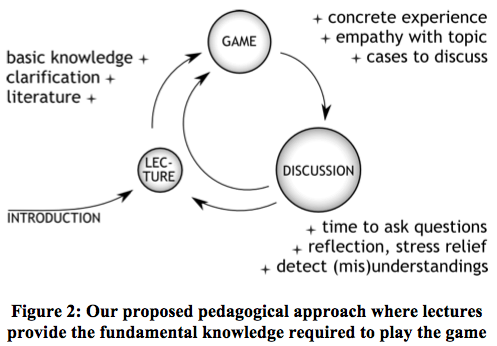
Figure 2 illustrates how we proposed the simulation game being integrated with lectures and discussions and how the different stages contributed to each other. It is cyclical in nature, showing how subsequent cycles of the game and discussions can be augmented with ad-hoc lectures. p. 3
The activity was expected to address a number of learning goals: to give participants concrete experience with concepts and numbers that are central to the workshop curriculum; to highlight some of the challenges surrounding decision-making under complexity and uncertainty and to provoke a critical discussion about the simulated topic. It was agreed that the simulation should challenge participants to address the question: What will be the cost of anthropogenic climate change and how should policy makers balance investments between greenhouse gas mitigation, adaptation to climate change and residual repairs within the next 40 years? p. 4
A simple economic model (see Figure 3) was designed, intended to enable participants, in the role of governments, to control spendings in terms of CO2 mitigation and adaptation to global climate change effects. On the one hand, both mitigation and adaptation cost money. On the other hand, both have the potential to save (more) money indirectly by reducing climate-related damage in different ways. Balancing investments over repeated cycles (decades) becomes a challenge when the goal is to maximize income. By providing participants with multiple copies of this model – which were termed regions, in order to avoid comparison with real countries – and linking the regions with a shared global temperature, the climateeconomic situation of several governments on one planet is approximated. The model was set so that mitigation spending benefits the whole planet, whereas adaptation spending only benefits a single region that spends the money. This set of rules gives rise to a socially complex ‘tragedy of the commons’ situation that it was hoped would encourage collaboration within teams. p. 4
Additional constraints on interaction were imposed through external control of the networked tablets. In particular, the facilitator controlled the timing of the game rounds. Between game rounds, the tablets turned into a noninteractive state, to make it easier for the facilitator to draw attention to salient aspects or to moderate discussions. p. 5
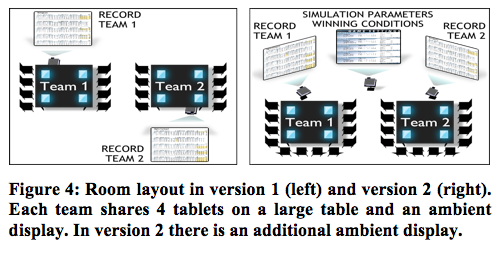
Our solution was to use a network of eight shareable tablet devices that supported the same simulation in real time, four for each team. Figure 4 shows the eight tablet devices distributed on two large square tables, with each table representing one of two competing planets and the four tablets per table representing the regions on the planets. To show the record of each team’s previous decisions and outcomes, a large shared ambient display was assigned to each team. The results of each round were updated after each round. The data displayed was designed to enable the two teams to reflect on their decision-making; to infer how the model worked and to draw conclusions about improving their collaboration and performance in the game while seeing what the other team had chosen to do. p. 5
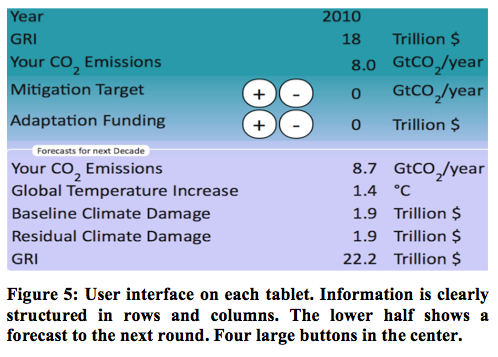
A number of constraints on awareness, control and the availability of information [18] were used with the goal of increasing collaboration. These decisions mainly concerned the user interfaces on the individual tablets and the way the network of tablets was controlled. p. 5
The forecast was placed below the four manipulation buttons, so that participants could see the values change directly. The rationale was that this would incentivize them to remove their hands immediately after touching it, thus freeing the screen for other collaborators to use. p. 5
A deliberate delay of one second was imposed on the responsiveness of the buttons, in order to slow down the exploration process, such that other participants could follow the changes more easily. p. 5
Over the course of the four matches, the extent of collaboration could be seen to gradually increase from controlling the simulation via tablets in pairs, to sub-team tactics, to team strategies and whole-classroom exchange of information. In the first matches, most of the talking occurred between pairs sitting by the tablets, changing the values on the screen, while the others were either watching intently or talking to their closest neighbors. Decisions in the game were made on a local basis without consulting the whole team. Later matches were characterized by efforts to establish a shared awareness of the whole team’s situation and a team-wide strategy, as groups realized that local decisions affected the state of the simulation for the whole team. Increasingly, seated participants made eye contact and verbal contact with other seated participants across the table and standing participants started walking between regions, comparing values between devices, making suggestions and engaging in clarifications and arguments. p. 6
Our observations of the teams revealed that as soon as the facilitator initiated the first round, all eyes were on the tablet devices. Seated pairs were immediately engrossed in pressing the buttons and watching the numbers change, thinking aloud together while exploring the interface. Standing participants watched the tablets over their teammates' shoulders. It appeared that the tablet interfaces were immediately accessible and understood by participants. Sharing the tablets worked seamlessly as tablets were kept centered between pairs and participants naturally drew their hands back after pressing buttons, thus effectively releasing control and freeing the screen for others to peek in (Figure 7). Standing participants seemed to benefit from this affordance as they often used their mobility to peek into several tablets to assist collaboration from more of a bird’s eye view. Standing participants were also engaged in dialogue with pairs. They contributed mostly in verbal form, e.g. suggesting theories and strategies, directing attention to other regions or data on the ambient displays, but rarely touching the tablets directly. No difficulties regarding the usability of the tablets and ambient displays were observed or mentioned in the debriefing discussion. Swapping roles between sitting and standing participants after each match allowed every participant to use the tablet interface. p. 6
Our starting point was a thematic analysis of the participants' discussions and comments, which resulted in two aspects that were found most controversial: first, the question of what it means to ‘win’ the challenge of climate change; and, second, the payoffs of mitigation and adaptation investments. These two aspects were found to also be controversial in the domain literature, as they touch on many scientific unknowns, speculations about future technology and socio-political disputes [7]. Our approach was to offer a range of choices (in addition to the assumptions that we had provided in the first version) to account for more optimistic as well as more pessimistic views represented in the mainstream climate literature. p. 7
Despite critical discussions about the discrepancy between expected and produced output values, participants' efforts to attribute this discrepancy to specific aspects of the model were rare and imprecise. Instead, it appeared more likely that they perceived the game as a black box that delivered certain outputs based on certain inputs and unknown transfer characteristics which were not intended to be known or criticized. This conjecture can be seen as supported by participants’ frequent use of words such as 'reward', 'punishment' or 'penalty' when referring to feedback from the game. p. 7
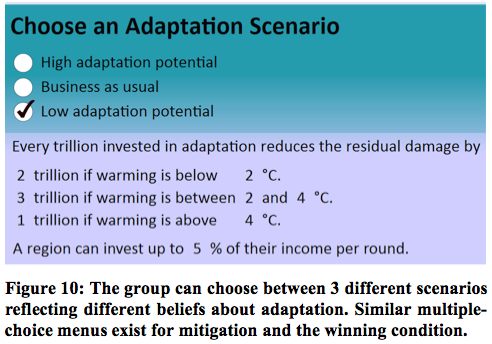
Since the game was structured in short matches, several of which could be played in one session, there was scope for groups to create and test about 4 different variations to the game. We chose to enforce turn-taking between teams for creating variations before each match, such that one team sets the rules for matches 1 and 3 and the other team for matches 2 and 4. The chosen solution involved a series of multiple-choice menus on one single tablet per team (see figure 10). p. 8
The discussion about winning conditions was concluded with the argument that real-world governments were currently playing a ‘one condition game’, while they should be playing a ‘two condition game’. Several participants suggested that future versions of the simulation should allow the definition of multiple winning conditions as a standard feature. p. 9
In sum, key design features that contributed to the success of using the contributory simulation include:
- the transparent interface and distributed system of displays not requiring prior learning or knowledge. p. 9
- the constraints of the tablet interface (only giving local, short-term information and control), so participants needed to collaborate beyond the tablets in order to effect strategies on a global and long-term level.
- the gradual increase of real-time data on the team-shared ambient displays (availability of information).
- no absolute winning condition, but criteria that require teams to compare, interpret and discuss each other’s results. p. 10
REFERENCES p. 10
Images
p. 2
p. 3
p. 4
p. 4
p. 8

