Knowledge Cartography for Open Sensemaking Communities
| Buckingham Shum, S., & Okada, A. (2008, May). Knowledge Cartography for Open Sensemaking Communities. Retrieved from http://oro.open.ac.uk/11772/. |
BibTex
BibTex
@misc{buckinghamshum2008knowledge,
author = {Buckingham Shum, Simon and Okada, Alexandra},
date-added = {2011-04-24 17:32:55 -0400},
date-modified = {2011-08-20 13:46:12 +0000},
howpublished = {http://oro.open.ac.uk/11772/},
month = {may},
note = {Knowledge Cartography is the discipline of visually mapping the conceptual structure of ideas, such as the connections between issues, concepts, answers, arguments and evidence. The cognitive process of externalising one's understanding clarifies one's own grasp of the situation, as well as communicating it to others as a network that invites their contributions. This sensemaking activity lies at the heart of the Open Educational Resources movement's objectives. The aim of this paper is to describe the usage patterns of Compendium, a knowledge mapping tool from the {OpenLearn} {OER} project, using quantitative data from interaction logs and qualitative data from knowledge maps, forums and blog postings. This work explains nine roles played by maps in {OpenLearn,} and discusses some of the benefits and adoption obstacles, which motivate our ongoing work.},
read = {1},
title = {Knowledge Cartography for Open Sensemaking Communities},
type = {Journal Article},
url = {http://oro.open.ac.uk/11772/},
year = {2008},
bdsk-file-1 = {YnBsaXN0MDDUAQIDBAUIJidUJHRvcFgkb2JqZWN0c1gkdmVyc2lvblkkYXJjaGl2ZXLRBgdUcm9vdIABqAkKFRYXGyIjVSRudWxs0wsMDQ4RElpOUy5vYmplY3RzViRjbGFzc1dOUy5rZXlzog8QgASABoAHohMUgAKAA1lhbGlhc0RhdGFccmVsYXRpdmVQYXRo0hgMGRpXTlMuZGF0YU8RAawAAAAAAawAAgAAB1NTREhvbWUAAAAAAAAAAAAAAAAAAAAAAAAAAMl5T9hIKwAAANrWUh9idWNraW5naGFtc2h1bTIwMDhrbm93bGVkZ2UucGRmAAAAAAAAAAAAAAAAAAAAAAAAAAAAAAAAAAAAAAAAAAAGaCAZy9b0clBERiBDQVJPAAIAAgAACSAAAAAAAAAAAAAAAAAAAAAHQmliZGVzawAAEAAIAADJeZYoAAAAEQAIAADL1yyyAAAAAQAMANrWUgAXPTEAAZ9eAAIAPlNTREhvbWU6VXNlcnM6AFN0aWFuOgBCaWJkZXNrOgBidWNraW5naGFtc2h1bTIwMDhrbm93bGVkZ2UucGRmAA4AQAAfAGIAdQBjAGsAaQBuAGcAaABhAG0AcwBoAHUAbQAyADAAMAA4AGsAbgBvAHcAbABlAGQAZwBlAC4AcABkAGYADwAQAAcAUwBTAEQASABvAG0AZQASADNVc2Vycy9TdGlhbi9iaWJkZXNrL2J1Y2tpbmdoYW1zaHVtMjAwOGtub3dsZWRnZS5wZGYAABMAAS8AABUAAgAM//8AAIAF0hwdHh9YJGNsYXNzZXNaJGNsYXNzbmFtZaMfICFdTlNNdXRhYmxlRGF0YVZOU0RhdGFYTlNPYmplY3RfEC0uLi8uLi9iaWJkZXNrL2J1Y2tpbmdoYW1zaHVtMjAwOGtub3dsZWRnZS5wZGbSHB0kJaIlIVxOU0RpY3Rpb25hcnkSAAGGoF8QD05TS2V5ZWRBcmNoaXZlcgAIABEAFgAfACgAMgA1ADoAPABFAEsAUgBdAGQAbABvAHEAcwB1AHgAegB8AIYAkwCYAKACUAJSAlcCYAJrAm8CfQKEAo0CvQLCAsUC0gLXAAAAAAAAAgEAAAAAAAAAKAAAAAAAAAAAAAAAAAAAAuk=}
}
Links here
Highlights (32%)
Abstract: Knowledge Cartography is the discipline of visually mapping the conceptual structure of ideas, such as the connections between issues, concepts, answers, arguments and evidence. The cognitive process of externalising one’s understanding clarifies one’s own grasp of the situation, as well as communicating it to others as a network that invites their contributions. This sensemaking activity lies at the heart of the Open Educational Resources movement’s objectives. The aim of this paper is to describe the usage patterns of Compendium, a knowledge mapping tool from the OpenLearn OER project, using quantitative data from interaction logs and qualitative data from knowledge maps, forums and blog postings. This work explains nine roles played by maps in OpenLearn, and discusses some of the benefits and adoption obstacles, which motivate our ongoing work. p. 2
By analogy to the discipline of spatial cartography, “knowledge cartography” (Okada et al, 2008) aims to provide an ‘aerial view’ of a topic by highlighting key elements and connections. Moreover, just as spatial maps simplify the world and can fuel controversy, maps of conceptual worlds provide vehicles for summarising and negotiating meaning. When we start mapping intellectual landscapes, we are structuring the way that we think and communicate knowledge graphically. Computer-supported knowledge mapping is one way to help people reflect on what they are thinking, and to sharpen the focus of their contributions. p. 2
People spatialise the world of ideas all the time, but they currently lack infrastructures for large scale, structured discourse and visualization. The web has evolved from HTML quite dramatically over the last few years with advanced techniques for content and structural modelling enriched with semantic and structural features (Geroimenko and Chen, 2002). Our research is working towards a social- semantic web environment for educators and learners to weave and contest collaboratively network of ideas through knowledge maps. p. 2
Talking about OpenLearn p. 3
In an open learning context, however, learners do not have ready access to an expert tutor or cohort of peers, and may be drawing on diverse other OERs, blogs, wikis, newsfeeds and so forth, some of which may be superior, complementary, contradictory, or of dubious authority. So while there is strong intra-unit structure embedded in the pedagogical narrative of a given OER, which the learner must critique and internalise, the weaker inter-unit structure must be constructed by the learner, or in conjunction with others, as they seek to integrate understanding across OERs and the universe of other information sources. p. 3
Open Sensemaking Communities [www.kmi.open.ac.uk/projects/osc: Buckingham Shum, 2005], a concept we are using to investigate designing for sensemaking: embedding OERs in an environment that supports end-users (both learners and educators) in engaging more deeply with the material and with each other in self- organising communities of interest. The focus on [sense][making] reflects Karl Weick’s formative work on giving shape and form to interpretations, and the individuals/communities articulating them: p. 3
“Sensemaking is about such things as placement of items into frameworks, comprehending, redressing surprise, constructing meaning, interacting in pursuit of mutual understanding, and patterning.” (Weick, 1995, p.6) p. 3
A primary challenge is to assist self-organising learners and educators in assessing, extending and contesting OERs. This requires access not only to the text, but also to the context (e.g. annotations, argumentation, and the people behind them). p. 3
Novak’s (1998) formative work on Concept Mapping p. 3
We refer to this broad spectrum of approaches to mapping as Knowledge Cartography (Okada et al, 2008), placing particular emphasis on digital representations specifically designed to: p. 4
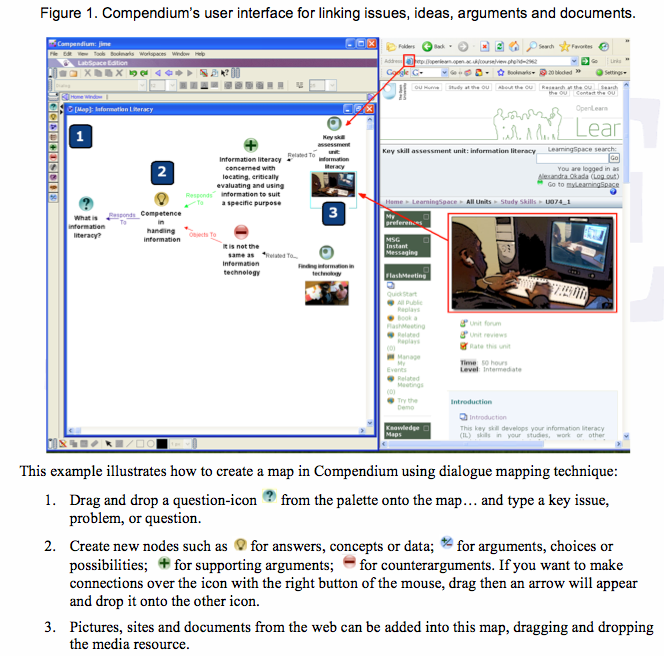
1. Clarify the intellectual moves and commitments at different levels. (e.g. Which concepts are seen as more abstract? What relationships are legitimate? What are the key issues? What evidence is being appealed to?) p. 4
2. Incorporate further contributions from others, whether in agreement or not. The map is not closed, but rather, has affordances designed to make it easy for others to extend and restructure it. p. 4
3. Provoke, mediate, capture and improve constructive discourse. This is central to sensemaking in unfamiliar or contested domains, in which the primary challenge is to construct plausible narratives about how the world was, is, or might be, often in the absence of complete, unambiguous data. p. 4
From the 242 knowledge maps uploaded, we have selected nine examples for closer discussion, which cover all of Compendium’s uses to date: organising a conceptual study, generating a brainstorm of existing knowledge, representing a learning path, organising a course module, creating a new OER, structuring a hypermedia OER, developing a learning activity, engaging in learning design, and managing a research project. p. 9
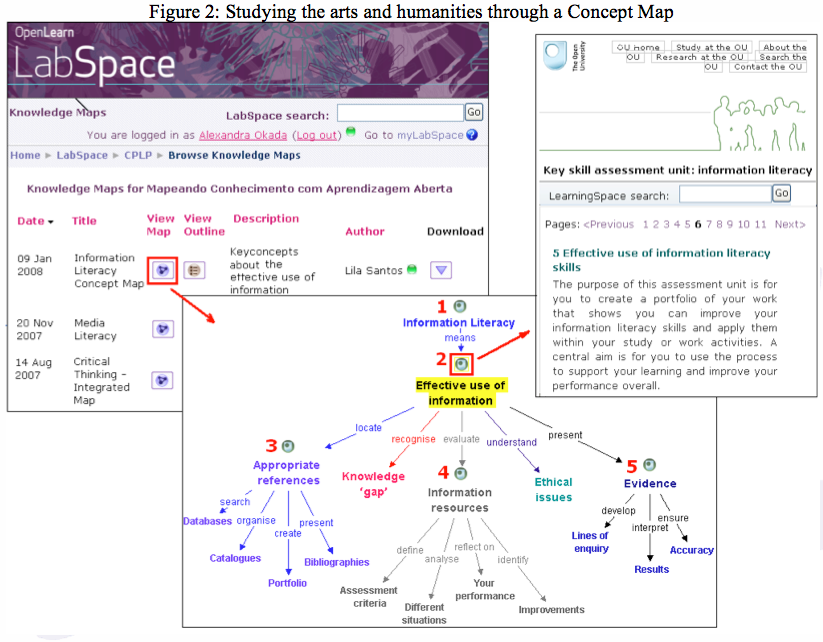
Figure 2: Studying the arts and humanities through a Concept Map Sharing concept maps can be useful strategy for recording what was studied, continuing later and accessing the content any time. Other OpenLearners interested in the same topic (e.g. media literacy) can also access this map within their web browser, see keyconcepts and get more information by reading their source. For instance, in Figure 2, users can click on the key concept “effective use of information” (number 2 in red) and page 6 will be automatically selected - “Effective use of information literacy skills”. 5.2 Generating a brainstorm of existing knowledge Figure 3 was created by a participant of a learning community in Guyana, in the LabSpace. Through this mindmap, the participant presented a brainstorm about “How we learn”, bringing different ideas to the OpenLearn unit LDT101_3 - “Learning how to learn”. Although the map has the same title, its content is not related to this unit, what suggested that the participant has not seen LDT101_3. p. 10
Generating a brainstorm of existing knowledge p. 10
However, mapping thoughts before studying an OER can be a useful strategy for identifying existing knowledge. Organising a brainstorm through mind maps before learning more about a topic can help students to generate significant ideas and identify their initial interests and hypothesis. Novak (1998, 33) explains that “working with generative words that have significance and meaning in the life of the learner leads to the learner’s control over the acquisition and use of knew knowledge”. In open education where students must be good self-learners, representing well-organised prior knowledge empowers them to become autonomous in their process of learning. p. 10
Figure2. Studying the arts and humanities through a knowledge map - How do we learn - OpenUniv-Guyana Collaboration (Natural resource management in wetland systems) 5.3 Representing a Learning path p. 11
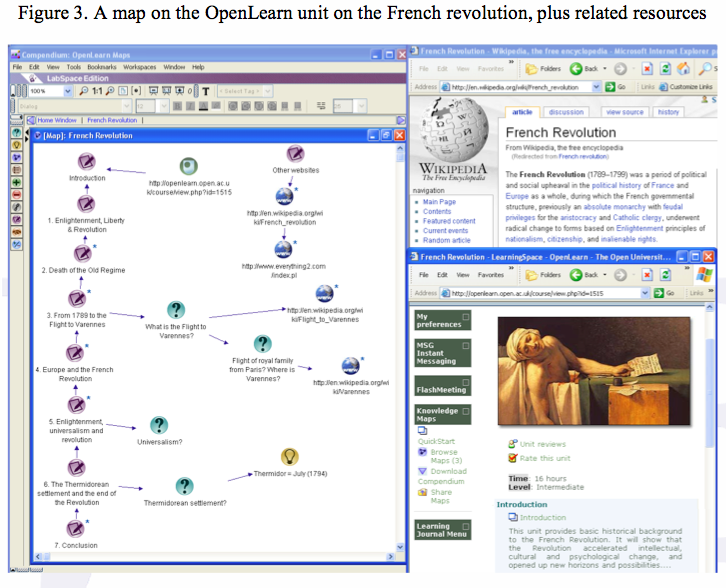
The map in Figure 3 was developed by an OpenLearn student registered in the unit A207_5 - “French Revolution”. On the left, he created a sequence of seven topics which represents the main sections in this unit. He dragged and dropped the OpenLearn website represented by the green icon , which spawned four questions. He added external references such as some Wikipedia pages, which explains some of key concepts in this unit. He also selected some notes from the websites, which were placed in the detail of nine nodes. p. 11
Was this a precursor to the new OU project for sharing learning paths? p. 11
Table 4 shows that this student uploaded three maps in the LearningSpace from September to December. During this period, he wrote three comments in his Learning Journal (Moodle’s blogging tool), which suggest three contributions of knowledge maps 1. outlining a course in order to summarise the whole unit; 2. making your own notes to help understand the content; 3. including external references to expand reading. p. 12
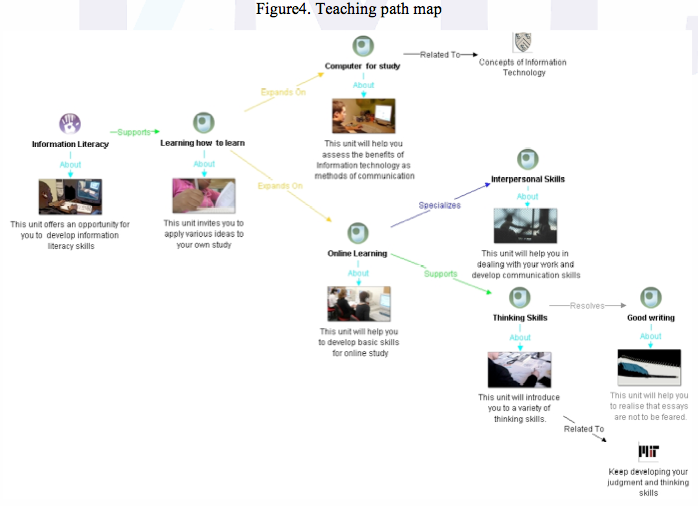
Another kind of representation is a Course Module Map, where educators offer a sequence of OERs significant to a learner to attend their specific needs. This map is also a learning path map which integrates several units. A course module map may offer an interesting group of reference nodes hyperlinked to activities or content from the OpenLearn OERs. It may represent an organised structure showing prerequisite knowledge, learning objectives and estimated study hours. p. 13
Compendium thus provides a visual authoring tool for the rapid (re)sequencing of learning resources, a form of high level “remixing” of the OU’s OERs. The teaching path map provides non-technical educators with a way to quickly drag and drop websites, documents and media clips into a map, link them and publish them. p. 13
Compendium provides a visual authoring tool for the rapid (re)sequencing of learning resources, a form of high level “remixing” of the OU’s OERs. It means that other teachers with similar interests p. 13
download this map and make changes by deleting or adding new learning materials. The course outline map provides non-technical educators with a way to quickly drag and drop websites, documents and media clips into a map, link them and publish them. p. 14
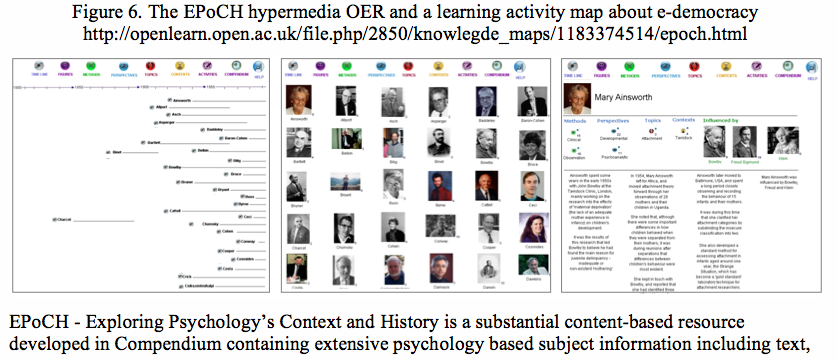
Compendium has been used to create hypermedia OERs, Web versions of interactive resources providing multiple paths through multimedia information spaces. One of these projects is the EPoCH resource on the history of psychology, illustrated in Figure 6 which presents three maps: 1. a timeline map, 2. a psychologists overview map, and 3. a psychologist’s profile map showing their contributions to the field classified by methods, perspectives, topics, contexts and influences. p. 14
It presents biographical details of 100 psychologists as well as descriptions and links between psychology methods, contexts, perspectives and topics. Epoch maps enable OpenLearn users to explore the development of psychological thinking across time and also within different perspectives, methodologies, social and historical context. p. 15
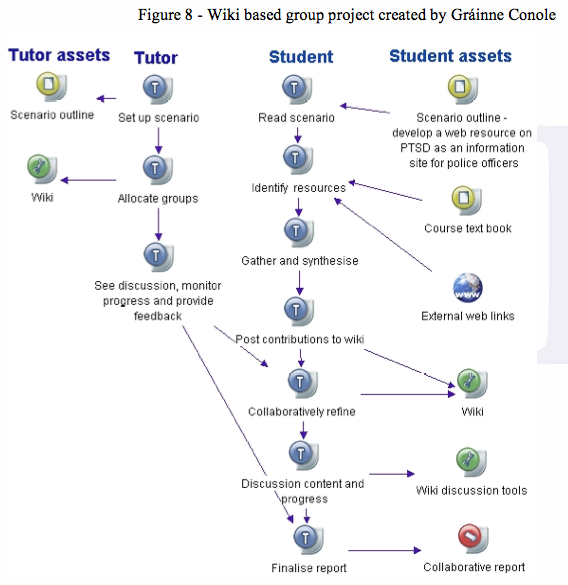
Knowledge mapping has also been useful for learning design. In the LabSpace. Compendium has been used by academics at the Open University to design online courses. Conole (2008) reports that in workshops with OU faculty, Compendium provided an intuitive interface to represent different p. 15
designs by bringing together both narrative accounts of learning designs with notational maps showing the design visually. For instance, the map in figure 8 shows a wiki activity for a course designed using Compendium. This learning design map shows the connections between student and tutor’s roles along with their respective tasks which are also associated with assets, tools, resources and outputs. p. 16
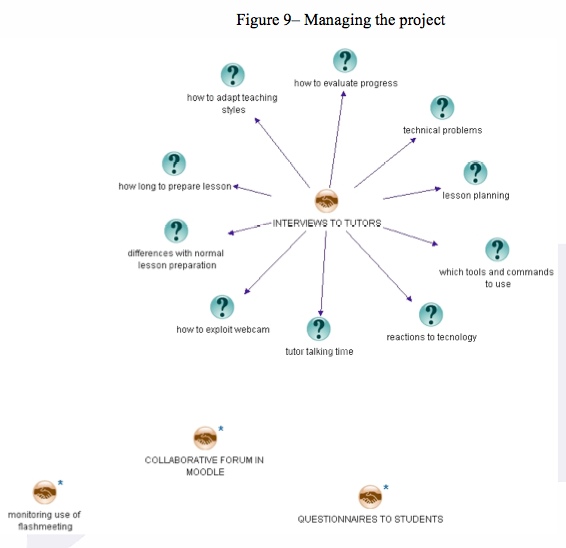
OpenLearn research team and some communities of collaborators have been using Compendium for planning, implementing and evaluating research projects. Knowledge maps have been useful for structuring and visualising connections between steps or components in different stages of a research. Some examples can be found in two areas in the LabSpace: Collaborators and Research. p. 16
We described nine kinds of knowledge map, playing the following roles: Helping learners make sense of OERs: 1. conceptual study map 2. brainstorm map 3. learning path map Helping educators create, reconstruct and publish learning materials: 4. course module map 5. new OER map 6. hypermedia OER map 7. learning activity map 8. learning design map Helping OpenLearn collaborators and researchers plan and implement projects: 9. research project map p. 18
References p. 19
Images
p. 5
p. 10
p. 12
p. 13
p. 14
p. 16
p. 17

