Paper discussed at Encore lab Oct 11, 2013. Design paper discussing interface for environmental game simulation with multiple tablets
Key ideas
Supporting collaborative learning with interactive computer simulations, focusing on 4Decades game, environmental simulation for executives at conferences.
Literature review
Model of simulations
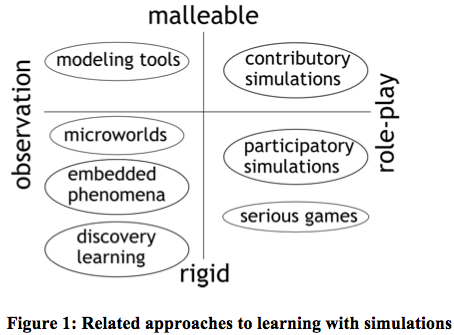
Previous examples
- Participatory Simulations [2,16]
- allow learners to explore a model from the perspective of virtual elements within the simulation
- it has been suggested that Participatory Simulations may be best suited for illustrating the basic idea of a topic, rather than a detailed account [2]. p. 2
- microworlds that were developed in the 1980s [4]
- Scientific Discovery Learning, based on predesigned computational models, in the 1990s [3]
- software tools that allow students to design and test their own systems models, such as
- NetLogo
- StarLogo TNG [9]
- Massively Multiplayer Online Role-Playing Games (MMORPGs)
- Serious Games – again largely played on single user desktop machines. p. 2
- Scientific Discovery Learning [3] is the instructional paradigm which Embedded Phenomena inherit from Participatory Simulations
Transparency
Is the micro-word/simulation a black box to learners, or are the conditions/algorithms exposed, and maybe even changeable?
Learners are presented with predesigned models and predesigned ways of interacting with them or observing their autonomous progression over time. In the context of entertainment oriented simulations of urban planning and biology, Turkle [15] warns that certain ways of interacting with predefined simulations can result in superficial understanding or factually wrong conclusions about the topic, particularly when the underlying models are not revealed to learners.
This call for transparency is inline with Jonassen’s [8] distinction between the black box approach typically taken in microworlds (which Participatory Simulations are a form of [2]) and the glass box approach where the underlying models are explicated and can potentially be modified by learners. Wilensky and Reisman [17] describe such a glass box approach to teaching biological phenomena through scientific modeling. Their approach allows individual students to reflect on emergent properties of complex systems (e.g. the dynamics of predator-prey populations) by manipulating models of local elements (e.g., the behavior of individual animals). p. 2
Technologies
Began with using individual computers - can lead to small groups around each computer. Move to interlinked tablets and ambient displays, “Multiple Linked Representations” which support peer-collaboration as well as individual agency.
Study
At a conference for executives to learn about climate change and mitigation.
Goals
- to give participants concrete experience with concepts and numbers that are central to the workshop curriculum
- to highlight some of the challenges surrounding decision-making under complexity and uncertainty and to provoke a critical discussion about the simulated topic
Key question
What will be the cost of anthropogenic climate change and how should policy makers balance investments between greenhouse gas mitigation, adaptation to climate change and residual repairs within the next 40 years?
Model
Mitigation and adaptation of CO2, across multiple regions. Balancing investment over repeated cycles (decades), goal is to maximize income.
Tech
Network of 8 shareable tablet devices, same simulation in real time (four per time). Large ambient display for each team - score keeping/result of actions.
Constraints
A number of constraints on awareness, control and the availability of information [18] were used with the goal of increasing collaboration.
- The forecast was placed below the four manipulation buttons, so that participants could see the values change directly.
- The rationale was that this would incentivize them to remove their hands immediately after touching it, thus freeing the screen for other collaborators to use.
- A deliberate delay of one second was imposed on the responsiveness of the buttons
- in order to slow down the exploration process, such that other participants could follow the changes more easily.
Runs
Initial run at a conference, participants had already gone through subject material (knew terminology etc). Went well, participants very engaged, but treated simulation as “black box”, felt that it was a “game” where they were “punished/rewarded” by the algorithm. Affordances of the technology worked well to encourage group work.
Second run was in the beginning of a conference (as an ice-breaker), so players needed more time to exchange knowledge of terminology and concepts. This time, they had the opportunity to manipulate final goals (at one point asking for a complex goal, maximize revenue, but if temperature rises above 3C, you lose immediately). Quite successful.
Conclusion
According to the article, key design features that contributed to the success of using the contributory simulation include:
- the transparent interface and distributed system of displays not requiring prior learning or knowledge
- the constraints of the tablet interface (only giving local, short-term information and control), so participants needed to collaborate beyond the tablets in order to effect strategies on a global and long-term level
- the gradual increase of real-time data on the team-shared ambient displays (availability of information)
- no absolute winning condition, but criteria that require teams to compare, interpret and discuss each other’s results

