Key ideas
Pedagogy of abundance → pedagogy that supports human beings in learning through active creation of resources
Emergent learning as learning in which actors and system co-evolve within a MOOC and where the level of presence of actors on the MOOC influences learning outcomes
Site and methods
Findings will be drawn from the Personal Learning Environments Networks and Knowledge course (PLENK2010) and the Connectivism and Connective Knowledge course (CCK11)
Surveys
- End of Course survey (N = 62)
- an Active Producers survey (N = 31)
- a Lurkers survey (N = 74)
- a Research into the Design, Delivery and Learning in MOOC PLENK2010 survey (N = 55)
Other:
- Virtual ethnography, focus group
- Moodle data-mining functionality p 7
- gRSShopper aggregator statistics functionality p 7
Theories
Weller (2011) highlights the changes involved in moving from a learning environment of scarcity, based around the lecture model and books, to a web-based environment of abundance and examines different models of pedagogy to deal with these changes.
Barnett (2002) had his own interpretations of knowledge in relation to uncertainty and change. He would like to see curricula and pedagogy move away from knowledge and skills to be a “pedagogy for human beings.” He discussed a form of knowledge that would involve learners thinking about and confronting themselves with the uncertainties and dilemmas in their own lives.
Folke (2010) emphasized the need for resilience, so people will anticipate change then in- fluence developments to achieve societal and personal goals. At the heart of sustainable change is developing and helping people to build up an “inner resilience” that guards them from experiencing every change that comes their way as disruptive. Instead, this resilience ensures that they learn to cope with these changes more as part of their continuous “ag- ile” development and learning (Cashman, 2009), recognizing patterns in one situation and making sense of them and applying them in another. p. 3
Shedroff (2009) argued that in current design practice, the main focus should be on creating environments that encourage relationships with individuals, experiences that connect on an emotional and value level. It is not enough to introduce some tools to create an effective working environment; one should also design for the building of connections, collabo- rations between resources and people. (see more here Kop, 2010Kop, R. (2010). The Design and Development of a Personal Learning Environment: Researching the Learning Experience. In European Distance and E-learning Network Annual Conference 2010, June 2010, Valencia, Spain.)
Learning cycle (Kolb 1984)
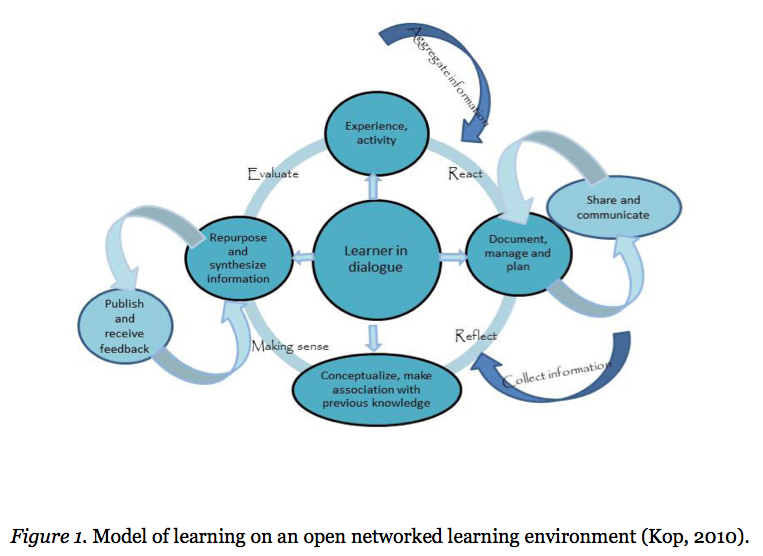
- The learner has an experience or a thought and would like to find out more or might want to get involved in an activity that requires exploration
- He or she then aggregates information, plans the learning activity might call on others to discuss the generated ideas and ask for assistance
- The learner would quite likely be engaged in a thinking process where links are made with other knowledge
- This might in turn lead to a repurposing of the information and resources, for instance by using them to produce something or publish an artifact that might receive comments
Presence
In support of the learning cycle model, Kop (2011) puts a high value on the creation of a “place” where learners might feel comfortable, where there is a certain level of trust between participants in that environment—a community. She argues that the development of a place or community would be reinforced by a level of “presence” of the participants.
Research by Garrison and Anderson (2003) and Jézégou (2010) emphasized the importance of presence in online learning environments. Presence is mostly defined in the literature as the “illusion of non-mediation” (Lombard & Ditton, 1997). In other words, there is a high level of presence when a participant in an online activity experiences the activity as if it were taking place in real life, without the mediation of the computer.
Garrison and Anderson (2003), in their research on communities of inquiry, identified three interlinked forms of presence that heighten the engagement of online learners: social, cognitive, and teaching presence. Social presence is characterized by affective engagement, open communication, and a high level of personal address by and between participants. Wenger, Trayner, and de Laat (2011, p.10) highlight that “the social fabric of learning” is supported in important ways through collaboration both in a “community” and on the “network.”
Cognitive presence is characterized by a triggering event, an exploration of ideas and points of view, a consensus on the points of view (reached by communication with and feedback from others), and then a testing and discussion of the found solution.
Teaching presence involves the design and organization of the course, the facilitation of the course, and direct instruction.
Social presence and cognitive presence could easily form part of the learning experience of a learner in such an environment through the formation and engagement both in communities and, more loosely, on networks.
Teaching presence is much harder to facilitate as learners do not necessarily have contact with the educator, but it is the teaching presence that heightens cognitive presence (Annand, 2011).
People learning on open networks could have access to knowledgeable others to support them, might find videos to inspire their thought processes, and could also self-regulate and organize their learning. This would, however, require a high level of self-direction by the learner.
Traditional role of teachers in online teaching
Educators would find resources and information and would distribute these to learners in their care, perhaps by displaying them in a learning management system (LMS). They would try to help learners in the develop- ment of conceptual frameworks by direct communication and social interaction within a classroom community, be it virtual or face-to-face.
New role of learners
Receiving information from a few “super nodes” on networks → moving into the information stream themselves and pulling just-in-time information off the networks, perhaps by receiving validation from other users (Boyd, 2010)
The challenge includes
- the validation of the information
- the generation of ideas and thoughts
- that the organized institutional social setting of the past might readily provide
- which is much harder to achieve on a network with much weaker ties.
Some argue that people’s information behaviour should change from receiving information from a few “super nodes” on networks to moving into the information stream themselves and pulling just-in-time information off the networks, perhaps by receiving validation from other users (Boyd, 2010).
Role of instructor
Researchers of learning on online networks can see new roles emerging for educators, such as those of
- curator
- learner
- facilitator
- supporter of “repurposing” and “remixing” of information
- coach
- moderator
- provider of technical support
- lecturer
- “sharer” of resources
(Siemens, 2008; Downes, 2010)
Conceptualization of MOOC
MOOC acts as an environment in which new forms of distribution, storage, archiving, and retrieval offer the potential for the development of shared knowledge and forms of distributed cognition.
Connectivist course
- Aggregation – access to a wide variety of resources to read, watch, or play, along with a newsletter called The Daily, which highlighted some of this content;
- Remixing – after reading, watching, or listening to some content, it was possible to keep track of that somewhere (ie, by creating a blog, setting up an account with Delicious and creating a new entry, taking part in a Moodle discussion, or using any service on the Internet
- Repurposing – participants were encouraged to create something of their own; in these MOOCs, the facilitators suggested and described tools that participants could use to create their own content it was envisaged that with practice, participants would become accomplished creators and critics of ideas and knowledge; and
- Feed Forward – participants were encouraged to share their work with other people in the course and with the world at large
Conversational framework
Characteristics of learning based on a conversational framework emphasize tutor–student dialogue and actions based on dialogue and reflection (Laurillard, 1993). In this sense, the MOOC allows a new model of learning based on adaptive responses to both discursive and active feedback from facilitators and participants, with the potential for engagement in a continual flow of dialogue and exchange and for reflective action on the part of the learner.
New pedagogy
Create a pedagogy that supports human beings in their learning where the social connections people make on the network provide their learning support
- how to help and support fellow learners in dealing with the new realities of an abundance of information
- How to make the most effective use of the tools
- How best to position oneself in the continuous stream of information and com- munication and learn from others
- What would motivate people to regulate their learning
Findings
Student ability
a high level of competency and interest in using a vast array of tools is required to do so effectively this puts the responsibility for information gathering, the validation of resources, and the learning process in the hands of learners themselves, and one should question if all adult learners are capable of taking on this responsibility
gRSShopper
This was accomplished with the gRSShopper application (Downes, 2008). gRSShopper, an RSS aggregator, and the Daily newsletter derived from it were used to overcome an identified limitation of a more rigid structure for forum discussions in the Moodle environment. gRSShopper allows a networked conversation to emerge from the personal learning spaces of individual learners through a connect-and-collaborate dynamic that facilitators found to be well suited to the just-in-time collection of information prevalent in MOOCs. The support offered through gRSShopper was significant, as evidenced by a participant who commented
It helps learners to map the terrain of the conversation without telling them where to go. Aggregation of independent points of view is one of the key mechanisms to cultivating and harnessing the wisdom of crowds, and gRSShopper does that.
Value of producing
Active participation through the production of digital artifacts and interaction with others was conducive to positive learning outcomes as it helped participants to reflect and involved them in a creative process that stimulated their cognitive processes
About 40–60 individuals on average contributed actively to the course on a regular basis by producing blog and discussion posts, while others’ visible participation rate was much lower, indicating a consuming behaviour
Social presence/trust
FB group - some did not join for privacy and personal security reasons. Others who joined remained as peripheral participants for the duration of the course.
Participants also highlighted the need for a sense of trust and feeling comfortable and confident to be able to participate, as well as a sense of presence and community. Some learners preferred the Moodle forum over FB as they expressed that they were able to learn more about the background, ideas, and beliefs of other participants than in FB. The CCK11 MOOC did not have a Moodle environment, and an excerpt from a blog post of a participant of CCK11 highlights some relevant issues:
The relative “character” anonymity of participants in the CCK11 as compared with the PLENK2010 cohort was an obstacle. The PLENK (Moodle) forum provided an easily navigated discussion interface. From the contributions on a wide variety of topics, I learnt a lot about the passions, the character, the beliefs of the participants. We were fellow learners, not just network nodes, and I would imagine a certain degree of trust was established between many of the participants. Facebook, the seeming preferred CCK11 gathering place, does not provide the same level of personal connection for me, so I am not currently feeling particularly nodish.
Learning under MOOCs is an interactive experience best achieved in a climate of
- relatedness
- care
- mutual respect
- support
Such care is offered, not imposed, and respects humans’ need for autonomy, self-determination, and challenge, as well as for security (Arnold, 2005, p. 18).
It enhanced social presence by providing a mechanism for just-in-time social interactions. It provided authentic opportunities to connect and be perceived as “real” in ways that traditional LMS-contained tools could not. There were participants who valued Twitter and found it the best tool for learning, connecting, and interacting with PLENKers.
Participants ranked Twitter as the most important tool for interaction and communication in the MOOC. The feedback from some participants, however, suggests that Twitter was still too new and foreign to them in PLENK2010, and a significant number of participants were hesitant to use it in public.
Observations of the use of Twitter, however, showed that it supported coherence and connections between different tools during
- including back channels to synchronous sessions
- updates of news and events
- links to recordings

