Key ideas
Overview of key features of connectivism, discussion of what is a learning theory, critique of connectivism as learning theory. Also the value of a “critical other” in learning, educator vs. facilitator
Use of theories
Two purposes of new theory (Kerr 2007d)
- replaces older theories that have become inferior OR
- builds on older theories without discarding them
Forster (2007): for connectivism to be a learning theory, limitations and full range of contexts in which learning can take place must be accounted for otherwise implementation might be misguided.
Connectivism
Learning
- learning happens when learner connects to and feeds information into learning community
- learning community is a node, always part of larger network
- nodes varying size and strength (concentration of info and number of people)
- learning transpires through use of cognitive and affective domains
- learning process is cyclical
- peripheries of knowledge fields porous, learners may traverse networks through multiple knowledge domains
- act of recognizing patterns shaped by complex networks
- internal, as neural networks
- external, as networks in which we adapt to the world around us (Siemens 2006b)
Learner
- important skills:
- seek out current info
- filter secondary/extraneous info
- see connections between fields, ideas, concepts
View of knowledge
- information is constantly changing (validity and accuracy change over time)
- knowledge is distributed across info network, stored in variety of digital formats
- learning and knowledge “rest in diversity of opinions” (Siemens 2008)
- knowledge is “subsymbolic” (Downes 1996)
- a recognition of a pattern in a set of neural events [if we are introspecting] or behavioural events [if we are observing]
- the experience of a mental state that is at best seen as an approximation of what it is that is being said in words or experienced in nature, an approximation that is framed and, indeed, comprehensible only from which the rich set of world views, previous experiences and frames in which it is embedded
- denies that knowledge is propositional (different from all other epistemologies)
- other epistemologies are cognitivist - language and logic
- connectivism is connectionist
- not essentially based in linguistic structures
- constraints and properties of linguistic structures are not the constraints and properties of connectivism
- ‘understanding’ is a distribution of connections across a network.
- * to ‘know that P’ is therefore equated with ‘a certain set of neural connections’ that entail being in a certain physical state” unique to the experiencer of that state.
- ‘deep thinking’ or ‘creating understanding’ are equivalent to the process of making connections, and that there are no mental models per se (i.e., no systematically constructed rule-based representational systems), and what there is (i.e., connectionist networks) is not built, like a model; but instead it is grown, like a plant
Consequences
If learning transpires via connections to nodes on the network, then it follows that the maximization of learning can best be achieved through identifying the properties of effective networks, which is precisely what Downes sets out to achieve in Learning Networks and Connective Knowledge
Epistemological frameworks
Driscoll:
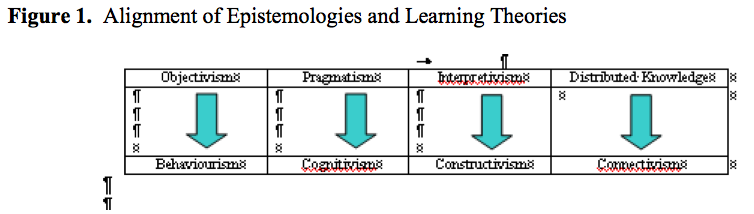
- objectivism
- reality external to the mind
- knowledge experientially acquired
- pragmatism
- knowledge is negotiation between
- reflection and experience
- inquiry and action
- interpretivism
- knowledge is internal construction
- informed through socialization and cultural clues
- distributed knowledge (Downes, Siemens)
Alignment of epistemologies and learning theories:
Critiques
Verhagen: unsubstantiated philosophizing
Kerr: existing theories are enough, we've already got:
Vygotsky
Internal and external knowledge environments
Language and scaffolding
Self-talk in children, externalizing as a form of self-guidance and self-direction (this ability comes from interaction with others)
Instructional scaffolding
- support for learning and problem solving using
- hints
- reviewing material
- encouragement
- complex problems → manageable chunks
(Woolfolk 1995)
Papert's constructivism
Learning occurs through engaging in creative experimentation and activity.
Learning vs. teaching, teaching secondary to creative process
Learning: interaction between individual and environment
Computer's role: enabling, means for children to use knowledge
Clark's embodied active cognition
Scaffolding provided by language and 'objects to think with' - mutual interaction between mind, brain and the environment.
Other
Communities of practice
Connectivism getting famous because of prevalence of networks
Lack of empiry
Lack of extensive body of empirical research literature to lend it support
Lack of critical "other"
Lack of critical engagement online (Norris 2001) because of temptation to connect with like-minded people, rather than more challenging transactions.
Freire and Macedo - essential that teachers have directive role.
Dialogue vs conversation, something is lost if educators are reduced to facilitators (Salmon, 2004)

