Key ideas
What role does learning play for communities, or communities for learning?
Literature review
Major models of how learning happens (and role of community)
- knowledge transmission
- naive, simply focus on communicating information, overlook difficulty in comprehension
- behaviorist learning
- learning as result of conditioned responses
- interaction with others in a community can be the feedback that conditions responses to stimuli
- developmental learning
- learning as result of interaction with the world, plus biologically mediated maturation processes
- interaction with peers and near-peers in a community may provide developmentally appropriate scaffolding
- cognitive learning
- learning as the result of active cognitive processes that yield new mental representations and predispositions
- participating with others in groups can provide an opportunity to generate explanations, which results in deeper individual cognitive processing and hence, better learning
- sociocultural learning
- learning as a result of appropriation of social practices
- communities provide fertile ground for sociocultural appropriation (adopting expert practices through social processes)
Developmental and cognitive theories both fall under constructivism.
Definition of learning
- learning as changed behavior
- developmental changes
- changed mental representations
- changed social practices
Learning does not need to be positive, for example “learning to be ruthless criminals”. Learned helplessness, learning to “play the game” in school.
Knowledge
“Knowledge as a systemic property of people in communities”
Ebb and flow between tacit and explicit, constructed by individuals, shared, reconstructed by others. Flows in formal dialogues, and in dialogues among groups. (see SECI model)
Learning and communities
CoP: Reciprocal relationship between communities and learning.
To endure, communities need to replicate themselves by enculturating new members through learning. As newcomers arrive in a community, they participate peripherally in its practices. Over time, their participation can become more central as their practices become more expert-like and their identities more entwined with community membership.
Knowledge-building communities
A particular kind of CoP, focused on learning. Based on scholarly communities, explicit goal: development of individual and collective understanding.
C4P
Five key elements
comprise a non-linear system that occurs in a CoP. An increase in any of the elements tends to result in an increase in all of them.
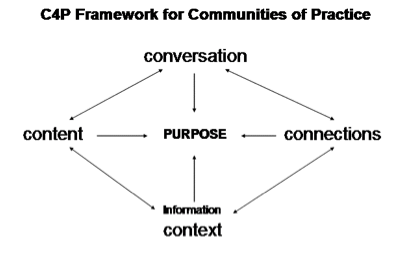
Content
explicit, static knowledge objects - documents, videos (monologue)
purposes:
- attracts members by providing immediate value
- socializes new members by implicitly communicating what kinds of topics and voices are appropriate
- serves as a basis for conversation
- motivates members as they see themselves jointly building their domain of knowledge
Generating quality content is one of the great challenges of nurturing a knowledge-building community, but people are often hesitant to contribute content. The other factors encourage content creation.
Separation between content as external (articles, etc) and generated by the group members? If generated, does it come under "conversation?"
Conversation
face-to-face or online discussions (dialogue)
The most effective mode of knowledge transfer and generation, because the personal connection and back-and-forth nature of conversation provide the greatest context for information.
The challenge within a knowledge-building community is to generate conversations that draw out meaningful knowledge, not aimless chatter.
Meaningful conversation fostered by
- quality content
- conversation that is focused on a piece of content is likely to build upon that existing knowledge, if content is relevant to community, conversation will probably be too
- clear purpose
- fosters culture of productive conversations
- everyone understands that goal of conversations is to support purpose, not just chit-chat
- personal connections
- leads to culture of trust, members feel safe to challenge each other's assumptions etc
Connections
interpersonal contacts between community members that involve some level of relationship
Lifeblood of a knowledge-building community. Without connections, an online space is merely a document repository (content) or chat room (conversation).
Foster the relationships and subsequent trust that enable distributed people to work together on the common goal of building their knowledge domain.
Can be facilitated by other elements:
- purpose
- members know they have things in common
- reduces barriers to forming connections
- content and conversation linked to member profiles of those who contributed knowledge
- other members get to know contributors, more likely to connect with them
(information) Context
whether and how information is useful to community members
Richness of detail that makes information meaningful and memorable
Enables learners to learn more efficiently and effectively
Answers
- where a knowledge object came from
- how it has been applied in the past
- who the contributor is, and his or her situations
- what a contributor is communicating
- whether the information applies to me
- how can I apply the knowledge to my own situations
Helps situate knowledge among people who are not physically co-located.
Conversations and relationships increase context of information.
Purpose
reason for which members come together in the community
Creates energy and produces results.
Stated purpose vs actual purpose, which inheres all the other four elements. Ideally stated and actual purposes are identical.
Interaction between elements
Elements reinforce each other
- Content shapes conversations and fosters connections
- Conversation generates new content and adds context to existing content
- Connections spark conversations and add context to content
- Information context connects content to related content and to the community’s purpose
- Purpose provides the metaconnection between all the other element
All five elements are important:
- If content is absent, conversation is likely to have difficulty getting started and staying focused on the community’s purpose
- If conversation is missing, knowledge may transfer but is unlikely to be generated
- If connections are absent, there will be fewer contributions of content and conversation the contributions will have less context
- If information context is absent, the community is prone to misinterpret content or apply knowledge inappropriately to new situations
- Without purpose, knowledge building will founder
- A clear communal purpose gives meaning to content, provides direction to conversation, fosters connections, and is the unifying context for all activities in the community.
Design for Distributed Cognition
Encompasses not only cognitive phenomena that might take place in the head (mental representations, human information processing) but also representations and phenomena that take place in the world, between and among people in a social system
Formerly called C-P-C framework, developed in 1998 by analyzing examples of successful information technologies for learning.
Guiding question: “What is the special value added by technology when used as part of best practices in education?”
Advantages that technology can provide to learning environments
Representational advantage
Enormous flexibility and new ways of representing information
- multimedia
- interactivity (real-time)
- presenting information in multiple forms
- microworlds and simulations (cognitive tools)
- multiple linked presentations (representational guidance, MUPEMURE)
- access to information that would otherwise be unwieldy (encyclopedia on your cellphone)
Process advantage
Ability of interactive technologies to scaffold tasks, procedures or processes that learners encounter during learning.
Computer as
- gatekeeper
- timekeeper
- grader
- scaffold/scripting
- intelligent tutoring systems
Support metacognition (self-regulated learning)
- self-quizzes or checklists
- post-hoc video analysis of tennis swings
- reflection prompting systems
Can also
- be used by instructivists to support students in just-in-tim einstruction
- by cognitive construcitivists trying to reduce a student’s cognitive load
- by sociocultural constructivists to support social scaffolding and appropriation processes
Social context advantage
Technology used to change or distort social context in which learner operates to facilitate more or better learning.
- bringing in external experts
- allowing anonymous communication
- role-playing
Can be used by
- an instructivist or a cognitivist to change the affect or motivational set of the learner
- a sociocultural instructor to alter context to support legitimate peripheral participation or other cultural shifts
Examples
Use DCC and C4P to discuss two web-based online communities, CompanyCommand (CoP for army pastors) and CILT Knowledge Network (defunct CoP for edutech researchers)

