Key ideas
Using Cohere to analyze peer-to-peer learning in P2PU course
Qualitative data analysis
Traditional qualitative analysis tools do not allow web data to be analyzed “in-situ”, but must be downloaded, normalized etc.
- The analyst looses potentially useful hints that may help him to make sense of the content they analyze (i.e. page formatting, images and metadata visible just when the data is accessed online)
- If new data are added to the data source Webpage they are not visible to the analyst. Therefore the results of the analysis are time-constrained and may become quickly obsolete. p. 4
Cohere let's us analyze data in-situ.
Cohere
Two main features for QDA:
- coding (tagging)
- memoing (annotation)
Study
Observing virtual users in P2PU course (Copyright for Educators, March-May 2010).
Look at discussion forums, particularly for “Pink group”
Analysis framework
Two interrelated dimensions, based on Burge’s (1994) peer behaviour models:
- participation: how do participants give alternative perspectives attending to the experience of others: how do they share resources and reflections?
- affective feedback: do participants use each others’ names, complimenting each other and offer supportive, remedial or critical interchanges
Process
Highlighted clips of text in each post, grouped into (evolving):
- people
- content
- rhetorical moves
Two main memo connection codes:
- posts
- addressed to
Used Cohere for sorting and visualization - has network approach. Data, codes and memos can be listed or represented in graph like structure.
Combine network search and code search, for example code “complain” and posts addressed to the whole group, to see what participants have complained more, and what they are complaining about.
Findings
The most popular activities that seek to facilitate the meditation of a “learning space” follow similar pattern for engaging peer and collaborative learning:
- read
- think
- reflect
- share
- peer comment
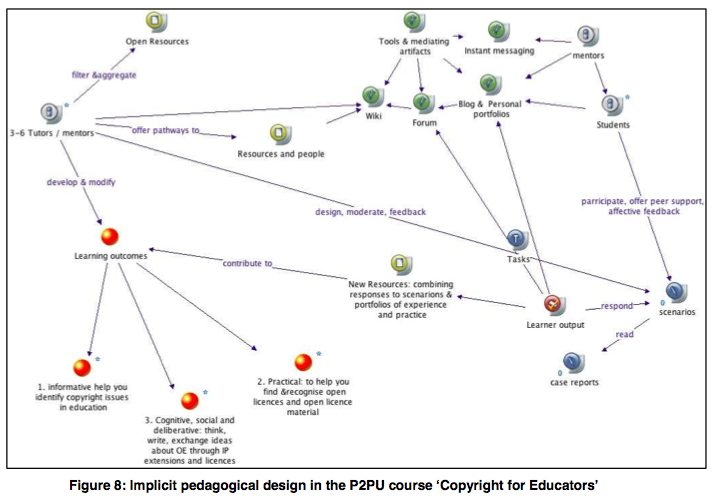
Course (Copyright for educators) has implicit pedagogical designs that evolve during the 6 weeks (also based on discussions with tutors).
3 core dimensions:
- informative: identify copyright issues around education
- practical: work with different IP jurisdictions and legal practicalities for open education design
- social and deliberative: exchange ideas about open education beyond and within context of copyright