Key ideas
Using research outside of educational sciences to explore experiential learning. Importance of experiential learning, learning cycle in organizations (formalization of tacit knowledge).
Learning vs teaching
Incredibly, the entire edifice of what has been called educational psychology, instructional theory, or recently cognitive theory, rests on the notion that learning is direct outcome of teaching, and that somehow the only way to help people learn better is to teach them better.
Even the recent emergence of concepts such as self-monitoring, individual learning strategy and social cognition (Zimmerman, Bonner, and Kovach, 1996; Bandura, 1986), although met with expectant optimism by adult education researchers, have fallen short of delivering an understanding of human learning that is anything but school-based.
Kinds of learning
- acquiring declarative knowledge (learning the facts)
- procedural knowledge (learning how-to)
Outcomes of cognitive processes:
- comprehension
- applicaton
- analysis
- evaluation
(used as basis for classifying educational goals, see Bloom, 1956; Gagne, 1977; Smith and Regan, 1993)
Experiential learning
Understanding of issue changed through a new insight, fresh outlook, aware a particular aspect of reality was expanding.
No new facts learned, no new procedures mastered.
Change that has occurred in your awareness cannot be directly ascribed to anything other than own perception or experiences.
Dewey
All learning is the result of experience of learner (including classroom instruction). Need not more structuring of previous generations' accumulated knowledge, but more and better structuring of experiences available to learners.
Kolb's cycle of experiential learning
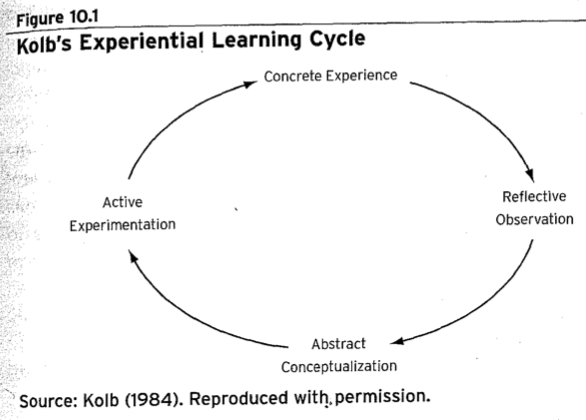
- Concrete experience is encountered in a given real-life situation, presenting a problem to be resolved through the application of new knowledge
- The learner, following such an encounter, will engage in reflective observation, arriving at an intuitive understanding of the reality at hand
- In order to solidify that understanding and define it in terms that may lead to action the learner then engages in abstract conceptualization, whereby mental representation, or schema, is built using what is already known of the situation
- Only through active experimentation can that conceptualization be fully tested and accepted as either true, partially true, or altogether false
Process is cyclical, similar to inductive-deductive scientific approach.
Experience does not equal learning
Often, with an identical external stimulus, two people may have very different perceptions, leading to different types of experiences and learning.
(Even for experiences that originate externally as an event, the representation of the experience is constructed by each individual within their own phenomenological context)
Teacher example
For example, one teacher with 25 years experience may have acquired much insight into the nature of the profession, the best way to approach certain students, and the importance of careful planning and evaluation.
Another teacher, with identical seniority, may have never valued reflection or experimentation, and have learned very little about the subtleties of the profession.
This phenomenon has been recognized as one important issue in Prior Learning Assessment (PLA), which makes a clear distinction between the person's experience and acquired knowledge and skills. (ref Scardamalia's work on experts).
Argyris: learning -> action
How do you know you know something? When you can produce what you claim you know.
Tacit knowledge = theory-in-use, as opposed to espoused theory, that which you are able to formulate.
Problem: what Argyris (1993) calls “single loop learning.” It works like a thermostat that is programmed to maintain the temperature at a certain level but the thermostat doesn't ask why the dial was set at that temperature in the first place. In order to benefit fully from the learning potential embedded in experience, we need to adopt a “double loop” learning strategy, requiring that we question and test assumptions that guide our actions. In other words, we need to ask ourselves, “Is the thermostat dial at the proper setting'? And why'?”
Learning styles
Even if they exist, strength in one area means weakness in others - should all be practiced evenly?
An ideal learning environment could opportunities for learners to approach the act of learning from all four angles:
- concrete experience
- reflective observation
- conceptualization
- active experimentation
Nonaka
Interplay between explicit knowledge and implicit knowledge. For an organization to learn something, knowledge needs to be transformed in one combination or other from explicit to implicit, or vice-versa.
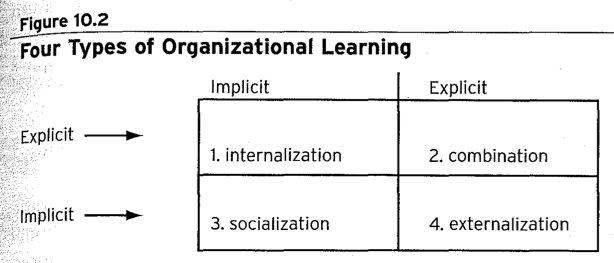
Internalization
Occurs when explicit knowledge (for example, the written rules and procedures for accomplishing a specific task) is absorbed by an individual or a unit to such an extent that the information becomes embedded in the person's own (implicit) knowledge-base.
Combination
Occurs when explicit knowledge is reproduced and transmitted to other individuals or units within the organization, through carefully drafted documents containing crucial information.
Socialization
Occurs when one person's implicit knowledge becomes another person's implicit knowledge. This happens in situations where people merge their tacit knowledge-base, for instance, in mentoring relationships.
Externalization
Occurs when implicit knowledge within the organization somehow becomes explicit. This can happen when a senior employee's experiential knowledge-base is tapped to produce documents or materials intended for others.
Usable knowledge
Information within an organization can be written down, saved on disk, or put on a library shelf, but it will not become useable knowledge until it is embedded in people's awareness through one of the four processes described above.
Emancipatory knowledge
Mezirow (1990) using term from Habermas (1972): “when people become aware of the cultural and psychological assumptions that have influenced the way they see themselves and the way they structure their lives”.
Book knowledge (experts)
Normally, what we learn in books is the result of careful inquiry by experts in a particular field. We have become so accustomed to this that, before accepting anything as legitimate knowledge, we usually check the credentials of those who proposed it. The problem, of course, is that such models of knowledge are often disembodied from their source, and merely convey the application of an objective (instead of subjective) set of rules or research methodology.
Participatory research
To overcome the pitfalls of one-way knowledge production and transmission, while remaining sensitive to the diversity of social experience, we need to produce knowledge rooted in the experience of those who are directly affected by it.
Take away
The nature of human experience suggests that individuals have potential to transform everyday occurrences into real insight, providing they approach the process as a learning task.

