Key ideas
Literature review
Lecturer speaks for more than 80% of the time, five students out of 40 dominate any classroom discussion.
Why is participation important?
Participation serves to
- let teacher better assess level of knowledge, attention etc of students, and adapt teaching
- utilize useful prior knowledge/insights of students (examples, cases, additional information etc)
- let students engage in constructivist learning
Constructivist learning
Students need to be actively engaged in their learning [1, 21].
Lecturers awareness of classroom comprehension
Skewed by students' social pressures and few speaking opportunities
- students try to present a positive image of themselves to their peers
- avoid volunteering info due to [22]
- evaluation anxiety
- fear of being judged by others for making a mistake
- or being the focus of attention
- those who speak generally self-confident or understand the material
Backchannel
- Face-to-face: yeah, uh, head nods, facial expressions, clapping, booing
Audience Response Systems
Multiple Choice
Often based on multiple choice or true/false. Often used when lecturer asks explicit MC questions [10, 19].
Challenge for lecturer to anticipate key moments to query the audience, structure the lecture to accomodate this format.
If not implemented properly, can become automated “attendance taking and quiz” interface - resented by students.
Text-based
Two challenges:
- ease of interpretation (need for attention)
- this often leaves the speaker out of the loop during the event
- danger of going off-topic
Course chatrooms [16, 23]:
- explain concepts to confused classmates, make help available, promote deeper learning
- can be tied with video recording for archival and retrieval [3]
- allow people access to initial thoughts of the audience in an asynchronous manner
Existing platforms for open public dialog:
- IRC
- instant messaging
- Twitter
- Facebook [9, 16, 18]
Writing systems:
- Classroom Presenter [2], enable students to mark directly on current slide with stylus
- Enables broad sampling of student understanding, active understanding
- Backchan.nl [6]
- audience organize collective questions for speaker in conference/after talk, includes role of moderator to filter
- Conversation Votes [11]
- participants annotated an abstract visualization of conversation with positive and negative votes to highlight agreement during conversation
- in small groups, this anonymous feedback increased the level of participation from those less satisfied with previous conversations
Affective
Quickly communicate the “mood” of the audience (using custom balls) [4]
Axis of expressivity
Distinct categories of low and high expressivity emerge
- low expressivity limit what a student can communicate, but ensure feedback can be quickly interpreted
- high expressivity allow students vast communication capabilities, but require more focused attention for lecturer and students
Own: other axis
Always on vs controlled by the presenter
Social mirror
a realtime depiction of interaction meant to augment natural face-to-face environment
Captures ephemeral moments in conversation and brings them into the public view through visualization. In our previous work, social mirrors displayed abstract visualizations to depict participation in conversation.
The resulting display of conversational dominance, non-participation, and turn taking encouraged more balanced conversation [6].
In these social mirrors, one shared visualization of conversation was projected centrally for all participants to see.
Design
Considerations
Based on idea of social mirrors, but differences:
- many more participants
- architecture of space different from layout of small group interacting around a small table
- natural asymmetry lecturer-audience
Fragmented:
- use of individual interfaces for each participant
- shortened time component, as opposed to full history present
Process
Observing active, engaged classroom of 100+ students to see what students say. Lecturers were rated as among the best in the department. Noted all student responses to understand what students want to say during class.
Categories:
- questions (on topic)
- information (adding)
- agreement/disagreement (answering lecturer's q)
- slow down/redo (procedural)
- cannot hear/repeat (procedural)
Used categories from above to group similar responses, highlight important categories of questions.
Investigate imagery:
- Three researchers independently drew graphics they felt captured messages
- 5-15 images per message
- survey of 54 CS undergrads to test icon designs
- eliminated slow down/speak up, ended up with four categories
Initial prototypes borrowed design components from Conversation Clock and Conversation Votes [5, 6], incorporated feedback into a timeline that structured the activity. Good for archival, required much attention to understand during lecture.
Product: Fragmented Social Mirror
- Java applet accessed from computer/mobile device
- Large public display in front
Input used to capture only one comment, history of feedback on public display, limited to history of most recent comments (based on needs of lecturer).
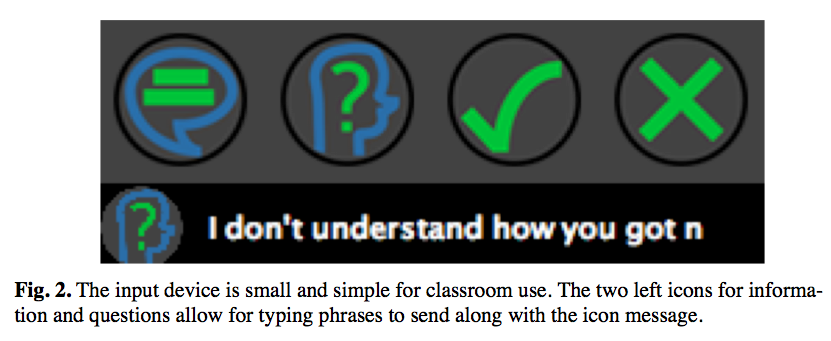
Icons
Information, Question, Yes/Agree, No/Disagree. Info and Q can be augmented by 40 character message, yes/no allow them to answer questions quickly.
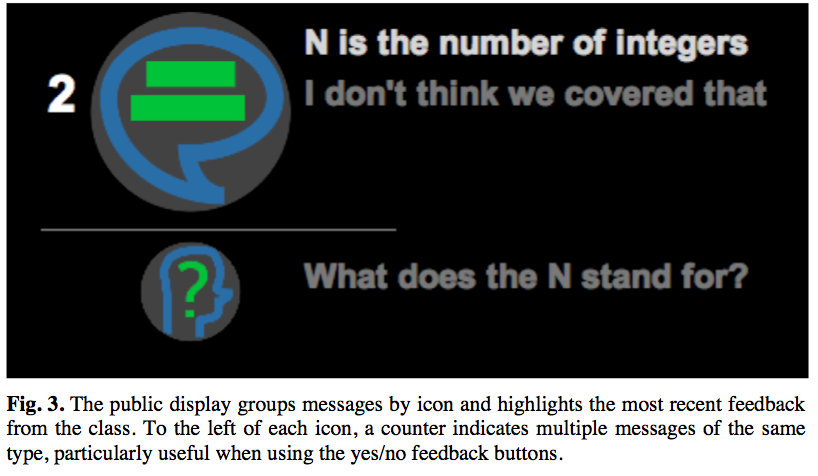
Messages on public display grouped by icon, icon group with most messages on top with larger icon.
Can only send one signal every 10 seconds to not flood.
Fading
Messages fade from black to grey, before disappearing. Message count next to icon.
Rationale
- Don't want lecturers overwhelmed
- If question goes unanswered and disappears, encourage students to ask again, or raise hand (see that others want to know the same thing)
Study
- Required second year course with 180 students, instructor not affiliated with research team
- Six course sessions: three without augmentation, three with FSM.
- Average of 100 students in attendance.
- Pre-survey and post-survey on participation
- Observe student participation.
Findings
Survey
Students not comfortable asking questions or clarification during class, more comfortable in smaller recitations.
Post-survey students felt it was easier to participate in the classroom. Recognized difficulty of maintaining order, maybe make semi-anonymous.
With FSM, classrom dialog was more involved, lecturer felt she was talking to rather than at people, students took more proactive role in directing conversation to points that were not clear.
Activity
Initial sessions very little participation.
Proactive using FSM, asking questions 11 times:
- ask questions
- keep professor from moving too quickly
- answer questions posed by professor
- most on-topic messages began with or contained a question for the professor interesting axis, question from professor to students, or from students to professor... or students->students?
Abuse
In backchan.nl, some users voted up questions for humor [11].
In FSM, there were many off-topic messages.
Challenges
- distracting off-topic messages
- relevant messages that bring in new information/topics - can cause planned material to not be covered
Future research
Does FSM encourage students who are already engaged to further surpass their peers, or genuinely help students who need a small boost to get involved? (Ie. who uses it?)

