Nicholas Burbules: MOOCs, the hype and the reality
professor at University of Illinois at Urbana-Champaigne
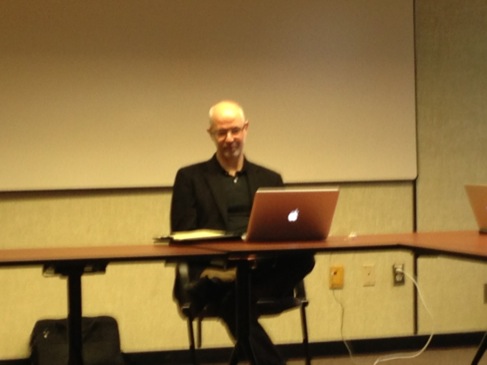
Coursera is a big issue at his campus, a number of committees trying to figure out issues regarding to faculty compensation, etc. A lot of buzz, chancellor been appointed to Coursera's faculty committee.
Nicholas is positive, but skeptical.
MOOCs (deconstructing the term)
massive
- scaleability, the more students the better
- Daphne Koller, one of the two heads of Coursera: idea that one course, with one professor, can serve hundreds of thousands of students is a very exciting idea
- but: what can be scaled, and what can't? what is lost with scale?
- word is using the word for many different courses, like courses with 30 people. Incorporating term because it has a lot of buzz behind it
open
- free
- deriving from open source ethos (that everything should be given away from free)
- but: people start figuring out how to make money from it, commercialized model - can still take courses for free, and I think the people behind it are quite committed to that. But if you want a certificate of completion, you have to pay for that. Monetization strategies are a big topic within Coursera (for Coursera, for individual institutions, and for professors)
- professors thinking like entrepreneurs, trying to get higher enrolment → more income?
- future: corporate sponsorship?
- how does the search for VC funding, and marketing etc merge with the traditional culture of the university?
- one monetization strategy: selling list of top performers in courses to companies
online
- online - is the delivery model, a MOOC is not an instructional model, you can do a lot of different things, but there is nothing about MOOCs that is innovative from an instructional point of view.
course
- not for-credit courses (yet at least)
- interesting situation: institutions offering courses not recognizing credit for them, but other institutions are
- someone takes the course from Illinois, Illinois not granting course credit, Michigan might… if a student comes with a credit from Michigan, will Illinois accept it?
- bending the idea of what a course is
- length: shorter
- is it a piece of a course, a module that can be combined to construct a course?
- we might see more workshop-style courses, focused on skills development
Hypes
A MOOC is not an instructional model, it's a delivery platform
But it does have implications for the instruction.
- To scale, very little synchronous contact.
- Peer-to-peer assessment, being experimented with
- Competency based instruction, programmed instruction - very conservative pedagogy
Going to revolutionize access to higher education
- Very low completion rates
- Students who do poorly in higher education, will do poorly in MOOCs
- don't have study skills
- background knowledge
- are not autonomous learners
- Can you build into MOOCs scaffolds and supports to help those students be successful? Maybe…
MOOCs will transform higher education
- Winners get it all (10 million students at Harvard), and nobody will want to go to second- or third-tier universities
- Sebastian Thrun: In 50 years, only 20 universities left
"Best classes from the best professors"
- Who decides what best is? Is there one best course in American history? One best professor in that area?
The reality
Disruptive technology
- Not easily incorporated into standard ways of doing business - a good thing. Makes us reexamine our standard ways of doing business.
- Pushing universities to ask new questions about access and cost.
- Creating competition, good to keep universities out of there comfort-zone
Evaluation
- as courses become more competency-based, how do you evaluate it?
- badges and other things, different from what universities traditionally deal with
Evolvement
MOOCs are evolving into something else.
- Mini-MOOCs
- Blended MOOCs - combining it with a for-credit on-site lecture
- MOOCs are kind of like textbooks
- or courseware (blog post)
- Adaptive instruction
- analyzing data using analytics/data mining, adapting learning environment to individual learners
- Flipped classrooms
- putting stuff online, that doesn't need live dynamics
- keeping classroom for interactive, live-interactions
Need for diversification of innovations
- Universities need to keep their options open
- Rapidly changing environment
- Wait five or six years, and then get in? Won't work - won't be stable by that time, if you want to shape that future, you need to be involved
- Part of the reason Illinois is involved with Coursera, is because we want to change the model
Problems
- Cheating
- there wasn't such an incentive to cheat before MOOCs made it high-stakes (certifications, recruitment to companies, etc)
- Commercial interests lead to exaggeration of benefits, with very little research or proof of effectiveness
- need more research on MOOCs
Role of schools of educations
We're supposed to know about
- online education
- evaluation
- curriculum design
etc. We need to be part of this movement. Need to be proactive, at the table, part of the discussions from day 1.
Discussion
Points
- Kant spent a lot of his career lecturing to fee-paying students
- There will be an opportunity for real “stars”, charismatic instructors - tier of instructors
3 levels of learning
- getting information
- getting a new skill
- learning a new role, becoming a different person
- social interaction is critical
- people who want to lose weight need to join a social activity
- difference between playing notes and playing music - modulating your activity to others
- going to university as an initiation rite - transformation. but if these roles are being peeled off, we have to become better at the social part of it.
- residential campuses have to be better at articulating their core business.
- part of liberal education is the stuff that you never wanted to learn, but in the future you'll thank us
Kind of courses
- the kinds of assessment are around particular kinds of courses. How to do drama, adaptively?
- is this an opportunity for niche courses, or is it a problem?
Illinois influencing Coursera
- first online course: sustainability, one of the most popular/successful course at Coursera
- pushing envelope on questions, encouraged Coursera to think about their model
- example: giving names of students to employers. How about federal privacy laws? Now it's opt-in
Usefulness of data
They don't record any demographic information, this might make a lot of their data “useless”.
Intellectual property issues
IP is retained entirely by the professor. Can pull off the course at any time. Might not be as clear at the university level. Tradition is that a course belongs to a university, when a professor leaves, the university does not retain any rights to their material - however, in the online environment, there are many universities that get confused, and start thinking of the material as “work-for-hire”.
Learning
Let's stop talking about MOOCs, about online learning, about flipped classrooms. Let's start talking about learning… That's what we're in the business of. Re-examining the entire campus undergraduate teaching/learning experience, how do we teach, how do we assess, and what role can technology play in this context? Every course should include technology in some way.

