Changing higher education to change the world: From critical thinking to creative contribution
by Cathy Davidson, HASTAC co-founder
Learning at the pace of change
Wikipedia HQ in San Francisco - Jimmy: Did you have any idea in 2002, that in decade WP would go to 23 million articles in 285 languages?
In 2002, there wasn't an economic theory that could explain the growth of Wikipedia. Rational choice theory - you can't get people to do anything without paying them to do it. Wikipedia should be an educational revolution - we have all these systems in place to force people to learn, look: if you give people a platform, they *want* to exchange information. Why hasn't that transformed how we operate education in the world today?
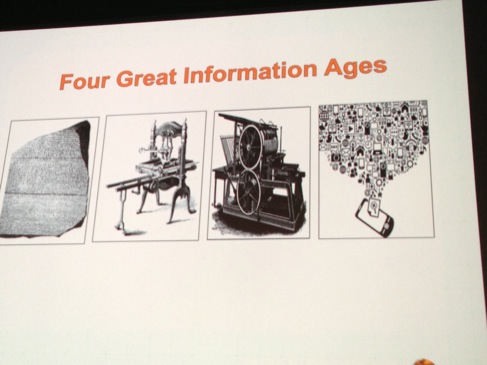
Four great information ages
- invention of writing (4000BC)
- movable type (10th Century in China, Silk Road)
- mass-printing (19th century)
- availability of lots of books, newspapers - generalized ownership of cultural products, library systems, education changes
- digital - WWW in 1993
- defining feature: you can have an idea, write that idea on the computer, and anyone with an internet connection can read what you write - no editor or publisher
What institutions do we have now that prepares young people (born post-WWW) for responsible, energetic, engaged, defensive for this world?
Students act in a confusing, commercialized world.
History of factory education
From scientific labor management to scientific learning management - from the invention of Johns Hopkins University to the invention of the SAT test
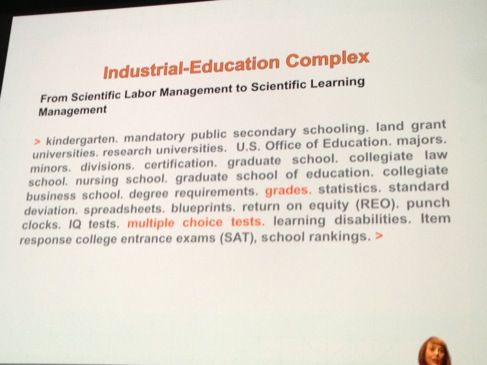
Mount Holyoke College & American Meatpackers Association - first two organizations that went from written comments to letter grades (many people were concerned that you could reduce something as complex as a piece of meat, down to something so simple as a letter grade) (read more)
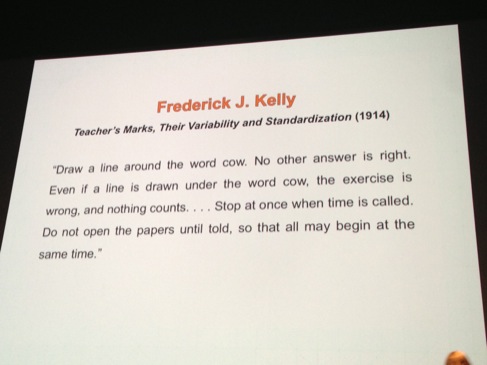
MC test, invented by Frederick J. Kelly, crisis with immigrants pouring in, learn from Henry Ford, student assembly line. Called it “Test of lower-order thinking for the lower-orders”.
US tests more often and earlier than anywhere else on the globe.
1917, war, teacher shortage → MC becomes widespread. 1925-26, SAT tests invented. Kelly was shocked that this was used for college entrance, was a Deweyite. President of University of Idaho, quickly fired.
7 ways you can shift the paradigm now
- Rethink liberal arts as a start-up curriculum for resilient global citizens
Teaching people how to program is not enough to prepare people for the world we're living in.
- Move from critical thinking to critical contribution
- we get too good at criticism
- Make the future together
- Why aren't we teaching 4-year olds to code, no distinction between programming and technology on one side, and humanities and creative thinking/arts on the other hand
- Scratch from MIT, used by millions of kids
- Project connect, hacking for a better world (May 9 in NYC)
- Be sure what we value is what we count
- Nick Sousanis, dissertation about comics as comics
- Find creative ways to model un-learning
- “The illiterate of the 21st century wil not be those who cannot read and write, but those who cannot learn, unlearn and relearn” - Alvin Toffler (or did he really say that?)
- Take institutional change personally
- how can we make alliances of grumblers, change institutions
- Make alliances with other paradigm-changers
Doing a MOOC on Coursera - we need to challenge and embrace, rather than to be scared and just critique. Nicholas Burbules had the same message to humanists.
Q&A
- Professors shouldn't be lecturing anymore. It was a replacement for the book. But students have been socialized into expecting lectures - ask them to read, they won't read it. We need expectations management.
- Yes. I didn't ask you “write silently and alone” - but you all did, automatically.
- In Japan, earlier, small groups where everyone told “you have a great talent, contribution to this group” - work together as the default. (Changed now).
- Kindergardners think they can do anything, by first grade, they think “I'm bad at math, I'm bad at dance”
- Passive class-bias in who can participate in digital technologies - how can we bridge to more marginalized populations?
- We usually learn far more than we give working with disadvantaged populations.
- Unlearning - ideas about how we get past ceremonial pieces of schooling, start thinking about learning instead of schooling?
- Almost impossible - from infancy we learn to bundle things into concepts that come to seem natural
- Think-pair-share (write three items on a card, share with neighbour, choose one common, share publicly through Twitter etc) - done with 6000 people
- Tried doing this with non-dominant hand - people came up with something different. Lakoff: be reflective about our reflexes
- Build a school in an impoverished area, and it isn't going to be the college teacher who knows how to do it
- When you are suffering culture shop, or other shocks, you see things you wouldn't have seen otherwise. Finding ways of rattling ourselves, terrible experience, if we survive them, they are the most valuable things.

