Andragogy
(also see connectivism, heutagogy, self-directed learning, paragogy)
Do we still need andragogy?
(points from blogpost discussion)
Main point
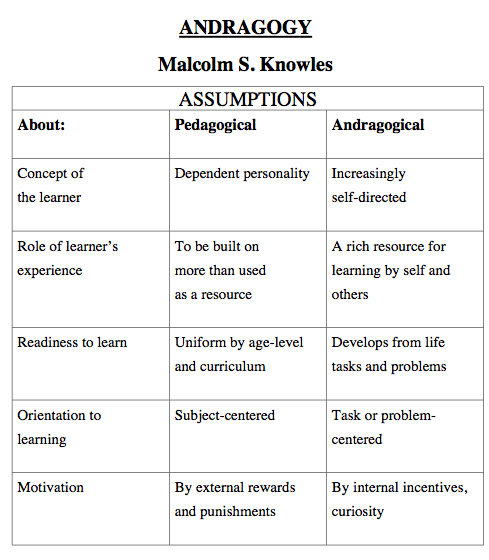
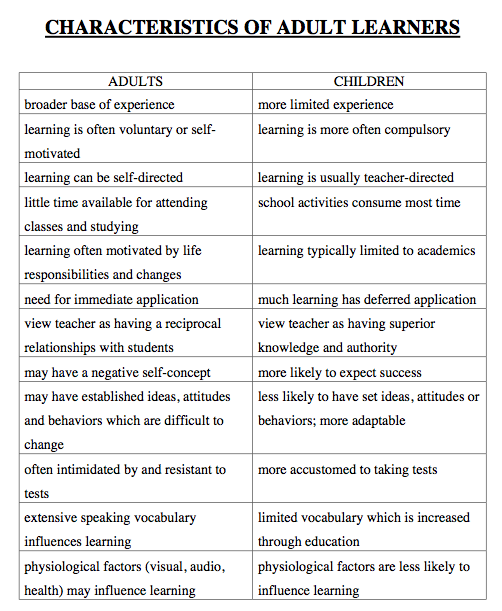
Blog post linked above demolishes his five principles by showing that they apply equally to children, or don't apply at all (adults are mostly interested in learning for work advancement etc). Seems more like a distinction between school/formal instruction and self-learning.
Historical development
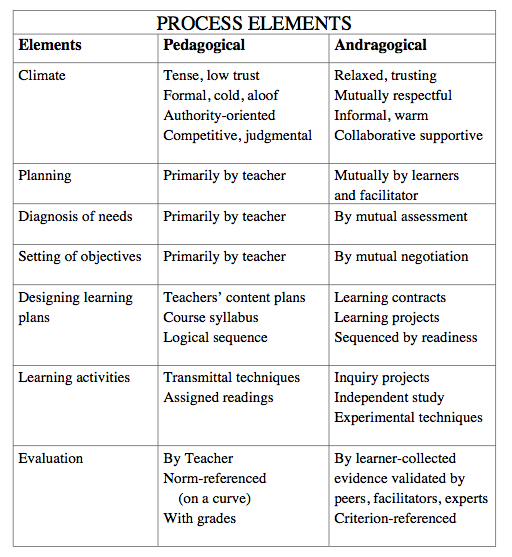
- Andragogy was originally defined as the art and science of teaching adults how to learn by Alexander Krap in 1833 and then further developed into a full theory of adult education by Malcolm Knowles. Pedagogy vs Andragogy | MYP @ Global Jaya International School
- andragogy reached its zenith in 1970-80s, afterwards shift to focus on lifelong learning - reduced separation between pedagogy and andragogy
It was appropriate back then
When Knowles came out with his initial ideas, pedagogy was only focused on children, and very delivery-centric - andragogy was a useful correx at the time
At around the time Knowles' The adult learner: A neglected species was published, I was a student volunteer in (yet to be professionalised) adult literacy and numeracy programmes. The materials in use were taken from surplus primary school stocks. Working with a 50 year old skilled machine setter who had played semiprofessional soccer, fought as a paratrooper, brought up two children, but happened not to be able to read … I quickly realised that using Little bill the Mountie was treating him childishly. The psychological effect on that man of having a student half his age teach him from Little Bill the Mountie was crushing to his self respect.
Knowles changes his mind
- Knowles changes his thoughts on the subject, new book (Knowles 1980) conceding that four of five key assumptions apply equally to adults and children - but children have fewer experiences and pre-established beliefs than adults, less to relate
- andragogy = learner-focused, pedagogy = teacher-directed
- continuum both for children and adults
Etymology
- andragogy means man, as opposed to woman (gunos) - led by man
- pedagogy from Roman slaves, pedagogs, tasked to train masters' children or “lead them to education”
Five issues
The andragogic model asserts that five issues be considered and addressed in formal learning. They include
- letting learners know why something is important to learn
- showing learners how to direct themselves through information
- relating the topic to the learners' experiences
- In addition people will not learn until they are ready and motivated to learn
- Often this requires helping them overcome inhibitions, behaviors and beliefs about learning
(Merriam et al, 2007, pg 84).
References
- Merriam, Sharan B., Caffarella, Rosemary S., & Baumgartner, Lisa M. (2007). Learning in Adulthood: A Comprehensive Guide (3rd Edition). CA: Jossey-Bass
- Brookfield, S. (2003). Adult cognition as a dimension of lifelong learning. In J. Field & M. Leicester (Eds.), Lifelong learning: Education across the lifespan. London: RoutledgeFalmer.
- Knowles. The Modern Practice of Adult Education; From Andragogy to Pedagogy (1980)